
Closet Light Fixture Clearance Code: A Minnesota Guide

Key Takeaways
- The closet light fixture clearance code is NEC 410.16. It governs which fixtures are permitted in clothes closets and how far each must sit from combustibles. Minnesota follows this baseline with no state amendments to this section.
- Four fixture types are allowed in closets. Open-lamp and pendant fixtures are banned, period.
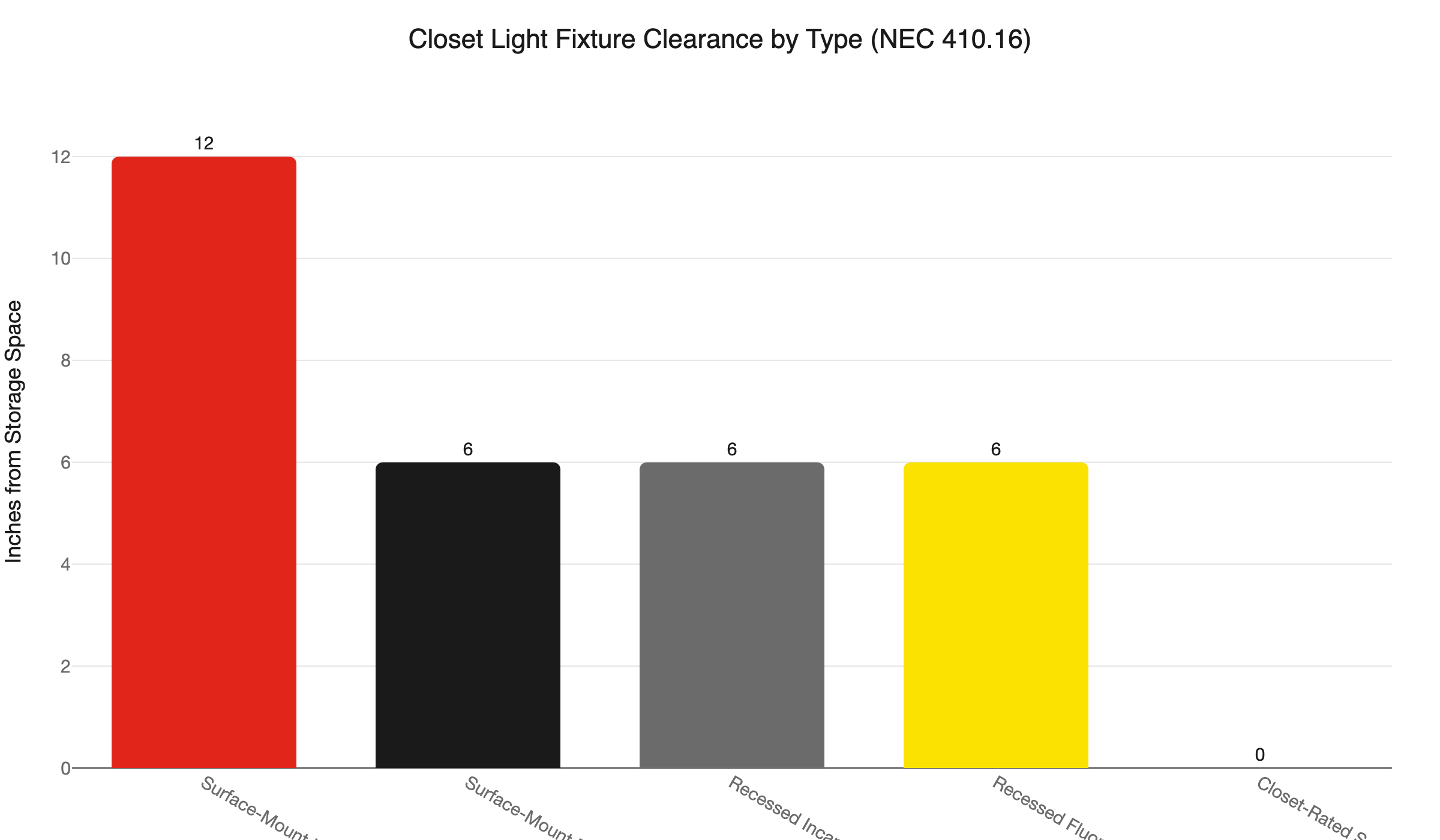
- Required clearance ranges from 0 inches (closet-rated fixtures) to 12 inches (surface-mounted enclosed incandescent or LED). Clearance is measured to the fixture body, not the bulb.
- The “storage space” is a defined 3D zone, not a flat wall measurement. Getting the geometry wrong is how inspectors catch DIY work.
- Pull-chain porcelain sockets with bare bulbs are prohibited. They are the most common closet lighting violation in Twin Cities homes.
- Minnesota’s 2026 NEC took effect August 17, 2026. Permits filed before that date fall under 2023 NEC; permits filed on or after that date fall under 2026 NEC.
- Replacing a closet light fixture may require a permit in your Minnesota municipality. A licensed electrician can handle the permit and inspection for you.
What Is the Closet Light Fixture Clearance Code?
Quick answer: The closet light fixture clearance code is NEC Section 410.16. It specifies which fixture types are allowed in clothes closets and sets minimum distances between each fixture and the closet’s “storage space” to prevent fires involving clothing and other combustibles packed close to the light source.
The National Electrical Code treats a clothes closet as a unique fire environment. Fabrics, cardboard boxes, and dry-cleaning bags can pack within inches of the ceiling fixture. An exposed or under-rated bulb raises local temperatures quickly. The code eliminates that risk by requiring both a permitted fixture type and a minimum clearance from the zone where those combustibles live.
Most homeowners do not think twice about the light in their closet. But inspectors do. A non-compliant fixture is one of the most commonly flagged items in pre-sale electrical inspections and DLI compliance reviews - especially in older Twin Cities homes where original fixtures have never been updated.
The good news for Minnesota homeowners: no state-specific amendments to Section 410.16 were found in current DLI resources. The national standard applies directly to your home. You do not need to track down a state overlay.
What Fixtures Are Allowed in a Closet - and Which Ones Are Banned?
Quick answer: Permitted types include surface-mounted or recessed incandescent and LED with a completely enclosed lamp, surface-mounted or recessed fluorescent, and surface-mounted LED or fluorescent with a closet-suitable UL listing. Bare-bulb fixtures, porcelain lampholders, and pendant fixtures are banned outright, regardless of bulb type.
NEC 410.16(A) lists the permitted types:
- Surface-mounted or recessed incandescent or LED with a completely enclosed lamp. The housing must seal the light source on all sides. Open-globe or exposed-filament styles do not qualify.
- Surface-mounted or recessed fluorescent. Standard tube fluorescent in an enclosed fixture is permitted.
- Surface-mounted LED or fluorescent identified as closet-rated. These carry a specific UL listing and can sit inside the storage space with zero required clearance.
NEC 410.16(B) identifies the prohibited types:
- Incandescent luminaires with open or partially enclosed lamps
- Pendant luminaires and hanging fixtures
- Lampholders (the porcelain pull-chain socket style)
That last category is where the real-world violations pile up. Minneapolis and Saint Paul have a high concentration of pre-1960 homes. Many of those homes still carry the original porcelain pull-chain socket in the closet ceiling. It is the exact fixture type the code prohibits. Switching to an LED bulb does not fix the violation. The fixture itself must come out and be replaced with a permitted type.
How Is the Closet “Storage Space” Actually Measured?
Quick answer: The storage space is a three-dimensional zone that rises from the floor, wraps around rods and shelves, and continues to the ceiling. It is not a simple wall-to-fixture gap. Clearance is measured from the nearest edge of the fixture body to the nearest point of that zone - not from the bulb.
Most homeowners assume “clearance” means the horizontal gap between the light and the nearest wall. The code defines it as a volume.
The storage space starts at the closet floor. It rises to 6 feet or the highest clothes-hanging rod, whichever is greater. At that height, the zone extends 24 inches outward from the back wall and each side wall. Above that point, the zone continues to the ceiling, but the horizontal depth narrows to 12 inches from the walls - or the width of the shelf, whichever is greater.
The result is a stepped 3D zone. It is wider at rod level and narrower above the shelf. A fixture positioned in the upper corner of the closet may feel far from your clothes. But it could still be inside or uncomfortably close to that upper zone.
One critical detail: the NEC is explicit that clearance is measured to the luminaire, not the lamp. A recessed fixture with a trim ring that extends 4 inches below the ceiling plane is measured from that trim ring to the nearest storage space boundary. Getting this wrong by a few inches turns a passing installation into a failed inspection. Inspectors measure carefully.
What Does the Closet Light Fixture Clearance Code Table Say?
Quick answer: Required clearance ranges from 0 inches for closet-rated fixtures to 12 inches for surface-mounted enclosed incandescent or LED. Every other common type requires at least 6 inches, measured to the fixture body.
The NEC 410.16(C) clearance table breaks down by fixture type:
| Fixture Type | Min. Clearance from Storage Space |
|---|---|
| Surface-mounted incandescent or LED (enclosed lamp) | 12 inches |
| Surface-mounted fluorescent | 6 inches |
| Recessed incandescent or LED (enclosed lamp) | 6 inches |
| Recessed fluorescent | 6 inches |
| Closet-rated surface-mounted LED or fluorescent | 0 inches (may sit inside storage space) |
The most practical choice for new installations is a closet-rated fixture. These carry UL category codes IFAM (LED surface-mounted) or IEUZ (fluorescent surface-mounted). They are tested to keep surface temperatures below 90°C under glass fiber insulation - which is how they earn the zero-clearance rating. You can verify any specific fixture’s listing status at ul.com/piq using a free account.
The 12-inch requirement for standard surface-mounted enclosed fixtures is easy to underestimate. In a small walk-in closet where rods and shelves pack tight to the walls, finding 12 clear inches from the storage space boundary can be a real constraint. A closet-rated fixture solves that problem.
Does Minnesota Have Its Own Closet Lighting Rules?
Quick answer: No. No Minnesota-specific amendments to NEC 410.16 were found. Minnesota follows the national baseline. The clearance table above applies directly to homes throughout the Twin Cities metro.
Minnesota adopts the NEC through Chapter 1315 of the State Building Code. The Minnesota Department of Labor and Industry administers electrical licensing, code adoption, and inspections statewide.
That Minnesota made no amendments to this section simplifies the compliance picture. You do not need to check for a state overlay. The NEC clearance table is the whole rule.
If you have a specific code question, DLI’s electrical code line is 651-284-5026 or dli.electricity@state.mn.us. They are responsive and it is a free call.
The MN Code Transition: What to Know Right Now
If you are planning closet electrical work, timing matters. Minnesota adopted the 2026 NEC effective August 17, 2026. The DLI published its 2026 Residential Electrical Inspection Checklist on July 6, 2026 - this is the document your inspector carries on-site.
The rule is simple:
- Permit filed before August 17, 2026: Work inspected under 2023 NEC.
- Permit filed on or after August 17, 2026: Work inspected under 2026 NEC.
The important context: NEC 410.16 clearance language is substantially unchanged across the 2020, 2023, and 2026 editions. The fixture types and distance requirements have been stable. This transition is not a reason to delay or panic. It is a reason to pull the permit promptly if you are ready to act - especially if you want the work done under the current edition.
Does Replacing a Closet Light Fixture Require a Permit in Minnesota?
Quick answer: Often yes. Minnesota requires a permit for most electrical work, and fixture replacement on existing wiring triggers that requirement in many jurisdictions. A licensed electrician can pull the permit on your behalf and arrange the inspection.
Our full guide to electrical permits in Minnesota covers how the permitting process works across different jurisdictions. The short version: a DLI-licensed electrician pulls the permit, does the work, and schedules the inspection. If you want to do the work as a homeowner, most jurisdictions allow a homeowner-pulled permit, but you must schedule and pass the inspection yourself.
That inspection matters. An inspector will verify the fixture type, the clearance distance, and the wiring method. A pull-chain socket is an automatic fail. Insufficient clearance is an automatic fail. A discovered code violation during a home sale - when a buyer’s agent is watching the clock - costs more to fix than the same job done on your own schedule. Getting it right the first time is always the better position.
The Most Common Closet Lighting Violation in Twin Cities Homes
No malarky: the most common closet lighting violation inspectors find in Twin Cities homes is the original pull-chain porcelain socket with a bare bulb.
This fixture dates to pre-1960 residential construction. The Twin Cities have an unusually high concentration of homes from that era. Buyers often purchase these properties not knowing the closet wiring has never been updated.
The violation is not about age. It is about fixture type. A porcelain lampholder with an exposed bulb is explicitly prohibited by NEC 410.16(B) regardless of bulb wattage, style, or age. Switching to an LED bulb does not correct the violation. The socket itself must be replaced with a permitted fixture type.
A licensed electrician can identify the violation, pull the permit, swap the fixture, and schedule the inspection in a single visit. Most of the time this is a straightforward job. The complication arises when the wiring behind the socket is old enough to need updating simultaneously - a common discovery in pre-1960 homes. That is not a reason to avoid the job. It is a reason to have a licensed electrician look at it rather than attempting it as a DIY project.
Our post on DIY electrical dangers explains why older home wiring and DIY fixture work are a particularly high-risk combination.
What About Recessed Fixtures and Insulated Ceilings?
Quick answer: Recessed fixtures are permitted in closets, but if the ceiling above is insulated, the fixture must be IC-rated (insulation contact rated). Air leakage must not exceed 2.0 cubic feet per minute per IECC. Many older recessed cans pre-date IC ratings and are not safe for contact with insulation.
Our recessed lighting installation guide explains how to identify whether existing cans are IC-rated and what to do when they are not.
For closet purposes, recessed fixtures also require the full 6-inch clearance from the storage space boundary, measured to the trim ring. If your trim ring sits flush with the ceiling and the storage space boundary runs close, you may need to relocate the fixture or switch to a closet-rated surface-mounted option instead.
Recessed cans in closets are a popular choice because they look clean and sit out of the way. Just make sure the IC rating and clearance both check out before assuming the installation is compliant.
What Are the Risks of Getting This Wrong?
Quick answer: A non-compliant closet fixture creates fire risk, insurance exposure, and resale complications. All three are avoidable with a code-compliant installation.
Fire risk. The clearance rules exist because heat from an exposed or under-rated lamp can ignite fabric fast. Clothes packed close to a bare bulb - especially in a small, enclosed space - is exactly the scenario the code was written to prevent. Closet fires spread quickly because of the fuel load.
Insurance exposure. If a fire originates in a closet and an investigator finds a prohibited fixture, your homeowners insurance carrier may use the code violation as grounds to reduce or deny the claim. Insurance adjusters examine electrical conditions in fire-origin rooms. A non-permitted fixture is a documented liability.
Resale complications. A pre-sale electrical inspection will flag a prohibited fixture or insufficient clearance. Buyers request corrections before closing. Repairs under a contract deadline cost more than repairs done on your own schedule and terms.
The fix is usually straightforward. A closet fixture replacement is a small job when done proactively. Done under pressure, it becomes expensive.
How Can You Check If Your Closet Fixture Passes?
Quick answer: Start by identifying the fixture type. If you see a bare bulb on a porcelain socket, stop - that fixture is prohibited regardless of clearance. If the lamp is enclosed, measure from the fixture body to the nearest point of the storage space zone and compare to the clearance table above.
Here is a step-by-step self-check:
- Identify the fixture type. Is there a bare bulb hanging from a socket? That is a prohibited lampholder. Is the bulb enclosed in a housing or globe? Move to step two.
- Find the storage space boundary. Picture the zone: 24 inches out from the back and side walls at rod height, narrowing to 12 inches above the shelf level. Mark that boundary.
- Measure from the fixture body. Use a tape measure. Go from the nearest edge of the fixture housing to the nearest point of that zone. Not the bulb. The fixture body.
- Compare to the clearance table. Surface-mounted enclosed incandescent or LED: 12 inches required. Recessed enclosed or any fluorescent: 6 inches required. Closet-rated fixture: no minimum.
- Check the fixture label. Open the canopy and look inside. A closet-rated fixture typically says “Suitable for Closet Use” or carries UL category code IFAM or IEUZ on the label.
If step one fails or you cannot locate the fixture label, stop and call a licensed electrician before assuming anything is safe.
When to Call a Licensed Twin Cities Electrician
Call our team if any of the following apply:
- Your closet has a pull-chain socket or any fixture with an exposed bulb.
- You cannot determine whether your fixture type is permitted under NEC 410.16.
- The clearance measurement does not pass the table for your fixture type.
- You want to add a new closet light or relocate an existing one.
- Your closet ceiling is insulated and you are not sure whether your recessed can is IC-rated.
- You are planning a closet renovation and want the electrical done before the walls close up.
- You are buying or selling a Twin Cities home and want the closet wiring inspected before the deal closes.
As a locally owned and operated Twin Cities electrician, our team knows exactly what Minnesota DLI inspectors check and what fails on a standard residential inspection. We pull the permit, do the work, and schedule the inspection - so you are not coordinating any of that on your own.
Our indoor lighting services include closet fixture replacement, prohibited-fixture corrections, and full lighting upgrades throughout your home.
Call us at 763-200-5956 or book online. Every job is backed by the UWIN(R) 100% satisfaction guarantee - from America’s On-Time Electrician(R).
Frequently Asked Questions
What is the minimum clearance for a closet light fixture? +
Are pull-chain bare-bulb porcelain sockets allowed in a clothes closet? +
Does replacing a closet light fixture require a permit in Minnesota? +
Need an electrician now?