
Cost to Add an Outlet in the Twin Cities: What to Expect

Key Takeaways
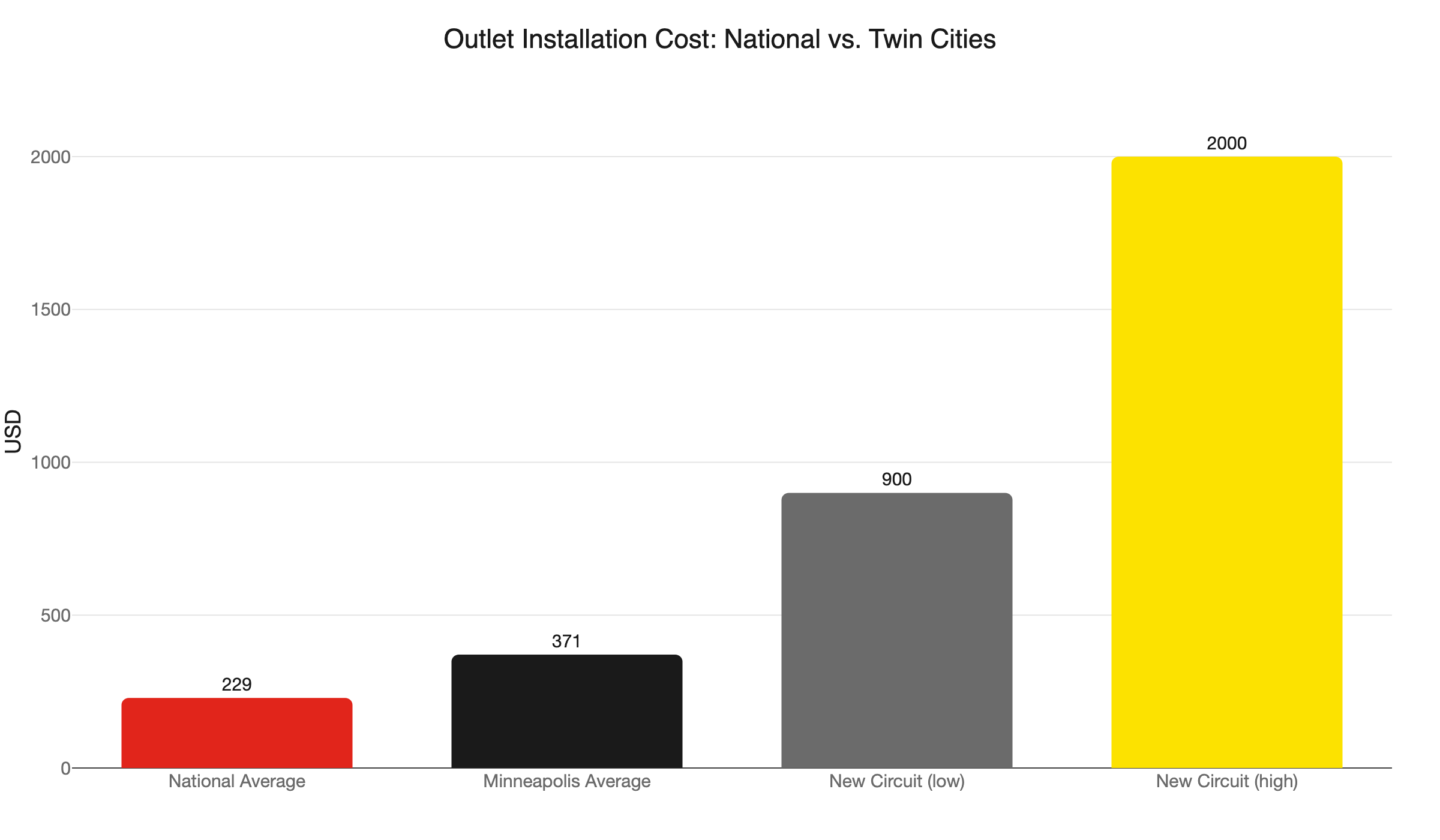
- The Minneapolis average for a standard outlet is $371, with a range of $171-$580. The national average is $229.
- Three scenarios cover most jobs: a short tap on a nearby circuit (fast and affordable), a long wire fish through finished walls (moderate to high cost), or a brand-new circuit from the panel ($900-$2,000).
- Plaster-over-lath walls in older Minneapolis and St. Paul neighborhoods add real cost that national guides never reflect.
- Knob-and-tube and aluminum wiring, common in pre-1975 Twin Cities homes, require full circuit replacement rather than a simple tap.
- Minnesota transitions to the 2026 NEC on August 3, 2026. Permits filed on or after that date must comply with the updated code.
- Bundling multiple outlets into one visit can significantly reduce your per-outlet cost by spreading the truck-roll and circuit-run costs.
- Call 763-200-5956 or book online for a quote specific to your home.
What Does It Cost to Add an Outlet in the Twin Cities?
The cost to add an outlet is not a single number. It is a range driven by three questions: How far does the wire have to travel? What does it have to travel through? Can your existing circuits handle another load?
The Minneapolis average for a standard outlet runs $371, with a range of $171-$580. The national average is $229. Twin Cities prices run higher because local labor reflects a real cost-of-living market, and the older housing stock in Minneapolis and St. Paul adds labor that a newer-construction home in another state would not need.
Get those three questions answered and the pricing range snaps into focus quickly.
What Factors Move the Cost to Add an Outlet Up or Down?
Short answer: Four factors drive the final price: distance from an existing circuit, wall condition, wiring type, and whether the job triggers a code-required GFCI or AFCI device. Distance and wall condition are usually the two biggest variables by a wide margin.
Labor rates
Journeyman electricians in Minnesota typically charge $50-$100 per hour. Master electricians run $90-$120 per hour. Most shops charge a minimum fee that covers 1-2 hours of on-site time, regardless of how long the actual work takes. That minimum explains why a fast outlet job can still cost $150-$200 when everything goes smoothly. The truck has to come out, the panel has to be assessed, and the permit has to be pulled. None of that is free.
Materials
A standard duplex outlet and cover plate cost $3-$8. A GFCI outlet runs $15-$30 more per device. The bigger material variable on longer runs is wire: 12-gauge NM-B Romex for a 20-amp circuit, 14-gauge for a 15-amp circuit. Wire cost per foot is modest on its own, but a full circuit run of 75-125 feet adds real material cost on top of labor. Specialty outlet types — 20-amp kitchen circuits, GFCI devices for wet locations, tamper-resistant outlets for rooms with young children — step material costs up further.
Permits
Minnesota requires a permit for almost all outlet work. Permit fees vary by city, covered in detail in the code section below. Budget $81-$101 for a typical single-circuit permit in the Twin Cities. We pull the permit on every job.
Does Wall Condition Really Change the Cost to Add an Outlet That Much?
Short answer: Yes, dramatically. An open, unfinished path takes roughly one hour. Fishing through a finished wall with insulation, fire blocks, plumbing, and HVAC ducts can take several hours for the identical wire distance.
The fishing premium for a finished wall runs $50-$200 per outlet beyond the base installation cost. Long runs requiring multiple drywall access holes add $300-$500 in patching on top of that. The patching cost surprises a lot of homeowners who get a low phone estimate — the estimate did not include putting the wall back together.
Twin Cities housing adds two local wrinkles that national pricing guides consistently miss.
Plaster-over-lath walls. Pre-1960 Minneapolis homes, and most of St. Paul’s older neighborhoods, were built with plaster applied over wood lath strips rather than drywall. Drilling through lath requires a carbide hole saw rather than a standard spade bit. Plaster cracks unpredictably around cut holes, and patching it properly is a different skill set than patching drywall. Electricians who work this housing stock build extra labor and patching time into their estimates. A generic “finished wall” figure from a national article does not capture any of this.
Split-levels and ramblers. The dominant 1960s-1980s suburban housing stock in Bloomington, Burnsville, Plymouth, and Edina often has no accessible attic above the main floor and a finished lower level below. There is no unfinished chase to route wire through vertically. The wire has to snake through the finished wall in both directions. What looks like a short horizontal run on a floor plan becomes a considerably more involved job when there is nowhere to go up or down.
If you are not sure what your walls are made of, our team will check before we quote. A locally owned and operated shop knows the difference between a 1958 brick rambler in Edina and a 1985 colonial in Woodbury — and prices accordingly.
How Does Distance from the Panel Affect the Cost to Add an Outlet?
Short answer: Every additional foot of wire adds material and labor cost. A tap 4-8 feet from a nearby outlet is fast and affordable. A 20-plus foot fish through finished walls costs several hundred dollars more. A full new circuit from the panel runs $900-$2,000.
Three tiers cover the vast majority of jobs.
Tier 1 — Short tap (4-8 feet, open or accessible path): The electrician opens a nearby outlet box, confirms the circuit has capacity for another load, runs a short wire to the new location, and installs the box and outlet. Added labor stays under $150. Total cost lands toward the low end of the Minneapolis range — typically $200-$370 all in.
Tier 2 — Finished-wall fish (15-40 feet): Now the electrician has to map wall cavities, locate fire blocks, find a workable path, drill access holes, fish the wire, and patch whatever was opened. Wiring labor alone on a 15-40 foot run through finished walls: $200-$500. Drywall or plaster patching adds $300-$500 when multiple access holes are required. A Tier 2 job in the Twin Cities often totals $700-$900 or more once all costs are counted.
Tier 3 — New circuit from the panel (full run, 75-125 feet of wire): This is the right call when existing circuits are at capacity, when the outlet location is too far from any usable box, or when older wiring makes tapping unsafe. A full new bedroom circuit runs $900-$2,000 installed, depending on panel distance, wall conditions, and whether the panel itself needs work to accommodate a new breaker slot.
Our outlet installation service covers all three tiers. Before we start, we tell you which tier your job is and why.
What If My Home Has Older Wiring?
Short answer: Older wiring types change the rules on what a tap can and cannot do. Knob-and-tube and aluminum wiring typically require full circuit replacement rather than a tap. Two-prong outlets depend on how the panel and circuit are configured.
Knob-and-tube wiring
Knob-and-tube is pre-1950s technology. It is ungrounded. It has no insulation jacket separating the hot and neutral conductors. Most jurisdictions, including Minnesota’s, do not allow new loads to be added to knob-and-tube circuits. If your home has knob-and-tube wiring, adding an outlet typically means replacing the affected circuit from the panel outward — a Tier 3 job — rather than tapping into what is already there. Our guide on knob-and-tube wiring replacement covers what that project involves and what it typically costs in Twin Cities homes.
Aluminum wiring
Some homes built between roughly 1965 and 1973 were wired with aluminum rather than copper. Aluminum expands and contracts at connection points more than copper does over repeated heating and cooling cycles. That movement gradually loosens connections, generates heat, and creates a real fire risk. Aluminum wiring generally requires full replacement or CO/ALR-rated devices at every connection point rather than a standard tap. If you are not sure whether your home has aluminum wiring, look for “AL” or “aluminum” stamped on the wire sheathing at any open outlet or junction box.
Two-prong (ungrounded) outlets
Converting a two-prong outlet to a grounded three-prong device is relatively straightforward when the panel is grounded and the circuit wiring runs the full path. The cost escalates when the panel or the circuit itself needs grounding work first. This is a job-by-job determination, not a flat-rate item you can quote over the phone.
If your home was built before 1980 and you have not had an electrical inspection recently, a quick evaluation before we quote outlet work gives us the complete picture of what we are working with.
What Are Minnesota’s Code and Permit Requirements for Outlet Work?
Short answer: A permit is required for almost all outlet installations in Minnesota. Cities with local inspection authority — including Minneapolis and St. Paul — issue their own permits rather than routing through the state. Minnesota’s 2026 NEC takes effect August 3, 2026, and the date your permit is filed determines which code version governs the work.
The August 3, 2026 NEC transition
Minnesota’s Board of Electricity adopted the 2026 National Electrical Code, effective August 3, 2026. Permits filed before that date are governed by the 2023 NEC. Permits filed on or after August 3 must comply with the 2026 NEC. If you are scheduling electrical work this summer, confirm with your electrician which code version applies based on the expected permit date. The difference can affect GFCI and AFCI requirements on certain circuit types, which in turn affects material costs.
GFCI and AFCI requirements
Under the 2023 NEC (adopted in Minnesota on July 1, 2023), GFCI protection is required on all kitchen receptacles and on circuits serving dryers, ovens, ranges, and microwaves. AFCI protection is required for dry living spaces. New circuits that trigger either requirement add $20-$60 per circuit in material cost for the compliant breaker or device. Our post on GFCI outlet requirements breaks down which rooms require them and what that looks like in practice for a Twin Cities home.
Local permit fees
About 66 Minnesota cities have adopted local electrical inspection authority, including Minneapolis and St. Paul — meaning those homeowners work with city inspectors rather than the state DLI.
In St. Paul, the permit for a single-circuit outlet addition runs $85 minimum fee, plus $15 per circuit, plus a $1 state surcharge — about $101 all in on the permit side alone. For towns without local inspection authority, state DLI fees run $25 for the permit plus a $55 minimum inspection fee per site visit plus the $1 surcharge — about $81 total.
We pull the permit on every job. It is included in the quote, not added as a line item after the fact. For a deeper look at how Minnesota’s permit process works, see our Minnesota electrical permit guide.
When Should I Bundle Multiple Outlets Into One Visit?
Short answer: Almost always, when you need more than two in the same area. Combining outlets in one visit lets you share the truck-roll, circuit-run, and permit costs across the entire project rather than paying those fixed costs repeatedly.
The math is simple. One outlet added to an open basement space might run $250-$300 all in. Three outlets on the same circuit, in the same space, on the same visit, might total $400-$450 — a per-outlet cost of $130-$150 instead of $250-$300. Nothing changed about the work; the setup costs were just divided across more devices.
The same principle holds when you are combining outlet work with other electrical projects already on your list. Adding outlets while we are on-site for a panel upgrade, a circuit repair, or a new appliance circuit costs a fraction of scheduling a return visit. Home office expansions, kitchen renovations, basement finishes, and garage workshop setups all tend to need multiple outlets at once — and those are exactly the right projects to bundle.
When you call, bring the full list of what you want. We can quote the complete scope in one conversation, and the combined number almost always looks better than you expected.
What to Have Ready When You Call
A few quick details help us give you a useful estimate before we visit:
- Exact location: “Left of the window in the master bedroom” or “behind the TV on the east wall of the living room” gives us a real starting point. Vague descriptions lead to wide estimates.
- What is on the other side of the wall: Finished drywall, plaster, open basement ceiling, or accessible attic — these four answers represent very different amounts of work and very different prices.
- Age of the home: Anything built before 1975 may have wiring types that affect the approach. Pre-1960 homes in Minneapolis and St. Paul almost certainly have plaster walls and may have knob-and-tube circuits.
- Any nearby outlets on the same wall: A neighbor box within a few feet means a potential tap. No nearby outlet usually means a longer run and higher cost.
- Any known electrical concerns on nearby circuits: A tripping breaker, flickering lights, or warm outlet covers are worth mentioning. They can affect whether the target circuit is safe to tap before additional load is added.
Gathering these details takes about two minutes. It makes the first conversation more useful for both sides and means a more accurate estimate before we ever pull into your driveway.
Ready to Add an Outlet?
A new outlet pays for itself quickly. Better placement means fewer extension cords, fewer overloaded power strips, and dedicated capacity right where you actually need it.
As America’s On-Time Electrician(R), we show up when we say we will. We pull the permit, do the work, and pass the inspection. Our UWIN(R) 100% satisfaction guarantee means the job is not done until you are satisfied with the result — no malarky.
Call 763-200-5956 or book online to schedule. We serve Minneapolis, St. Paul, Bloomington, Brooklyn Park, Woodbury, Blaine, Maple Grove, Plymouth, and surrounding Twin Cities communities.
Frequently Asked Questions
How much does it cost to add an outlet in Minneapolis? +
Do I need a permit to add an outlet in Minnesota? +
Can I add an outlet to an existing circuit myself? +
What does the 2026 NEC transition mean for outlet work after August 3? +
Need an electrician now?