
Electric Fireplace Dedicated Circuit Requirements

Key Takeaways
- A plug-in electric fireplace does not require a new dedicated circuit by code, but the NEC load math shows a shared 15A circuit is legally undersized at full heat.
- A hardwired or built-in electric fireplace always requires a dedicated circuit. A licensed electrician must install it, and a permit is required in Minnesota. No exceptions.
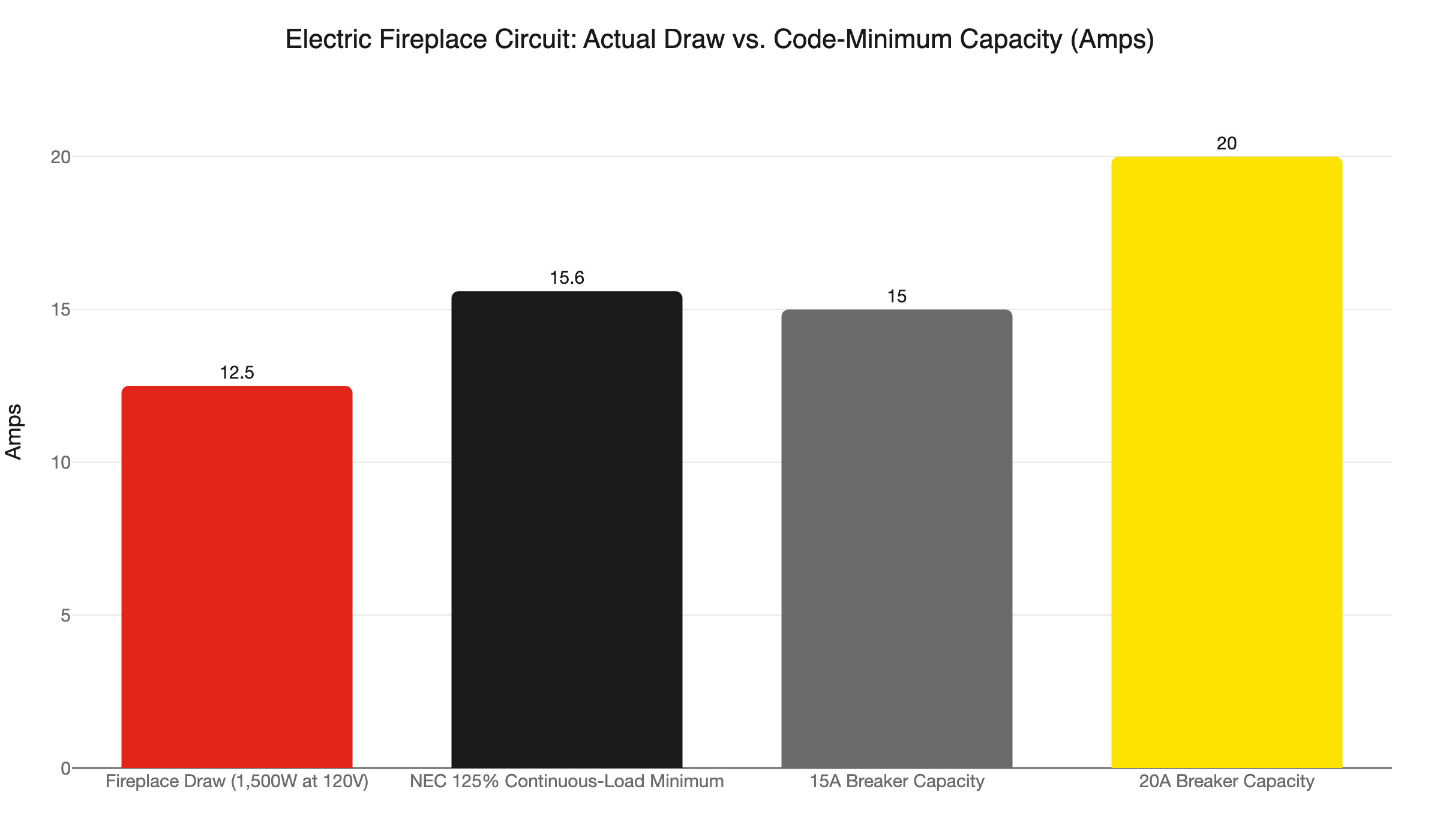
- A 1,500W unit draws 12.5A at 120V. NEC Section 210.20 requires continuous loads be sized at 125%, meaning 15.6A minimum. A 20A dedicated circuit is the code-compliant solution.
- “Dedicated circuit” means the breaker in your panel feeds one outlet or device and nothing else. An outlet with nothing else plugged in right now is not a dedicated circuit.
- Minnesota permits pulled before August 3, 2026 must comply with the 2023 NEC. Permits pulled on or after that date must comply with the 2026 NEC.
- There is no Xcel Energy rebate for electric fireplaces in Minnesota.
What Is a Dedicated Circuit, Exactly?
A dedicated circuit is a breaker in your panel that feeds exactly one outlet or device and nothing else. Flipping that breaker should cut power to that single location only. Any other load on the same breaker means the circuit is shared, not dedicated.
This matters because the most common mistake homeowners make is assuming an outlet with nothing else plugged in right now is dedicated. It is not, unless the breaker was wired to serve only that outlet when the home was built or when a circuit was added later.
Here is a quick field test. Flip the breaker for the outlet where your fireplace runs. If anything else in the house goes dark, the circuit is shared. A dedicated circuit means the breaker feeds one location only, regardless of what is or is not plugged in at any given moment.
This distinction carries real consequences. A shared circuit in an older Twin Cities home may already be running close to capacity before the fireplace turns on. Adding 12.5A of continuous load to a circuit that already serves recessed lights, a TV, and a sound bar is a recipe for nuisance tripping at best and an overheated breaker at worst.
If you are not sure whether your outlet is on a dedicated circuit, we can trace it for you in a single visit.
Does a Plug-In Electric Fireplace Need a Dedicated Circuit?
Not by code, but the load math makes a strong case for one. A 1,500W plug-in unit on a shared 15A circuit sits at or above the continuous-load limit under NEC Section 210.20. Anything else on that circuit puts you over the edge.
Most plug-in electric fireplaces run on a standard 120V cord and plug into a standard 15A or 20A outlet. The NEC does not mandate a new dedicated circuit for plug-in appliances the way it does for hardwired units. On paper, you can plug into an existing outlet.
Now look at the math.
A 1,500W fireplace at 120V draws 12.5A. NEC Section 210.20 requires circuits that serve continuous loads (any load expected to run for three hours or more) to be sized at 125% of that load.
12.5A x 1.25 = 15.6A minimum circuit capacity required.
A standard 15A circuit tops out at 15A. You need 15.6A minimum. That means a 15A circuit is legally undersized for a 1,500W fireplace running as a primary heat source. A 20A dedicated circuit clears the threshold with room to spare.
Running that fireplace on a shared 15A circuit with a floor lamp, a TV, and a phone charger is not a safe setup. If your breaker is already tripping when you run the fireplace, read our post on why circuit breakers keep tripping. That is the panel telling you it is out of room.
The practical call: If you plan to run the fireplace daily as a zone-heating source, add a dedicated 20A circuit. The cost is modest and it eliminates the risk entirely.
Does a Built-In or Hardwired Electric Fireplace Require a Dedicated Circuit?
Yes, always. A hardwired or built-in electric fireplace requires a dedicated branch circuit by code. This is not optional or recommended. It is required. A licensed electrician must install it, and a permit is mandatory in Minnesota.
Wall-mounted plug-in units are one category. In-wall built-ins, linear fireplaces designed for permanent installation, and insert-style units that hardwire directly into your home’s wiring are a separate category with stricter requirements.
These units must have a dedicated branch circuit run from the panel. The circuit must be in place before drywall closes the wall cavity. Retrofitting wiring after the fact means opening walls, fishing wire, patching drywall, and painting. The cost gap between rough-in wiring and after-the-fact wiring is significant.
If you are finishing a basement and adding a built-in fireplace, plan the dedicated circuit in the same conversation as your framing and rough-in. Waiting until the inspector is scheduled is too late. For a sense of how this fits into a broader project, our post on basement finishing electrical costs breaks down what to budget when electrical work is part of a renovation scope.
Wall-mounted plug-in units (the kind you hang like a TV and cord to a nearby outlet) sit in a gray zone. Technically plug-in, but manufacturers often call for a dedicated circuit given the continuous-load wattage. Read the installation manual and treat the dedicated circuit recommendation as effectively required if you plan to run it for heating.
Why the NEC Math Points to a 20A Circuit
The 1,500W figure is standard for most residential electric fireplaces regardless of brand. Here is the full calculation, laid out clearly:
| Factor | Value |
|---|---|
| Rated wattage | 1,500W |
| Voltage | 120V |
| Draw | 1,500 / 120 = 12.5A |
| NEC 125% continuous-load multiplier | 12.5 x 1.25 = 15.6A minimum |
| 15A breaker capacity | 15A (undersized) |
| 20A breaker capacity | 20A (compliant) |
A 20A dedicated circuit is not merely a best practice. The NEC math makes a 15A circuit legally insufficient for this load when it runs continuously.
There is an error in the other direction to watch for as well. Seeing a 30A breaker on a 1,500W fireplace is a code violation. Over-fusing means the breaker will not trip until current exceeds 30A, but the wiring may be rated for only 20A. The wire overheats before the protection kicks in. That gap is a fire risk, not a safety margin.
The circuit and the breaker must be matched. A 20A circuit needs a 20A breaker and 12 AWG copper wire. Nothing else is code-compliant for this application.
What Wire Gauge Does an Electric Fireplace Circuit Need?
12 AWG copper for a 20A circuit. 14 AWG copper for a 15A circuit. Using undersized wire on an oversized breaker is a code violation and a fire risk. The two must always match.
This is one of those details that gets skipped in retailer guides. Wire gauge is not a suggestion. Pairing a 20A breaker with 14 AWG wire is a code violation because the wire overheats before the breaker trips.
Here is the standard pairing:
- 15A breaker: 14 AWG copper minimum
- 20A breaker: 12 AWG copper minimum
If you are adding a dedicated 20A circuit for your fireplace, the electrician runs 12 AWG wire from the panel to the new outlet. If someone previously upgraded a breaker without upgrading the wire, that is a hazard that needs to be corrected before anything gets plugged in.
For a broader look at dedicated circuit requirements across your home’s appliances, that post covers the full list, from dishwashers and refrigerators to EV chargers and air conditioners. The wire-gauge-and-breaker pairing principle is the same for all of them.
Does Adding an Electric Fireplace Circuit Require a Permit in Minnesota?
Yes. Minnesota requires an electrical permit for any installation, addition, or alteration of an electrical circuit. Adding a dedicated circuit for an electric fireplace, plug-in or hardwired, requires a permit and an inspection.
Here is what you need to know about the process:
Who can pull the permit. A licensed electrical contractor, or the homeowner on their primary owner-occupied residence. Homeowners may do their own electrical work on a homesteaded primary residence, but not in rentals, condos, or apartments. In those cases, only a licensed contractor can do the work.
Who should do the work. Running a new circuit from the panel involves working inside a live electrical panel. This is not a weekend project for most homeowners. The permit process includes an inspection, and inspectors will catch errors. A failed inspection means corrective work and a re-inspection. In practice, hiring a licensed electrician is the right call for panel-to-outlet circuit work.
Saint Paul and Minneapolis have their own permit processes. Saint Paul’s DSI office (651-266-8989) handles “Circuits and Service” permits separately from the state DLI system. Minneapolis uses its own permit system as well. Do not assume one city’s process applies to another. Call your city’s building department to confirm before starting.
Our post on electrical permits in Minnesota walks through the statewide process in detail and explains how to find your local permit office.
What Is the 2026 NEC Transition and Does It Affect My Project?
Minnesota adopted the 2026 NEC with an effective date of August 3, 2026. Permits pulled before that date must comply with the 2023 NEC. Permits pulled on or after that date must comply with the 2026 NEC. If your project is in planning now, the transition date may matter.
For most electric fireplace dedicated circuit installations, the 2026 NEC changes are unlikely to dramatically affect the scope. A 20A dedicated circuit with proper wire gauge and a permit was the right answer under the 2023 NEC and remains the right answer under the 2026 NEC.
Where the transition matters more is if your fireplace circuit is part of a broader project - a basement finish, a panel upgrade, or a home addition. Permits for a larger project pulled in phases may straddle the August 3 date. Work permitted under the 2023 NEC must comply with that code; work permitted under the 2026 NEC must comply with the newer edition.
Ask your electrician which edition governs your permit date before work starts. This is not a trick question; a licensed contractor working in Minnesota knows the answer.
What Is the “Fake Dedicated Circuit” Mistake?
It is the assumption that an outlet with nothing else plugged in right now is a dedicated circuit. It is not. “Dedicated” is a panel-level fact about how the breaker was wired, not a plug-level observation about what is connected today.
This is the most common misconception we run into in older Twin Cities homes. A homeowner unplugs everything from the outlet, plugs in the fireplace, and believes the circuit is now dedicated because the outlet is not shared with anything visible.
A dedicated circuit means the breaker feeds that location and nothing else. Other rooms, fixtures, outlets, and switches that are wired to the same breaker make it a shared circuit regardless of what is plugged in at any given time.
Homes built before 1990 often ran multiple rooms off a single 15A breaker. It was standard practice at the time. An electric fireplace running at 12.5A continuously on one of those circuits leaves almost no room for the rest of the load that breaker serves.
If your home has not had an electrical inspection recently and you are in a house built before 1990, a circuit audit before adding a fireplace is worth the cost. It will also surface other issues that are common in older Minnesota homes.
Is There a Rebate for Electric Fireplaces from Xcel Energy?
No. Xcel Energy offers no rebate for electric fireplaces in Minnesota. Their residential heating rebates target cold-climate heat pumps (up to $2,000) and high-efficiency gas furnaces. CenterPoint Energy has no electric fireplace rebate either.
We want to save you the research. If zone heating with a utility rebate is the goal, a mini-split heat pump is the right direction. Mini-splits qualify for up to $2,000 from Xcel Energy and provide both heating and cooling. They have their own electrical requirements, including a dedicated circuit sized to the unit’s load, but the rebate math can offset a meaningful portion of the installation cost.
Electric fireplaces serve a different purpose. They provide supplemental heat and ambiance without the complexity of refrigerant lines or outdoor units. They are good at that job. They simply do not qualify for utility rebates under current Minnesota programs.
When to Call a Licensed Electrician
Any of these situations calls for a licensed electrician, not a weekend project:
- You are installing a hardwired or built-in electric fireplace
- You need a new circuit run from the panel for any electric fireplace
- You are not certain whether your existing outlet is on a dedicated circuit
- Your current circuit is 15A and you want to upsize to 20A
- Your breaker has been tripping when the fireplace runs
- You are not confident reading wire gauge markings inside an outlet box
Running a new circuit from the panel means opening the panel, connecting to a live bus, and running wire through walls. That is the line where most homeowners are beyond their depth, and it is exactly where inspection failures happen. The cost of hiring a licensed electrician is almost always less than the cost of a failed inspection plus corrective work.
We are locally owned and operated in the Twin Cities, and we back every job with the UWIN(R) 100% satisfaction guarantee. If your electric fireplace install needs a dedicated circuit, we pull the permit, run the wire, install a proper 20A outlet, schedule the inspection, and see the job through. You make one call.
If your panel is already near capacity, adding a fireplace circuit might also be the moment to look at a broader upgrade. Our post on signs you need an electrical panel upgrade lays out the indicators homeowners commonly miss until something trips.
Call us at 763-200-5956 or book online to schedule service. We serve Minneapolis, St. Paul, Bloomington, Brooklyn Park, Woodbury, Blaine, Maple Grove, Plymouth, and the surrounding Twin Cities metro.
Frequently Asked Questions
Does an electric fireplace need a dedicated circuit? +
What size circuit does an electric fireplace need? +
Do I need a permit to add a circuit for an electric fireplace in Minnesota? +
Is there an Xcel Energy rebate for electric fireplaces in Minnesota? +
Need an electrician now?