
Electric Water Heater Wiring: The Minnesota Homeowner's Guide

Key Takeaways
- A standard electric water heater needs a dedicated 240V circuit, a 30-amp double-pole breaker, and 10 AWG copper wire. No other loads may share that circuit.
- NEC 422.31(B) requires a disconnect within sight of the water heater or a lockable breaker at the panel. A standard toggle breaker in another room does not qualify.
- In Minnesota, exposed wiring to a water heater must run in metal conduit. Bare NM cable stapled to framing does not pass inspection here.
- Minnesota Statute 326B.38 classifies water heater replacement as electrical work. A licensed electrical contractor must do the wiring and pull the permit. Plumbers have no exemption.
- Most heat pump water heaters reuse the existing 30A/10 AWG circuit. The biggest new requirement is GFCI protection for garage and basement installations.
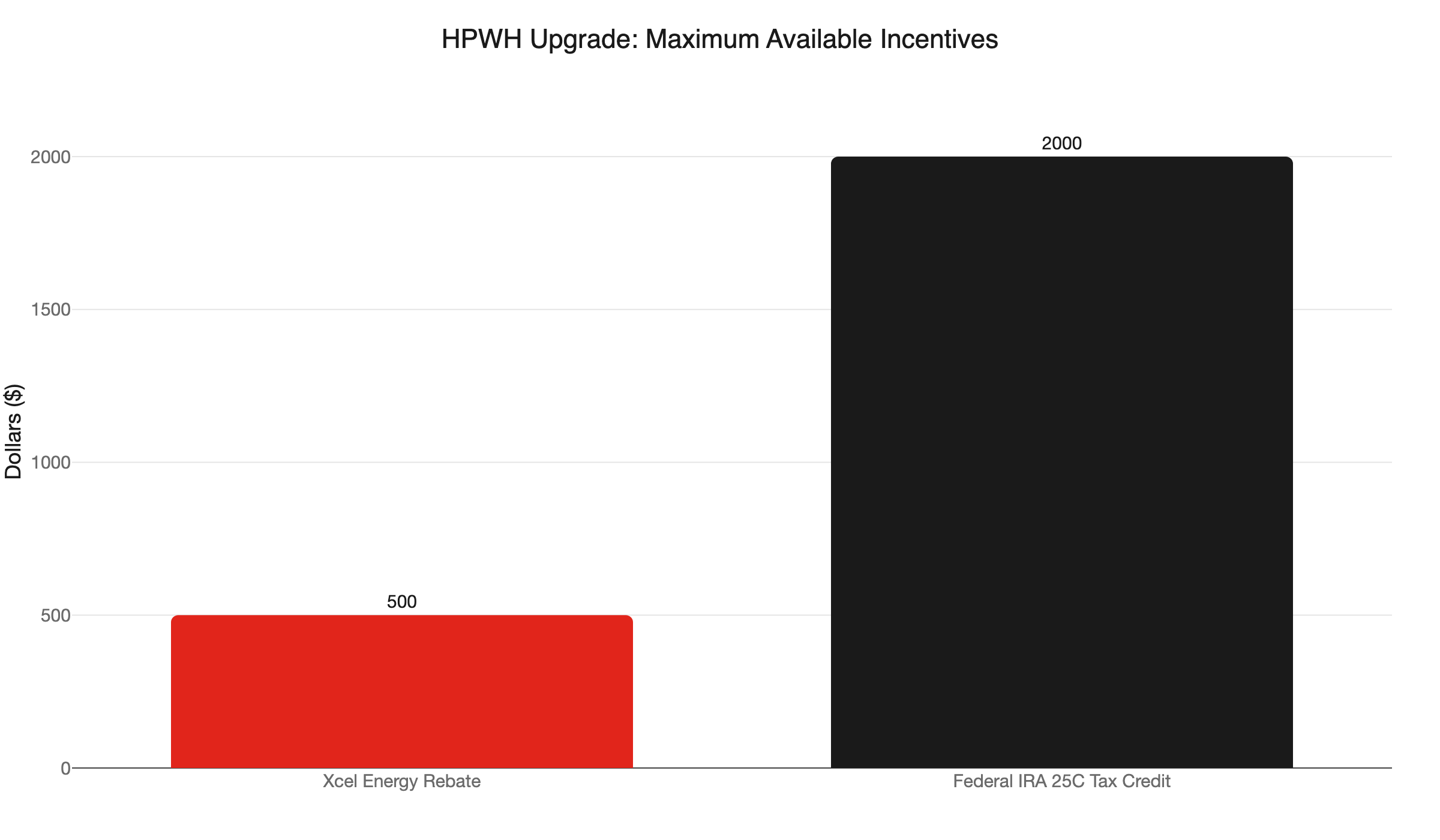
- A qualifying HPWH can earn up to $500 from Xcel Energy and up to $2,000 from the federal IRA 25C tax credit, stackable on a single project.
- NEC 2026 takes effect in Minnesota on August 3, 2026. Permits filed on or after that date must comply with the new edition.
What Does Electric Water Heater Wiring Actually Require?
A standard 40-80 gallon electric water heater needs a dedicated 240V circuit, a 30-amp double-pole breaker, and 10 AWG copper wire. NEC 422.12 prohibits sharing this circuit with any other load.
Here is where the 30-amp number comes from. A typical water heater element draws 4,500 watts. Divide by 240 volts: 18.75 amps. NEC’s 125% continuous-load multiplier pushes that to 23.4 amps. You round up to the next standard breaker size, which is 30 amps.
Wire gauge follows the breaker. A 30-amp circuit requires 10 AWG copper at minimum. Undersizing the wire is one of the most common shortcuts in residential electrical work, and one of the most dangerous. The wire heats under load. Repeated overheating breaks down insulation over time. If the circuit is being replaced as part of this project, run 10 AWG. There is no reason to size down.
The dedicated circuit rule is absolute. NEC 422.12 prohibits sharing a water heater circuit with any other load - no washer, no dryer, no utility outlet on the same breaker. If your current water heater shares a circuit, that gets corrected when the permit is pulled.
Before you order a new water heater, check whether your panel has an open slot for a 30-amp double-pole breaker. If the panel is full, you need either a tandem breaker or a panel upgrade. Our guide to dedicated circuits for appliances explains how to read your panel’s capacity and what to expect from a circuit evaluation.
What Is the Disconnect Requirement - and Does a Standard Breaker Count?
NEC 422.31(B) requires a disconnect that is either within sight of the water heater or lockable in the open position. A standard breaker in another room, without a lockout device installed, does not satisfy this requirement.
“Within sight” has a specific code definition: visible and within 50 feet. A 240V disconnect switch mounted near the water heater satisfies this cleanly. A lockable breaker at the panel satisfies it too, but only if a lockout device is physically installed on the breaker handle - not just a breaker you can flip off.
Structure Tech, a Minneapolis-based inspection firm, is direct about this: a standard toggle breaker in a different room does not meet NEC 422.31(B). In most Twin Cities homes, the panel is in a different room from the water heater. The utility room, mechanical room, or basement corner where the heater lives is rarely the same space as the panel. That means the lockout question comes up on nearly every job here.
The fix is usually one of two things. A licensed electrician installs a lockout kit on the existing breaker - a small clip or device that lets the breaker be padlocked in the open position. Or a dedicated 240V disconnect switch is mounted near the water heater, satisfying the “within sight” option directly. Either approach is code-compliant when done correctly. Your electrician will assess which solution is cleaner for your layout.
This is a standard inspection item on water heater permits in Minnesota. If your current installation lacks a proper disconnect, plan to address it when the replacement goes in.
Minnesota’s Electric Water Heater Wiring Rules: The Conduit Standard
National DIY guides routinely show NM-B cable - the white or yellow jacketed wire most people call Romex - running directly to a water heater. That is legal in many states. Minnesota enforces a different standard.
NEC 334.15 requires protection of exposed NM cable. Minnesota’s Authority Having Jurisdiction (AHJ) - the state inspectors who sign off on permitted electrical work - consistently require that the exposed run to a water heater be protected by conduit. Rigid metal conduit or flexible metal conduit are the standard choices. Bare NM cable stapled to framing does not pass inspection here.
This is not an isolated quirk of one city or county. It is a consistent statewide enforcement position. Minnesota AHJs are uniform on it. If you received a cost estimate based on a national guide or a video filmed in another state, and that estimate did not include conduit, the final bill will be different.
The conduit requirement adds material cost and a modest amount of labor. It is not a large line item on a water heater project. But it is non-negotiable with a Minnesota inspector. If your current installation runs bare NM cable to the heater, note it as a correction item when the replacement permit is pulled. An inspection triggered by a new installation is the right time to bring the wiring up to current standards.
Who Must Pull the Electric Water Heater Wiring Permit?
Minn. Stat. 326B.38, subd. 4 classifies replacing an electric water heater as electrical work. A licensed electrical contractor must do the wiring and pull the electrical permit. No exemption exists for plumbing or HVAC contractors.
This is the rule most national guides miss entirely. In many states, a plumber who installs a water heater can reconnect the 240V circuit as part of the same job. Minnesota draws a clear line. The plumber handles water connections. The licensed electrician handles everything electrical.
The DLI is explicit: there is no carve-out for a plumber to reconnect the circuit, even on a straight swap with no new wiring. If that reconnection happens without a licensed electrical contractor, the work is unpermitted. The installation is not legal.
Minnesota homeowners in owner-occupied single-family homes may pull their own electrical permit. That does not skip the inspection. The work still requires review by a state electrical inspector. Homeowner self-permit is a valid path for those doing the work themselves. For a job with this many specific code requirements, most homeowners hire a licensed electrician and let them handle the permit.
Our Minnesota electrical permit guide covers what triggers a permit, how to apply, what inspectors check, and what can happen if work is done without one. If you are coordinating a water heater swap between a plumber and an electrician, that post clarifies each trade’s scope.
What Changes When You Upgrade to a Heat Pump Water Heater?
Less than you might expect. Most heat pump water heaters run on the same 240V, 30-amp circuit with 10 AWG wire as a standard tank. The existing circuit can often be reused after a condition check. The new code requirement for most Twin Cities basement installations is GFCI protection.
Heat pump water heaters extract heat from surrounding air rather than generating it with resistance coils. That is why they use substantially less energy than standard tanks. The compressor that drives the process adds a starting-current surge. That surge is why manufacturers still specify a 30-amp breaker and 10 AWG wire even though the running current is lower - typically 12 to 20 amps versus around 19 amps for a standard resistance element.
Rheem’s ProTerra HPWH, one of the most widely installed models in Minnesota, is available in 15-amp or 30-amp versions depending on the model. The 30-amp version uses 10 AWG - same as a standard tank. The 15-amp version uses 14 AWG on a smaller circuit. Always check the data plate on the specific unit you are installing. Specifications vary by model, and the nameplate governs.
Before reusing your existing circuit, an electrician needs to verify three things: the wiring is in good condition with no nicks or degraded insulation, the circuit is sized correctly for the specific HPWH model, and the panel has available capacity without overloading it. If your panel is already close to full, a HPWH installation is a natural trigger for a panel evaluation at the same time. Our post on signs you need an electrical panel upgrade covers what to look for before your electrician arrives.
Does My Basement HPWH Need GFCI Protection?
Yes. NEC requires GFCI protection when a heat pump water heater is installed in a garage or basement. Most Twin Cities homes keep water heaters in the basement, so this applies to nearly every HPWH installation here.
GFCI stands for ground-fault circuit interrupter. It monitors the difference between current leaving and current returning on a circuit. If current is leaking through an unintended path - including through a person - the GFCI trips the circuit in milliseconds. Basements and garages are classified as higher-risk environments because of moisture, which is why NEC requires protection there for certain appliances.
For a hardwired 240V appliance, a GFCI breaker at the panel is the standard solution. It protects the entire circuit. A GFCI receptacle is not practical for a hardwired unit. Budget a few hundred dollars more than a standard breaker for this item.
This requirement applies specifically to heat pump water heaters. A standard resistance-only electric tank in the same basement location does not trigger GFCI protection under current NEC. If you are replacing a standard tank with a HPWH, the GFCI breaker is a new line item in the project scope.
Our GFCI requirements guide explains where GFCI protection is required throughout the home, the difference between a GFCI receptacle and a GFCI breaker, and why the distinction matters for hardwired appliances.
What Rebates and Tax Credits Stack on a Heat Pump Water Heater?
A qualifying HPWH installation in Minnesota can combine an Xcel Energy rebate of $400-$500 with a federal IRA 25C tax credit of up to $2,000, for combined savings of up to $2,500 on a single project.
Here is each incentive in plain terms.
Xcel Energy rebate: Xcel’s Minnesota residential rebate program offers $400-$500 for qualifying HPWH installations. Applications are accepted through September 30, 2026. The unit must be installed by a registered contractor and must not exceed 80 gallons. The rebate comes directly off your project cost.
Federal IRA 25C tax credit: The Section 25C credit covers 30% of the installed cost of a qualifying HPWH, up to $2,000 per tax year. There is no income limit. The unit must meet ENERGY STAR efficiency requirements. You claim it on your federal return for the year the installation is complete. The HPWH credit has its own $2,000 annual cap - separate from the $1,200 cap for envelope and HVAC improvements. Claiming both credits in the same tax year is possible.
Stacking: These incentives can be combined, provided total savings do not exceed your installation cost. The utility rebate reduces your out-of-pocket cost first. The federal credit is then calculated on what you paid after the rebate. Consult a tax preparer for your specific numbers, but the general principle is that Xcel, IRA 25C, and any applicable state programs can all stack.
On a HPWH project costing $2,500-$4,000 installed, up to $2,500 in stacked incentives changes the math significantly. A heat pump upgrade that looked like a premium option starts to look like the obvious call.
The NEC 2026 Transition: What It Means for Permits Filed After August 3
Minnesota has been operating under NEC 2023 since July 1, 2023. The GFCI and disconnect requirements discussed in this post reflect that edition. All permits filed since that date must comply with NEC 2023.
The next transition arrives soon. NEC 2026 takes effect in Minnesota on August 3, 2026. Any permit filed on or after that date must comply with the 2026 edition. The core water heater wiring specs - 30A, 240V, 10 AWG, disconnect, conduit - are unlikely to shift dramatically between editions. But GFCI scope, disconnect specifications, and inspection details can change with each cycle.
If your water heater project is already taking shape for late July, filing the permit before August 3 locks in the current code edition. That is not a reason to rush a poorly planned job. It is useful context if your timeline already points to that window.
Larger projects tied to this work - a panel upgrade, additional circuits, or EV charger preparation - carry the same permit-date consideration. Our electricians stay current on both editions and can sequence your project scope to match whichever timeline works best.
Ready to Schedule Your Water Heater Wiring?
Electric water heater wiring is not complicated in theory. In practice, the Minnesota-specific rules around conduit, licensing, disconnect requirements, and permits are specific enough that national guides leave homeowners underprepared. The licensing rule alone - that a plumber cannot legally reconnect the wires - surprises most people getting their first estimate.
Northern Mister Sparky is locally owned and operated in the Twin Cities. Our licensed electricians work in these homes every day. We know what Minnesota inspectors look for on water heater permits, and we handle the full scope: circuit evaluation, conduit, disconnect, GFCI breaker where required, permit filing, and inspection coordination. As America’s On-Time Electrician(R), we show up when we say we will, and every job is backed by the UWIN(R) 100% satisfaction guarantee.
Whether you are doing a straight tank replacement or upgrading to a heat pump model, call us at 763-200-5956 or book online. If this project is part of a larger electrical update - a panel that is running low on space, circuits that need attention, or an EV charger you have been putting off - ask about a full panel evaluation at the same time. One visit, full picture.
Frequently Asked Questions
What size breaker does an electric water heater need? +
Can a plumber wire my new electric water heater in Minnesota? +
Does upgrading to a heat pump water heater require new wiring? +
What rebates are available for a heat pump water heater in Minnesota? +
Need an electrician now?