
Furnace Wiring Electrician Near Me: What MN Code Requires

Key Takeaways
- A gas furnace requires a dedicated branch circuit per NEC 422.12. No other appliance may share it.
- A service disconnect switch must be within sight of the furnace per NEC 422.31. In most Twin Cities basements, the main panel is too far away to qualify.
- High-efficiency furnaces (90%+ AFUE) produce acidic condensate. The pump that removes it needs a properly sourced, grounded outlet on the dedicated furnace circuit.
- Minnesota adopted the 2026 NEC on August 17, 2026. The code version governing your permit depends on when it was filed.
- Only a licensed electrical contractor, or an owner-occupant on their own single-family home, can pull the electrical permit. The HVAC installer cannot, unless they hold a separate electrical license.
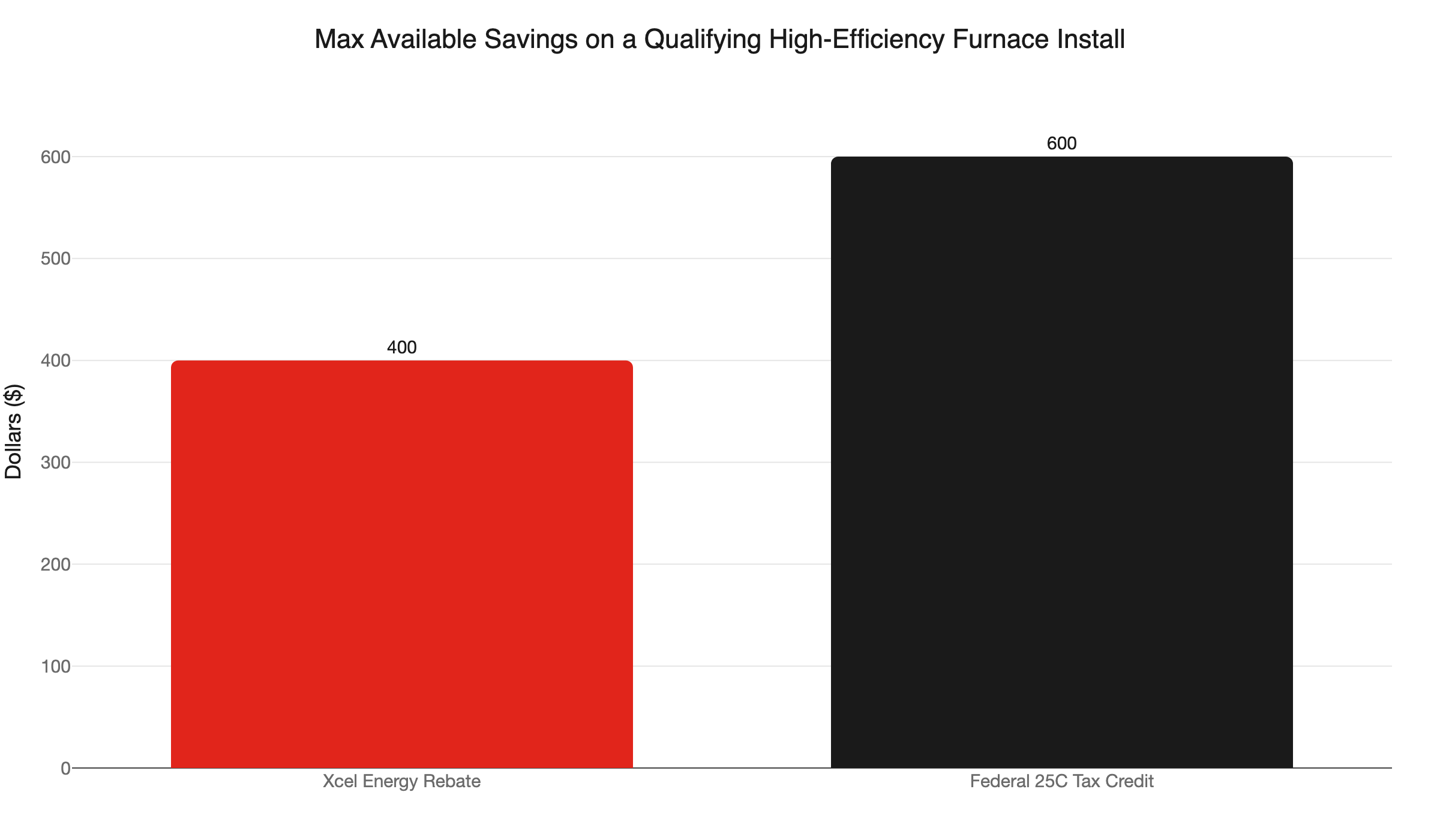
- A permitted install supports Xcel Energy rebates up to $400 and the federal 25C tax credit up to $600.
Why Furnace Wiring Belongs to the Electrician, Not the HVAC Crew
Your HVAC contractor installs the furnace. Your electrician owns everything from the panel to the appliance. These are two different licenses, two different permits, and two different inspections in Minnesota.
Minnesota’s electrical code lives in Chapter 1315 of the Minnesota State Building Code, which adopts the NEC as published by NFPA. A heating contractor without a separate electrical license cannot legally pull an electrical permit. They also cannot perform the circuit, disconnect, or outlet work a furnace installation requires.
This distinction matters most when something goes wrong. If the HVAC company wired your furnace without a licensed electrician, there may be no electrical permit and no inspection. That creates problems at resale. It blocks rebate applications. And it leaves you without recourse if the wiring causes a problem.
The right sequence: the HVAC company and the electrician coordinate, each pulls their own permit, and both scopes get inspected before the system is energized. Starting that conversation early, before the HVAC crew shows up with the new unit, is how you avoid a schedule conflict that delays the inspection.
What Does a “Dedicated Furnace Circuit” Actually Mean?
A dedicated circuit serves one appliance and nothing else. For a gas furnace, NEC 422.12 requires exactly that: one circuit, one load. The code allows auxiliary equipment on the same circuit, including a condensate pump or a whole-home humidifier, if the total load still fits. Nothing unrelated may share the circuit.
Most gas furnaces draw 6-12 amps for the blower motor, igniter, and controls. A standard 15-amp circuit handles that comfortably. But “dedicated” is doing real work here. Sharing the furnace circuit with a chest freezer, a shop light, or a sump pump is a code violation. It is also how a tripped breaker takes out your furnace on the coldest night of the year.
A licensed electrician runs a new circuit from your panel to the furnace location. They size the wire and breaker to match the nameplate amperage, not a round number that seems close. They label the breaker clearly so the next tech knows exactly what they are looking at.
If your panel is already at capacity, adding a furnace circuit may require a panel upgrade first. That is a conversation worth having before the HVAC crew arrives with the new unit, not after. A licensed electrician can assess available capacity in the same visit that scopes the furnace circuit work.
Does My Furnace Need a Service Disconnect Switch?
Yes, in almost every Twin Cities basement. NEC 422.31 requires a service disconnect within sight of a permanently connected appliance rated over 1/8 HP. A furnace blower motor exceeds that threshold. If the main panel is not visible from the furnace and within 50 feet, the breaker alone does not satisfy the code.
Most Minnesota basements fail the within-sight test. The furnace sits in a mechanical room, behind a closed door, or across a finished basement from the panel. An electrician looks at the actual layout, measures the sight line, and makes the call. If the sight test fails, a dedicated wall switch or a small disconnect box gets mounted near the furnace.
That disconnect gives any service tech a safe way to de-energize the furnace before working on it. Without it, the tech has to walk to the main panel and find the right breaker. Then they walk back and verify the furnace is actually off. In a winter emergency, that extra distance matters.
Some older installs use a standard light switch as the disconnect. That is not always compliant. An electrician checks whether the existing switch is properly rated for the disconnect function or needs to be replaced with a correctly rated unit.
What Does a Furnace Wiring Electrician Near Me Actually Do?
A qualified furnace wiring electrician near you handles three electrical scopes: the dedicated branch circuit from the panel to the furnace, the service disconnect switch mounted within sight of the unit, and the condensate pump outlet. Each requires a permit, and each gets inspected before the system is energized.
Here is what each scope involves in practice.
The dedicated branch circuit. A new run from the panel to the furnace location, sized to the unit’s nameplate rating, with a correctly rated breaker. If the existing circuit was shared or undersized, it gets replaced entirely, not patched.
The service disconnect. A wall switch or lockable disconnect box within sight of the furnace and within 50 feet. On a new install, this gets wired at the same time as the circuit. On a furnace swap where the old disconnect was missing or improperly placed, the electrician corrects it now rather than carrying the violation forward to the new unit.
The condensate pump outlet. A properly sourced, grounded 120V receptacle at the right location. The outlet comes from the dedicated furnace circuit, not a random nearby receptacle on a different circuit. The pump plug stays off the floor and away from standing water.
All three items appear on the DLI 2023 NEC inspection checklist. A Minneapolis inspector checks each one after the work is complete. If any is missing, the inspection fails and the system cannot be energized until the correction is made.
For the broader picture of which appliances require their own circuit, see the dedicated circuits guide. Furnaces are not unique in this regard, but they are among the most consequential.
What About the Condensate Pump Wiring?
A 90%+ AFUE furnace produces acidic condensate at roughly pH 3-4 that gravity cannot always drain. In many Minnesota basement installs, a condensate pump is necessary to lift the water up and out. That pump needs a properly wired outlet. An extension cord into the nearest receptacle is not a compliant install.
High-efficiency furnaces are standard in Minnesota for a practical reason. The Twin Cities averages roughly 8,000 heating degree days per year. A 90%+ AFUE furnace is not a luxury at that load. It is a sensible response to the climate. The condensate is a byproduct of efficiency, not a defect.
These systems run five to six months out of the year. The condensate pump works every time the burner fires. The wiring behind it needs to be right from day one, not corrected after the first failure.
If the pump fails because of a wiring problem, the condensate backs up into the secondary heat exchanger. The pressure switch trips. The furnace shuts down. In February, that is an emergency.
The outlet for the condensate pump must be sourced from the dedicated furnace circuit, properly grounded, and positioned so the plug stays off a wet floor. Depending on the installation layout and current code, GFCI protection may also be required. An electrician makes that determination based on the specific job, not a general rule of thumb.
What Changed with Minnesota’s Electrical Code in 2026?
Minnesota adopted the 2026 NEC effective August 17, 2026, per the DLI transition notice. Permits filed before that date are governed by the 2023 NEC. Permits filed on or after August 17 must comply with the 2026 NEC. Licensing exams transition to the new code on September 8, 2026.
If you are scheduling furnace work this fall, your permit may land right on the seam between two code versions. A licensed electrician knows which version applies to each permit they file. They do not guess. They file the permit, note the date, and build to the correct requirements.
The furnace circuit and disconnect rules under NEC 422.12 and 422.31 are stable across both the 2023 and 2026 versions. But any co-occurring work may trigger 2026 requirements if the permit was filed after August 17. This includes a new outlet in the mechanical room or a lighting circuit in the adjacent space.
Code knowledge is a living skill, and it is one of the practical reasons to hire a locally licensed electrician rather than someone operating outside the licensed contractor system. The person who filed permits after August 17 has already worked through which jobs the new code version governs. That experience is not available from a handyman or an unlicensed contractor.
Who Can Pull the Electrical Permit in Minnesota?
In Minnesota, only a licensed electrical contractor can pull the electrical permit for furnace wiring. The homeowner can also pull it for their own single-family home if they own and occupy it. No one else qualifies: not the HVAC installer, not a handyman, not a general contractor without a separate electrical license.
This is one of the most common misunderstandings in furnace replacement jobs. The HVAC company pulls a mechanical permit for the equipment installation. That covers the duct connections, gas line, and the furnace itself. It does not cover the dedicated circuit, the service disconnect, or the condensate pump outlet. Those require a separate electrical permit.
If the HVAC company wires the furnace without a licensed electrician, no electrical permit gets pulled. There is no inspection. The work is unpermitted. Xcel Energy can deny the rebate application. A buyer’s home inspection may flag unpermitted electrical work. Your homeowner’s insurance may raise questions about a loss traced to that wiring.
The licensed electrician also serves as the accountable party when the inspector comes out. They know what was installed, when the permit was filed, and which code version applies. That accountability is what an unpermitted job cannot provide.
See the post on electrical permits in Minnesota for the full breakdown of what is required, how the process works, and how long a typical inspection turnaround takes.
Can Proper Wiring Help Me Qualify for Rebates and Tax Credits?
Yes, directly. Xcel Energy pays $200-$400 in rebates for qualifying 95-97% AFUE gas furnaces installed in 2026. The federal 25C Energy Efficient Home Improvement Credit covers 30% of equipment and installation cost, up to $600 for qualifying high-efficiency gas furnaces. Both programs require documented, permitted installation.
“Documented installation” means a permit was pulled, the work was inspected, and the inspection passed. A rebate application without that documentation can be denied. The same logic applies to the federal credit: an unpermitted install is not a qualifying install.
The math is worth running before any work starts. A $400 Xcel rebate and a $600 federal credit is $1,000 back against the install cost. That does not happen without the permit, and the permit requires a licensed electrician.
CenterPoint Energy customers in the Twin Cities should also check their current efficiency rebate program directly. Amounts vary by year and by service address, and what applies to your account depends on factors the utility confirms when you call.
If the job involves a panel upgrade or significant circuit additions alongside the furnace work, ask about financing when you call. Knowing that option exists before the first estimate changes the planning conversation.
What Happens If the Electrical Work Is Wrong in a Minnesota Winter?
A tripped breaker, a failed disconnect, or a flooded condensate pump is not a comfort issue in Minnesota. It is a pipe-bursting emergency. The Twin Cities sees sustained cold snaps at -20°F to -30°F. A furnace that goes dark for 12-18 hours in those conditions can crack pipes. In sustained cold, that damage runs into tens of thousands of dollars.
No malarky: a code-compliant electrical install is not bureaucratic box-checking. It is the difference between a service tech who safely de-energizes the furnace at a clearly labeled disconnect switch and one who has to locate the right breaker across a dark basement before touching anything.
A dedicated, labeled circuit means the next electrician on the job does not have to guess what feeds the furnace. A service disconnect within sight means any tech can work safely. A properly grounded condensate pump outlet means the pump runs reliably and does not introduce a shock hazard in a wet mechanical room.
The time to make these things right is during installation, when the permit is open and an inspector will check the work. Correcting them after a failure costs more, takes longer, and happens in the worst possible conditions.
Questions to Ask Before Scheduling Furnace Work
If your furnace was installed a few years ago, the electrical work may or may not meet current code. Here are four questions worth answering before winter arrives.
- Is the furnace on a dedicated circuit, or does it share a breaker with other basement loads?
- Is there a service disconnect switch within sight of the furnace?
- Is the condensate pump connected to a properly sourced, grounded outlet, or plugged into an extension cord or the nearest available receptacle?
- Was an electrical permit pulled for the original installation, and was a final inspection completed?
If you do not know the answers, a licensed electrician can assess the existing install and tell you exactly what is there and what needs correction. That is a low-stakes conversation now. It becomes a much higher-stakes one after a mid-winter failure.
If the furnace is more than 15-20 years old, the original wiring may be undersized or improperly configured. It may have been compliant under an older code version but fall short of current requirements. A furnace replacement is the right time to correct those issues so they do not carry forward to the new unit.
Ready to Book a Furnace Wiring Electrician Near Me?
Northern Mister Sparky is locally owned and operated in the Twin Cities. As America’s On-Time Electrician(R), we show up when we say we will, and we back every job with the UWIN(R) 100% satisfaction guarantee.
Our team pulls the permit, handles all three electrical scopes (dedicated circuit, service disconnect, condensate pump outlet), calls the final inspection, and coordinates with your HVAC installer so the schedule works for everyone. We flag panel issues before they become a problem and walk you through the rebate paperwork.
Larger jobs qualify for financing. Ask about it when you call.
Call 763-200-5956 or book online. We serve Minneapolis, St. Paul, Bloomington, Brooklyn Park, Woodbury, Blaine, Maple Grove, Plymouth, and the broader Twin Cities metro.
Frequently Asked Questions
Do I need an electrician to wire my furnace? +
What NEC code section covers furnace circuits? +
Does my furnace need a service disconnect switch? +
Can a condensate pump share the furnace circuit? +
Need an electrician now?