
Replace Fuse Box with Breaker Panel Cost: Twin Cities Guide

Key Takeaways
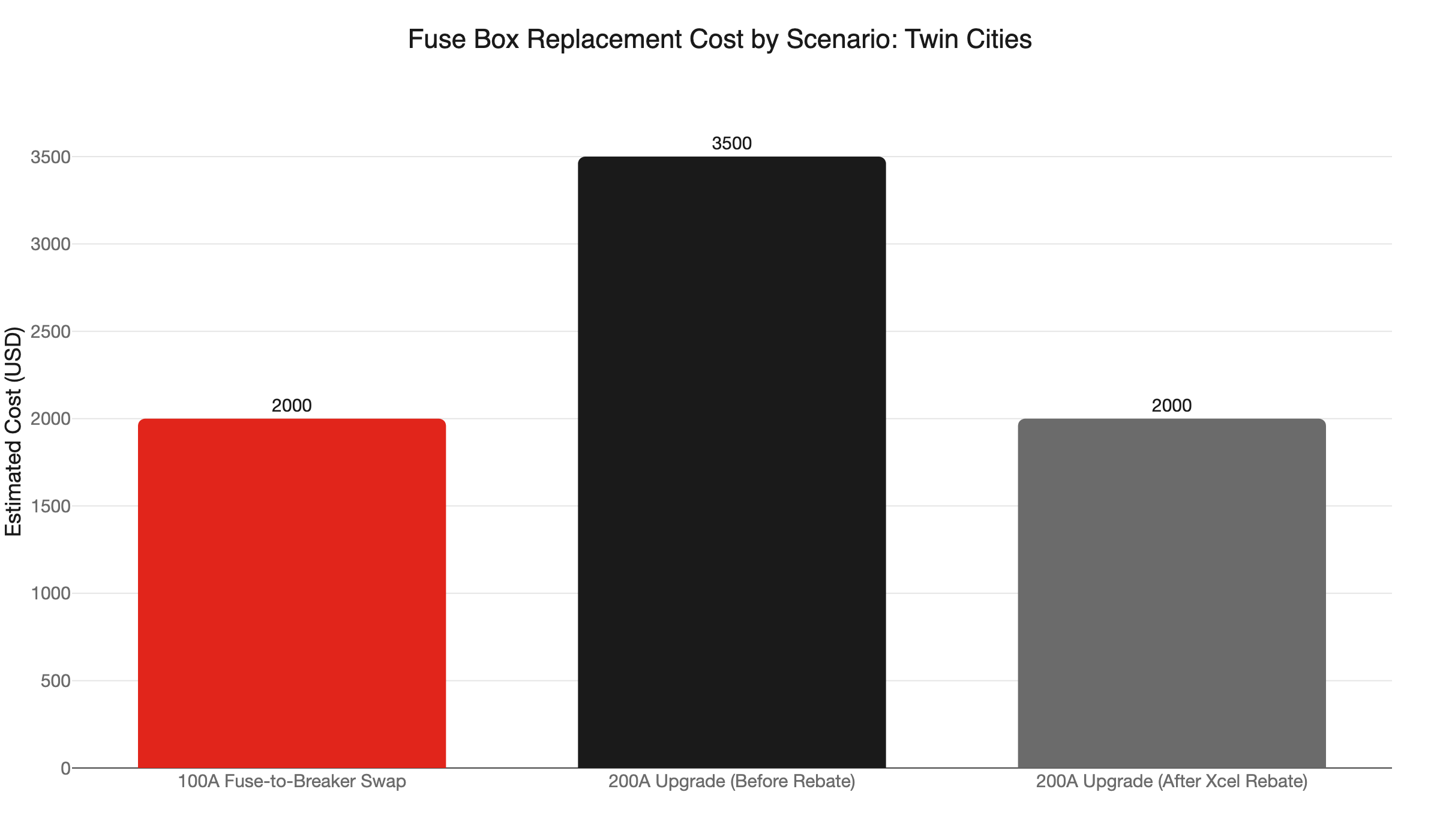
- A screw-in fuse box replacement with a new breaker panel costs $1,500 to $2,500 when you keep your existing 100-amp service.
- Adding a 200-amp service upgrade at the same time raises the total to $2,500 to $4,500.
- Xcel Energy customers in the Twin Cities can receive up to $1,500 back on a qualifying panel upgrade, bringing the effective out-of-pocket cost to roughly $1,000 to $3,000.
- A state electrical permit is required for every panel replacement in Minnesota.
- Minnesota adopted the 2026 NEC effective August 17, 2026. Permits pulled before or after that date fall under different code editions.
- Replacing a fuse panel does not fix knob-and-tube wiring. The two problems often share the same pre-1960 Twin Cities home and need separate scopes.
- The IRS 25C tax credit for panel upgrades expired December 31, 2025. New 2026 installs do not qualify under current law.
What Does It Cost to Replace a Fuse Box with a Breaker Panel?
Quick answer: Expect $1,500 to $2,500 to swap a screw-in fuse panel for a modern breaker box while keeping your existing service size. Add a 200-amp service upgrade at the same time and the range climbs to $2,500 to $4,500 before rebates. Xcel Energy customers can knock $1,500 off the top on qualifying jobs.
Most national cost guides lump a fuse panel swap together with a full service-size upgrade. They are not the same job, and they do not carry the same price. Here is what drives each scenario.
Fuse-to-breaker swap, 100-amp service retained: $1,500 to $2,500.
This is the right scope when your home has adequate service capacity and the screw-in fuse panel is the only thing being replaced. The electrician pulls the permit, installs the new breaker panel, transfers each circuit to a properly sized breaker, and schedules the inspection. Utility outage time is typically one to two hours.
Fuse panel replacement with 200-amp service upgrade: $2,500 to $4,500.
Many older Twin Cities homes were wired for 60-amp or 100-amp service. If you plan to add an EV charger, central air, or a heat pump, upgrading to 200-amp service at the same mobilization is cheaper than returning later. The Xcel Energy rebate applies to this scenario, not to a same-amperage swap.
Meter base or weatherhead replacement: $300 to $800 additional.
If the existing meter socket is damaged or cannot support the new service size, your electrician will coordinate a replacement with the utility. This adds cost and a second utility appointment. Not every job requires it.
Why Screw-In Fuse Panels Fail: The Overfusing Problem
Screw-in fuse panels are not dangerous because they are old. They are dangerous because they are easy to defeat.
Here is the mechanism. A 15-amp fuse protects a circuit wired with 14 AWG wire. The fuse is sized to blow before the wire overheats. But fuses blow inconveniently. A homeowner whose 15-amp fuse keeps tripping replaces it with a 20-amp fuse from the hardware store. The wire is still 14 AWG, rated for 15 amps. The fuse no longer blows before the wire gets dangerously hot. A wall fire can start before anything trips.
The worst version of this is the “penny trick”: a copper coin wedged into the fuse socket to bypass the fuse entirely. The circuit is left with no overcurrent protection whatsoever. This is a code violation and a documented cause of residential fires.
The NEC addressed this hazard with Type S tamper-resistant fuses. NEC Article 240 specifies a non-interchangeable adapter system that makes it physically impossible to install a higher-rated fuse in a lower-rated socket. A Type S retrofit is a code-compliant interim fix if full panel replacement is not immediately feasible. Interim is the right word. A modern breaker panel removes the problem at the root.
Is My Home’s Fuse Box a Fire Hazard?
Quick answer: A properly fused panel with the correct amperage fuses is functional. But most screw-in fuse panels still in service in older Twin Cities homes show signs of overfusing or have been modified in ways that reduce their safety margin. The only way to know the condition of yours is an inspection.
Signs that a screw-in fuse panel warrants attention:
- Fuses that keep blowing and have been replaced repeatedly
- Fuses with a higher amperage rating than the circuit’s wire gauge allows (14 AWG wire is rated for 15A, 12 AWG for 20A)
- A fuse holder that shows scorch marks, discoloration, or visible modification
- Mixed fuse types or sizes in a single panel
- Any evidence that fuse sockets have been bypassed or bridged
If your home was built before 1960 and the panel has never been inspected, reviewing the signs you need an electrical panel upgrade is a useful starting point. A hands-on inspection by a licensed electrician is the only way to get a real answer for your specific panel.
What Does a Fuse Box Replacement Actually Include?
Quick answer: A licensed electrician schedules utility disconnect, removes the fuse panel, installs a new breaker panel with labeled circuits, and schedules a state inspection. Power is out during the swap, typically one to two hours. The whole job is normally completed in a single day for a standard residential panel.
Here is what happens in order.
Utility coordination. Xcel Energy or your local utility must disconnect power at the meter before work begins. This is scheduled in advance and is part of any licensed electrician’s standard process.
Panel removal and installation. The old fuse panel comes out. The new breaker panel goes in. Each circuit gets its own properly sized breaker and a clear label. Accurate circuit labeling is required by code and matters for every future service call or home sale.
Permit and inspection. Minnesota requires a state electrical permit for every panel replacement. On most properties, work must be performed by a licensed electrical contractor. A state inspector approves the finished work. The permit and inspection record protect you at resale and satisfy insurance documentation requirements.
Meter base and weatherhead review. If the existing meter socket cannot support the new service, the electrician coordinates a replacement with the utility. This is not required on every job, but it is common when upgrading from 60-amp to 200-amp service on a pre-1960 home.
Twin Cities Cost Breakdown After Rebates
Here is how the numbers work for the most common scenarios in the Twin Cities market.
Same-amperage fuse-to-breaker swap: $1,500 to $2,500. The Xcel Energy rebate does not apply here because service amperage does not change. This is the right scope when your home has adequate capacity and the fuse panel itself is the problem.
Fuse panel replacement with 200-amp upgrade: $2,500 to $4,500 before rebates. With Xcel’s $1,500 rebate applied after the job, effective out-of-pocket cost lands at roughly $1,000 to $3,000. For most Twin Cities homeowners upgrading from a 60-amp or 100-amp fuse panel, this scenario offers the best long-term value per dollar spent.
Meter base or weatherhead replacement: $300 to $800 added to either scenario above, when the utility requires it.
These are Twin Cities figures. Material costs, permit fees, and licensed electrician labor in the Minneapolis metro differ from what a national cost guide based on data from another region will tell you.
Does the Xcel Energy Rebate Apply to My Job?
Quick answer: It does if you are an Xcel Energy residential customer, the job includes a service amperage increase (for example, from 60 or 100 amps to 200 amps), and a licensed electrician performs the work. The Xcel panel upgrade rebate pays up to $1,500. You submit your invoice and permit approval after completion, and Xcel processes payment in six to eight weeks.
The rebate is tied to the amperage upgrade, not to the panel type being replaced. A homeowner who swaps a fuse panel for a breaker panel while keeping the same amperage does not qualify. The rebate covers 1-4 unit residential properties.
Two things worth knowing before you schedule: the rebate cannot be applied retroactively, and program terms can change. Locking in the work and the permit before program terms shift is the safer play. Ask your electrician to confirm current eligibility before the job begins.
What About the Minnesota HEAR Program?
Quick answer: Income-qualified households may receive up to $4,000 for a panel upgrade under this program, but as of July 2026 it had not yet launched for applications. No rebates are available retroactively. If you qualify, contact Minnesota Commerce to verify current status before scheduling any work.
The Minnesota HEAR program offers households under 80% of area median income up to $4,000, and households at 80 to 150% of AMI up to $2,000. There is a condition: the panel upgrade must support a qualifying high-efficiency appliance, such as a heat pump or a heat pump water heater. A stand-alone panel replacement follows a separate Residential Electrical Panel Upgrade Grant track.
On the IRS 25C tax credit: The federal energy tax credit for panel upgrades expired December 31, 2025. Homeowners who completed qualifying work by that date can still claim it on their 2025 return using IRS Form 5695. Work completed in 2026 does not qualify under current law. No planning workaround changes this for new installs.
How Does the 2026 NEC Transition Affect My Project?
Quick answer: Minnesota adopted the 2026 National Electrical Code, effective August 17, 2026. A permit pulled before that date is inspected under the 2023 NEC. A permit pulled on or after that date is inspected under the 2026 NEC. If your project falls near that date, ask your electrician which code edition applies and confirm the inspector will use the same one.
The Minnesota Department of Labor and Industry electrical codes page has current adoption details and the effective date in writing.
For the vast majority of residential fuse box replacements, the transition does not change the scope of work in a material way. But for projects scheduled right around August 17, 2026, a short conversation with your electrician before signing the contract avoids surprises at inspection.
One more point on permits: the homeowner self-permit option in Minnesota is narrower than many people expect. You may self-permit electrical work on your own homesteaded single-family property. You may not self-permit on a condo, a rental, or any property occupied by others. Licensed electrician work is required in those cases under state law.
Will a New Panel Fix My Insurance Problem?
Quick answer: Often yes. If your insurer specifically cited the screw-in fuse panel, replacing it with a modern breaker panel typically resolves the issue. If the insurer cited knob-and-tube wiring, ungrounded circuits, or a Federal Pacific Stab-Lok breaker panel, a fuse box swap alone does not close those items.
Insurance companies increasingly refuse to renew coverage on older Twin Cities homes without electrical remediation. Many Minneapolis and St. Paul home sales now hinge on electrical updates before closing. If your insurer sent a letter or a list of required repairs, share it with us before scheduling work. We will tell you exactly what the letter requires, what the job costs, and whether you are looking at one project or two.
What Happens to My Knob-and-Tube Wiring?
Quick answer: A fuse panel replacement does not touch it. Knob-and-tube wiring and a screw-in fuse panel are separate systems. They co-exist frequently in pre-1960 Twin Cities homes, but replacing the panel does not remediate the wiring. Each requires its own scope and its own quote.
Knob-and-tube carries a different set of hazards: deteriorating cloth insulation, no ground conductor, and an open-air design that becomes a problem when blown-in insulation surrounds it. Our knob-and-tube wiring replacement guide explains what that project involves and what a full rewire estimate covers.
Some older Minnesota homes also have aluminum branch wiring from the 1960s and 1970s. That is a third distinct issue with its own remediation path. If your home was built or rewired in that era, ask about aluminum wiring during the panel inspection. Combining the panel replacement and wiring remediation on a single mobilization can reduce total cost, but the scopes must be quoted and planned separately.
What If My Panel Is Not a Fuse Box?
Quick answer: Some problem panels in 1950 to 1990 vintage Twin Cities homes are Federal Pacific Stab-Lok or Zinsco breaker panels, not screw-in fuse boxes. These are different from fuse panels but carry documented reliability and safety concerns. If you are not certain what you have, identify it before you call.
Our guide on dangerous electrical panel brands in Minnesota walks through how to identify Stab-Lok, Zinsco, and other panels that warrant replacement on their own terms, separate from the fuse panel conversation. The replacement process and cost ranges are similar, but the hazard mechanisms differ.
How to Get an Accurate Replace Fuse Box with Breaker Panel Cost Quote
A firm price requires an electrician to look at your specific setup. An accurate quote depends on several variables:
- Your current service size (usually stamped on the meter base or the panel cover)
- Whether the meter base or weatherhead needs replacement
- Whether you are adding service amperage at the same time
- The condition of existing wiring connections inside the panel
- Whether knob-and-tube or aluminum branch wiring is present and complicates the circuit transfer
A phone estimate is useful for budgeting. No malarky: any contractor quoting a hard price without seeing your panel is guessing. A firm number requires eyes on the equipment.
Northern Mister Sparky is locally owned and operated right here in the Twin Cities. As America’s On-Time Electrician(R), we show up when we say we will. Every job is backed by the UWIN(R) 100% satisfaction guarantee.
Call 763-200-5956 or schedule your panel assessment online. We will tell you exactly what your home needs, what it will cost, and whether the Xcel rebate applies to your job.
Frequently Asked Questions
How much does it cost to replace a fuse box with a breaker panel in the Twin Cities? +
Does Xcel Energy offer a rebate for replacing my fuse panel? +
Do I need a permit to replace a fuse box in Minnesota? +
Will replacing my fuse box fix my knob-and-tube wiring problem? +
Does replacing a fuse box qualify for the IRS 25C tax credit in 2026? +
Need an electrician now?