
How to Find an Electrical Short in House: A Safe Triage

Key Takeaways
- A breaker that trips instantly - often with a pop - signals a dead short. A breaker that trips after the circuit runs warm signals an overload. The fix is different for each.
- A dead outlet with no tripped breaker is almost always a GFCI outlet that tripped somewhere else in the house. Check the bathroom, garage, kitchen, and exterior outlets first.
- A burning smell at an outlet: unplug everything and stop using that outlet. A burning smell at the panel or from inside a wall: leave the area and call now.
- Twin Cities homes built before 1980 may have Federal Pacific or Zinsco panels with documented breaker failure modes. A breaker that “looks fine” in one of those panels is not a safety guarantee.
- Minnesota requires a permit before any in-wall electrical repair. Resetting a breaker or pressing a GFCI reset button does not require a permit.
- If you cannot safely identify and clear the fault, call Northern Mister Sparky at 763-200-5956.
What Is an Electrical Short, and Why Does It Matter?
Short answer: An electrical short occurs when current takes an unintended path - through a damaged wire, a failed device, or a wet surface - instead of flowing through the load it is supposed to power. The circuit protection trips to interrupt the current. The cause determines the correct fix.
“Electrical short” gets used loosely to describe any fault that trips a breaker or kills a circuit. In practice, three separate problems hide behind that term. Knowing which one you have tells you whether you can handle it safely at home or whether you need to stop, step back, and call.
What Type of Fault Do You Have?
Short answer: Listen and watch when the breaker trips. A dead short trips instantly, often with a pop or a visible flash at an outlet or device. An overload trips gradually after the circuit runs hot. A ground fault typically trips a GFCI outlet, not the main panel breaker. Each type points to a different cause and a different response.
Dead Short
A dead short trips the breaker immediately, often with an audible pop and sometimes with a visible spark at the outlet or device. Hot and neutral conductors have made direct contact, or current has jumped to a ground path with almost no resistance. The resulting current spike is massive, and the breaker clears it in a fraction of a second.
What this means for you: do not reset the breaker a second time if it trips instantly again. You have an active wiring fault that will not go away on its own. Keep the circuit off and call us.
Overload
An overload is slower. More current is flowing than the circuit is rated to handle - typically because too many appliances are running at once. The breaker heats up and trips after running above its rated capacity for a period of seconds or minutes, not instantly.
If your breaker trips every time the microwave and toaster run together, the circuit is telling you it is out of room. Redistributing the load to a different circuit often resolves this without any repair. Our post on why your circuit breaker keeps tripping walks through the full overload diagnosis.
One firm rule: never replace a 15-amp breaker with a 20-amp breaker to cure an overload. The wiring on that circuit is rated for 15 amps and will overheat before the larger breaker trips. Upsizing the breaker does not fix the overload - it removes the last line of protection on the circuit.
Ground Fault
A ground fault occurs when current leaks from a live conductor to a grounded surface: a wet countertop, a cracked weatherproof cover on an exterior outlet, a damaged cord on a power tool. Most ground faults trip a GFCI (ground fault circuit interrupter) outlet before they ever reach the main panel breaker.
If your circuit is dead and none of your panel breakers are tripped, a ground fault on a GFCI-protected circuit is the most likely explanation. The next section covers exactly how to find it.
Why Won’t My Outlet Work When Nothing Is Tripped?
Short answer: A GFCI outlet upstream on the same circuit has tripped. One GFCI outlet protects all the outlets connected downstream, even outlets in a different room. When it trips, they all go dead. Press RESET on every GFCI outlet in the house - bathroom, garage, kitchen counters, and exterior - and then test the dead outlet again.
This is the most common call we receive. A homeowner loses power to one outlet or a cluster of outlets. The breaker panel looks normal. Nothing obvious is wrong.
The reason is wiring topology. Builders wire GFCI protection in series. A single GFCI outlet in the master bathroom can be the upstream protector for outlets in an adjacent bedroom, a hallway, or the exterior wall of the house. When the GFCI trips - from a hair dryer in a damp bathroom or water on a kitchen counter - every outlet it protects goes dark, no matter where those outlets are located.
Try this sequence before anything else:
- Walk through every bathroom, every garage bay, kitchen counter areas, and all exterior outlet locations.
- Look for outlet faces with small TEST and RESET buttons in the center.
- Press RESET firmly on every GFCI outlet you find, whether it looks tripped or not.
- Return to the dead outlet and test it with a lamp or phone charger.
Our full guide on what to do when a GFCI outlet won’t reset covers the less common situations: failed GFCI devices that need replacement, and GFCI outlets that trip repeatedly because of an actual ground fault downstream on the circuit.
If you reset every GFCI in the house and the dead circuit stays dead, you likely have a wiring fault between the GFCI device and the dead outlet, or the outlet itself has failed internally. That is an electrician call.
What Does a Burning Smell Tell You?
Short answer: Location determines urgency. A burning smell at a device or outlet may mean a failed device - unplug everything and stop using the outlet. A burning smell at the panel means leave the area immediately. A fish or chemical smell from inside a wall means insulation is burning - treat it as a pre-fire condition and call now.
Not all burning smells in electrical systems carry the same weight. Where you detect the smell changes what you should do next.
Smell at an Outlet or Switch
Unplug every device from the affected outlet. Do not use that outlet again until it has been inspected. The device plugged in may have failed, or the outlet’s internal contacts may be scorched or melted. Our post on burning smells from outlets and breakers covers what the specific odor types indicate and what steps to take for each.
Smell at the Breaker Panel
Stop. Do not open the panel. Do not try to reset any breakers. If you see smoke or discoloration on the panel cover, leave the area and call 911. Then call us. A burning smell from the panel means something inside is overheating: a loose bus connection, a failing breaker, or wiring that has run hot long enough to begin degrading its insulation.
Fish or Chemical Smell from Inside a Wall
That specific odor is melting Bakelite - the plastic compound used in older breakers and outlets. It does not smell like burning wood or hot dust. It has a sharp synthetic quality, similar to hot electronics. This means insulation is burning inside the wall cavity. It is a pre-fire condition, not an oddity to investigate later. Cut power at the main breaker if you can do so safely, leave the area, and call.
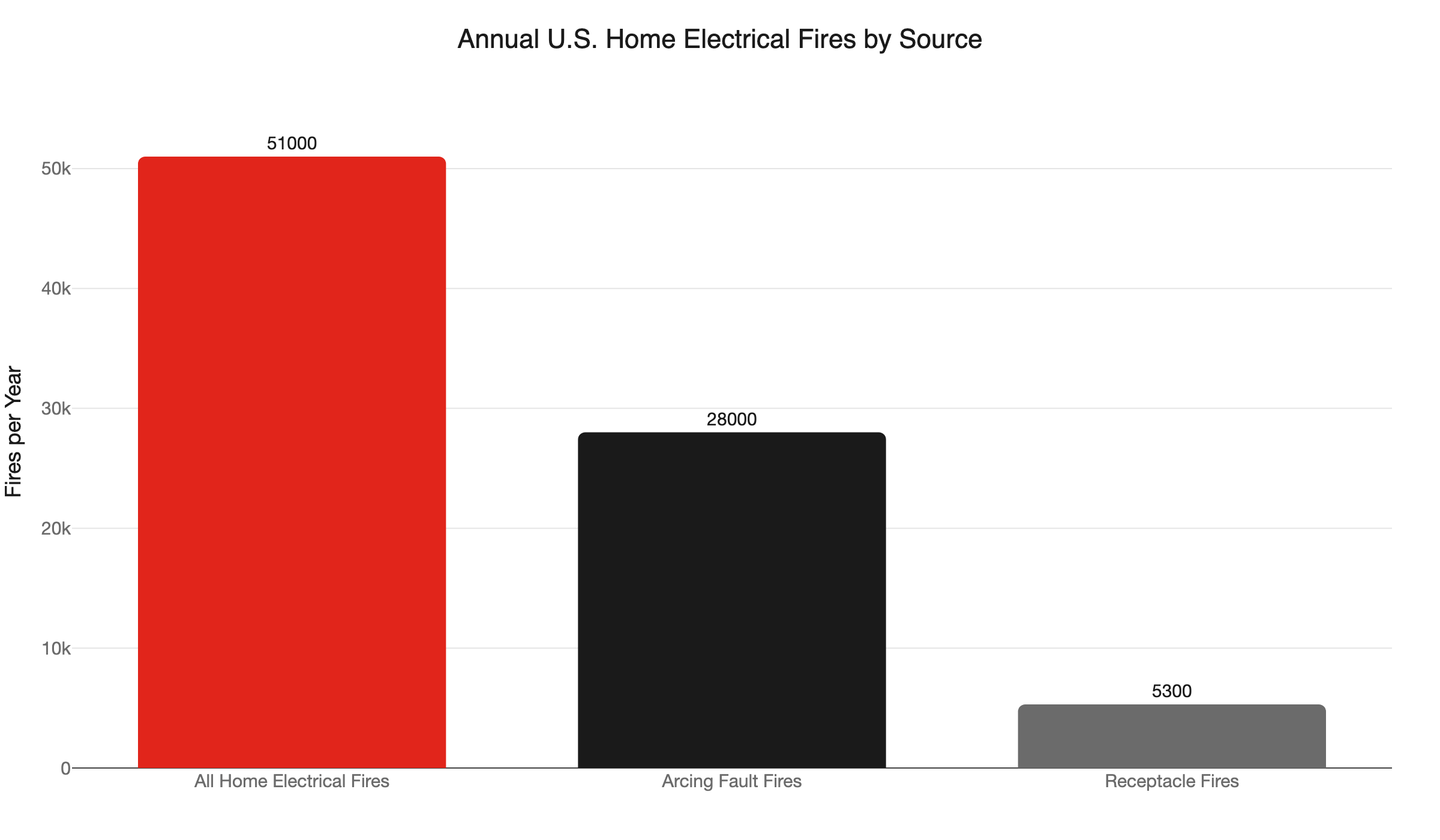
Electrical receptacles are involved in roughly 5,300 home fires per year, causing 40 deaths and more than 100 injuries annually. A burning smell at an outlet is not something to monitor and address this weekend.
How to Find an Electrical Short in House: Step-by-Step Triage
The following steps cover what you can do safely, without tools, before an electrician arrives. Stop at any step where you are uncertain or where the symptom worsens.
Step 1: Identify the affected circuit. Go to the main panel. Look for a breaker in the tripped position - typically sitting halfway between ON and OFF, sometimes with a red or orange indicator showing. If you are unsure which circuit is down, use a lamp to test outlets one by one until you locate the dead zone.
Step 2: Unplug everything on the circuit. Walk through the affected area and unplug every device: lamps, phone chargers, small appliances, power strips. You want zero load on the circuit before resetting anything.
Step 3: Reset the breaker. Turn the tripped breaker firmly to OFF first, then firmly to ON. If it holds, begin plugging devices back in one at a time. Wait about 30 seconds between each device. The circuit will trip again when you plug in the faulty device. That device is your culprit. Remove it from service.
Step 4: If the breaker trips with nothing plugged in, stop. A circuit that trips with zero load on it has a wiring fault inside the cable, at a splice in a junction box, or inside an outlet or switch box. Do not keep resetting the breaker. Each reset on a live fault creates an opportunity for arcing. Call us.
Step 5: Check for a tripped GFCI if no panel breakers are tripped. Follow the GFCI reset sequence from the earlier section. This resolves the problem in the majority of “dead outlet” calls we receive.
Step 6: Do a quick visual and smell check before calling it resolved. Look at the outlet or switch where the problem started. Scorch marks, discoloration, or any burning odor means the device needs replacement, even if the breaker reset and held. A breaker that reset does not mean the outlet behind it is safe.
When Should You Stop and Call an Electrician?
Short answer: Stop and call if the breaker trips with nothing connected, if you smell burning from the panel or a wall, if a breaker physically will not stay reset, or if your home has any of the Twin Cities-specific risk factors listed below. These are not judgment calls - they are hard stops.
Full list of stop conditions:
- The breaker trips instantly with no load on the circuit.
- You smell burning at the panel or from inside a wall.
- A breaker trips again and again after you reset it.
- You find scorch marks, discoloration, or melted plastic at any outlet, switch, or junction box cover.
- Your home has a Federal Pacific Stab-Lok or Zinsco panel (more on this below).
- Your home has aluminum branch circuit wiring, common in Twin Cities homes built 1965-1973.
- The problem started after water entered the house or the basement flooded.
Arcing faults - the kind that develop from unresolved shorts and deteriorated wiring - cause more than 28,000 home fires and over $700 million in property damage each year. The time between “something is wrong” and “there is a fire” can be very short. Do not spend that window attempting repairs that require opening junction boxes or walls.
What Makes Twin Cities Homes Different?
Short answer: Older Twin Cities housing stock carries specific risks - Federal Pacific and Zinsco panels that can fail to trip under fault conditions, aluminum branch wiring that oxidizes at connections, and outdoor GFCI outlets vulnerable to freeze-thaw failure. None of these show up in national how-to guides.
If your home was built before 1985 in the Minneapolis-Saint Paul metro, read this section before relying on any breaker reset as a signal that the circuit is safe.
Federal Pacific and Zinsco Panels
The Twin Cities is heavy with 1950s-1980s housing. Federal Pacific Stab-Lok panels and Zinsco panels were installed through the late 1970s. Both have a specific documented failure mode: their breakers can fail to trip under fault conditions.
If you have one of these panels and a breaker “seems fine,” that is not a safety guarantee. A breaker that does not trip under a dead short is not protecting your wiring - it is giving you a false sense of security while the circuit runs at fault-level current. Our post on dangerous electrical panel brands in Minnesota covers how to identify these panels and what replacement options look like.
Stab-Lok breakers have a narrow rectangular form and the Federal Pacific name on the panel door. Zinsco panels are often cream or tan with colored breaker handles. If you see either, call us before trusting any breaker reset.
Aluminum Branch Wiring
Homes built between 1965 and 1973 across the inner-ring suburbs - Richfield, Columbia Heights, New Hope, parts of St. Louis Park and Brooklyn Center - often have aluminum branch circuit wiring. Aluminum oxidizes at connections over time. That oxidation increases resistance and generates heat at the connection point. A tripped breaker in one of these homes may indicate a loose aluminum connection at a junction box or outlet rather than a true short. The repair protocol for aluminum wiring is different from standard copper-circuit repair and requires a licensed electrician.
To check: find exposed wire in your basement or utility room. Aluminum wiring is silver-colored. The cable sheath is usually marked AL or ALUMINUM.
Outdoor GFCI Outlets After a Hard Winter
Outdoor GFCI outlets in Minnesota fail at a higher rate than in warmer climates. Freeze-thaw cycling stresses the internal mechanism over several seasons. An exterior outlet that will not reset in April, or after a stretch of hard cold, is most likely a failed GFCI device rather than a wiring fault. Replace the outdoor GFCI outlet and retest the circuit before assuming something more serious is wrong underneath it.
What Does Minnesota Law Say About Electrical Repairs?
Short answer: Homeowners can do their own permitted electrical work on their primary residence. A permit must be in place before the work starts, and an inspection is required after. Hiring an unlicensed electrician is not permitted under any arrangement, and skipping the permit means skipping the inspection that protects you.
Minnesota homeowners can pull their own electrical permit and perform their own electrical work on their primary residence. The rules have no wiggle room:
- The permit must be filed and approved before the work begins.
- A state electrical inspector must inspect the completed work before the circuit is put back into service.
- You cannot hire an unlicensed electrician even if you pull the permit yourself.
- Diagnostic steps - unplugging devices, resetting a breaker, pressing a GFCI reset button - do not require a permit. Replacing an outlet, a switch, or any in-wall wiring does.
Minnesota has adopted the 2023 National Electrical Code. Under that code, AFCI (arc-fault circuit interrupter) protection is required in virtually all rooms of new and substantially remodeled homes. AFCI breakers are more sensitive than standard breakers. They can nuisance-trip on motor loads from treadmills, vacuums, and power tools. If an AFCI breaker trips on a specific appliance but holds with everything else unplugged, that is likely a sensitivity quirk, not a short. If the AFCI breaker trips with no load on the circuit at all, that warrants an inspection.
If you are not comfortable with permitted DIY electrical work, or if the fault is inside the wiring rather than at a device, calling a licensed electrician is the safer and legally cleaner path. It is also the only legal option if you are a renter or if the property is not your primary residence.
How We Can Help
Northern Mister Sparky is locally owned and operated in the Twin Cities. When you call 763-200-5956, you reach our team - not a national dispatch center. We know the housing stock here: the old Federal Pacific panels, the 1960s ramblers with aluminum wiring, the exterior GFCI outlets that fail every hard winter.
As America’s On-Time Electrician(R), we show up when we say we will. If we do not resolve the problem, the UWIN(R) 100% satisfaction guarantee has you covered. For larger work - a panel replacement, a full fault diagnosis, or rewiring after water damage - we offer financing options. Ask when you book.
No malarky: if a breaker trips the moment you reset it with nothing plugged in, that is a phone call, not a YouTube tutorial.
Call us at 763-200-5956 or book online to schedule a diagnostic visit.
Frequently Asked Questions
What is the difference between a dead short and an overload? +
My outlet is dead but no breaker is tripped. What do I do? +
Is a burning smell from an outlet an emergency? +
Can I do electrical repairs myself in Minnesota? +
Need an electrician now?