
Lake Cabin Electrical Winterization Minnesota Guide

Key Takeaways
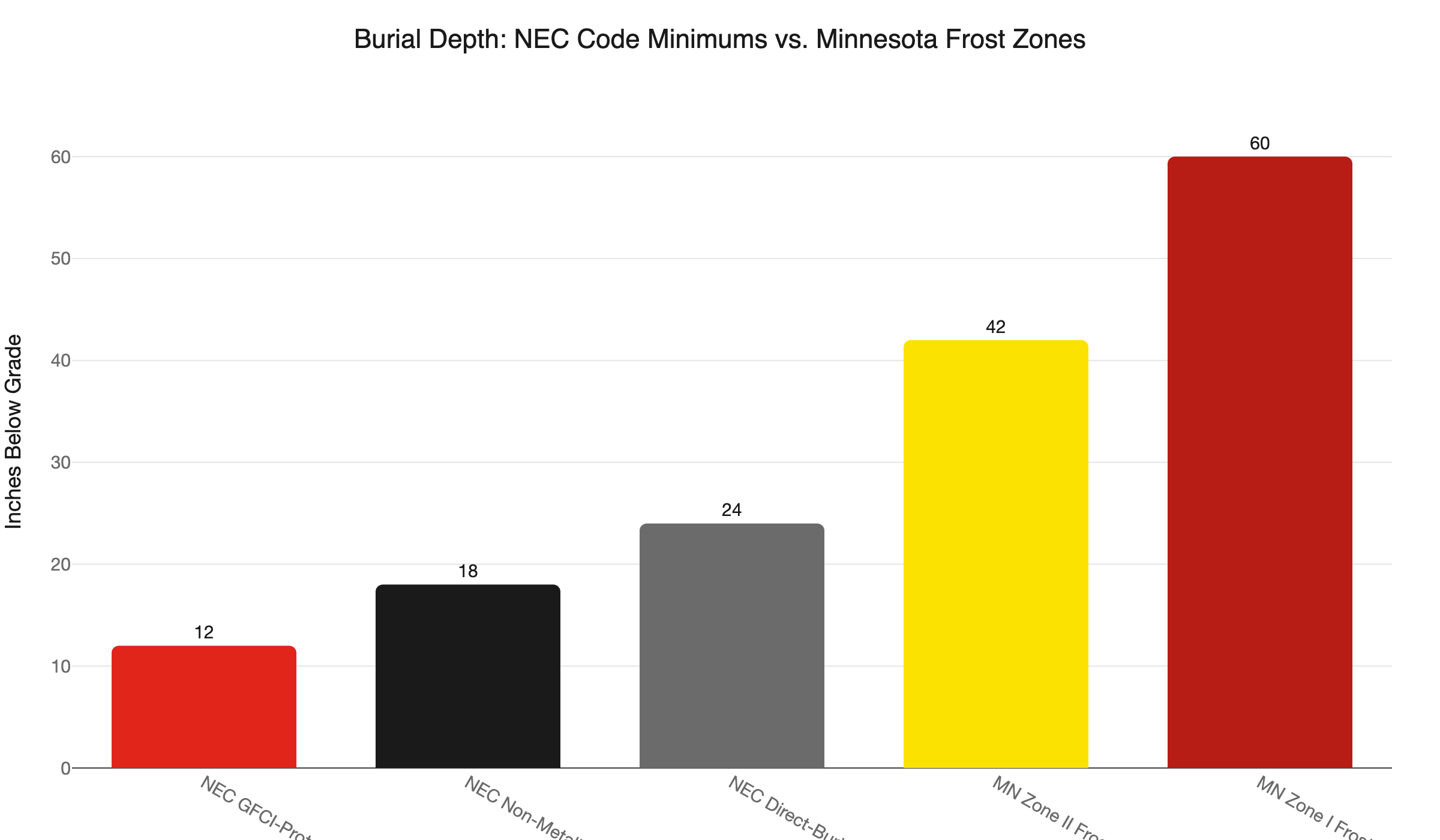
- Minnesota’s frost penetrates 42 to 60 inches deep depending on where your cabin sits. NEC burial minimums of 12 to 24 inches fall short in most MN lake counties.
- A proper winterization means opening the main service disconnect at the panel, not just individual branch breakers.
- All dock and boathouse receptacles must be GFCI-protected per NEC Article 555 (2023). Skipping this creates a drowning risk.
- Boathouses and detached garages fed from the main cabin require their own grounding electrode system per NEC 250.32.
- Cold weather reduces the magnetic trip threshold on standard circuit breakers. A panel in an unheated north-shore cabin may trip at lower loads than rated.
- Most cabin electrical work in Minnesota requires a permit. Homeowners can pull their own online.
- Spring reconnect has its own checklist. Do not flip the main back on without running through it.
What Do Minnesota Cabin Owners Get Wrong About Lake Cabin Electrical Winterization?
The short answer: Most homeowners stop at unplugging appliances. The real risks are in the panel shutoff procedure, underground conduit buried shallower than Minnesota’s freeze line, and dock wiring that has never been updated to NEC Article 555 standards.
Lake cabin electrical winterization in Minnesota is not one task. It is three separate electrical systems with three different failure modes in a climate where the ground freezes 42 to 60 inches deep.
Most closing guides treat the electrical section as a single bullet: unplug your appliances. That advice comes from real estate agents and HVAC technicians. It does not come from electricians who have opened a boathouse panel in May and found frost-cracked conduit, a corroded main lug, and a dock GFCI that failed because the luminaire was never listed for marine use.
This guide covers your main panel, your underground wiring, your dock, and the spring reconnect step that no one else writes about.
Why Does Minnesota’s Frost Depth Matter for Underground Cabin Wiring?
The short answer: Minnesota splits into two frost depth zones. Zone I, which covers northern Minnesota including the Brainerd Lakes area and the Iron Range, sets a 60-inch burial minimum. Zone II, which covers the metro and southern Minnesota, sets 42 inches. NEC national minimums run 12 to 24 inches. That gap is where conduit fails.
Minnesota Building Code MN Rules 1303.1600 defines the two zones and their burial requirements. They apply to all buried utilities, including electrical conduit.
Here is the gap in practical terms. NEC 300.5 sets national burial minimums. Direct-burial cable requires 24 inches. Non-metallic conduit requires 18 inches. A GFCI-protected 120V branch circuit can go as shallow as 12 inches. Every one of those depths sits above the freeze line in most MN lake counties.
DNR frost monitoring data shows that even in Ramsey County, a Zone II location, frost reaches 35 inches or more in some winters. In northern Minnesota, frost regularly exceeds 60 inches.
Conduit buried at NEC minimums in a Zone I county moves when the ground freezes and thaws. PVC joints crack. Conduit shifts at the foundation entry point. Water gets in. Conductors can be nicked where the conduit moves against the structure.
The most visible sign of frost heave at a conduit entry point is a crack or gap in the concrete or sill plate where the conduit passes through. Look for rust staining around the entry. Look for new dips or ridges in soil along the conduit path. These are not cosmetic. Water that enters cracked conduit can reach the panel.
When you winterize, walk any underground conduit path you know of. Examine every point where conduit enters the cabin foundation or boathouse slab. Heaved soil, cracked masonry, or conduit that has shifted are reasons to call before you close up.
A frost depth map for building code purposes is available from MN DLI. If you are not sure which zone your cabin falls in, start there.
How Do You Properly Shut Off Power to a Lake Cabin?
The short answer: Open the main service disconnect, not just the individual branch breakers. The main breaker is the required disconnecting means under NEC 230.70. Opening it de-energizes the entire panel. Tag the main breaker with the date and your name before you leave.
Here is the complete shutoff sequence:
- Walk each room and confirm all appliances are unplugged or switched off at the device.
- Open the largest branch breakers first: electric range, water heater, well pump, baseboard heaters.
- Open the remaining branch breakers one at a time.
- Open the main service breaker last.
- Apply a lockout tag with the date and your contact information.
- If your cabin is served by Xcel Energy, their seasonal stop-service program lets you pause service online or by phone at 1-866-235-6881. Smart-meter cabins can be reconnected remotely in about 15 minutes when spring arrives.
- Close and latch the panel cover.
If your panel has never been properly labeled, do it before you close up for the season. A panel with unlabeled or badly labeled breakers is not ready for a safe spring reconnect. Our post on how to label your electrical panel walks through that step.
What Are the GFCI Requirements for Docks and Boathouses?
The short answer: NEC Article 555 (2023) requires all dock receptacles to be GFCI-protected and mounted at least 36 inches above deck. Shore power receptacles need ground-fault protection at 30 mA or less. Dock luminaires must be listed specifically for marine use. These requirements exist because faulty dock wiring kills swimmers.
Electric Shock Drowning is what happens when AC current leaks into the water near a dock. Swimmers in that current become paralyzed and drown. It is not a theoretical hazard. It happens at residential docks. Dock wiring that skips Article 555 protections is the cause.
NEC Article 555 covers both commercial marinas and residential docking facilities. The 2023 version tightened the rules. Here is what applies to your cabin dock:
- All dock receptacles must be GFCI-protected and mounted at least 36 inches above deck level.
- Shore power receptacles serving boats require ground-fault protection at 30 mA or less.
- Feeder and branch conductors running to the docking facility require 100 mA protection or less.
- NEC 555.38 (2023) requires dock luminaires to be listed and identified for marine or dock use. Standard UL 1598 wet-location outdoor fixtures are no longer sufficient.
- Underwater dock lights must be UL 676 listed, GFCI-protected, and use low-voltage isolation.
- Boat hoists at a dwelling-unit docking facility rated at 240V or less require GFCI protection.
During winterization, inspect every dock outlet cover for physical damage. Press the test button on each GFCI outlet to confirm it trips. If any outlet fails the test or shows damage, do not reconnect the dock circuit until it is repaired.
Minnesota adopted the 2023 NEC. On August 17, 2026, the state transitions to the 2026 NEC. Permits pulled before that date work under the 2023 rules. Any permit pulled after August 17 triggers the 2026 requirements. If you are planning dock wiring work this season, the timing of your permit affects which rules apply.
For more on outdoor and damp-location GFCI protection, our post on outdoor GFCI outlet installation covers the requirements.
How Does Cold Weather Affect Circuit Breakers in an Unheated Cabin?
The short answer: Standard circuit breakers are calibrated at 40 degrees Celsius (104 degrees Fahrenheit). Below that temperature, the bimetallic trip strip changes behavior. A breaker in a below-zero cabin may trip at 70 to 80 percent of its rated load, or respond more slowly than expected.
The MN DLI technical bulletin on circuit breakers in low ambient temperatures documents this behavior. Most homeowners do not know about it.
If you de-energize the panel entirely over winter, this is a non-issue. But if you keep any circuits live for a heat tape or a sump pump, the breakers on those circuits may not perform as their label suggests at minus 20 degrees Fahrenheit.
A nuisance-tripped heat tape breaker in an unmonitored cabin means frozen pipes. A tripped sump pump circuit may go unnoticed for weeks.
If you keep circuits live over winter, ask your electrician whether those breakers are rated for low ambient temperature service. Some manufacturers produce breakers specifically designed for cold installations. Most standard residential breakers carry a minus 40 degree Celsius lower limit on the label, but the calibration curve still shifts, and nuisance trips in cold conditions are a documented field problem.
The safest approach is to open the main disconnect entirely and leave no circuits energized.
Do You Need a Permit for Lake Cabin Electrical Work in Minnesota?
The short answer: Yes, for most work. Minnesota requires permits for new circuits, panel modifications, and wiring to detached structures. Homeowners can pull their own permits online through MN DLI. The rule applies whether a licensed electrician does the work or you do it yourself.
Minnesota DLI homeowner electrical permits are available through the state’s online system. The process is straightforward and does not require a contractor account.
Work that typically requires a permit:
- Adding or extending circuits in the cabin or any detached structure
- Replacing or upgrading the service panel
- Installing a subpanel in a boathouse or detached garage
- Running a new underground feed to a detached structure
- Adding dock receptacles or rewiring dock circuits
- Spring reconnect work that involves panel modifications or new circuits
What you can generally do without a permit: replacing like-for-like devices (outlets, switches, fixtures) at an existing location. Any new wiring or panel modification requires a permit.
The permit process exists so an inspector can verify the work before it is covered. A failed dock wiring inspection is an inconvenience. A dock wiring fault that causes an Electric Shock Drowning is not.
Our post on electrical permits in Minnesota covers the full process from application through final inspection.
Does Your Boathouse Need Its Own Grounding System?
The short answer: Yes. NEC 250.32 requires any detached structure fed from the main cabin to have its own grounding electrode system. That means a ground rod at the boathouse, bonded to the panel enclosure at that structure. Extending the equipment grounding conductor from the cabin panel alone is not sufficient.
This is the most commonly skipped requirement on lake properties. It is also a consistent cause of failed inspections.
The MN DLI technical bulletin on grounding and bonding for detached buildings explains the rule and the reason behind it. Without a local grounding electrode, a fault at the boathouse has no local reference point. The structure’s metal components can become energized. At a boathouse sitting at the water’s edge, that failure mode is not abstract.
If your boathouse was built more than a decade ago and has never had an electrical inspection, the grounding electrode is worth verifying before you reconnect in spring. Ask your electrician to check it during a winterization or spring reconnect visit.
Our post on running electricity to a shed or outbuilding covers the subpanel, grounding, and permitting process for detached structures.
What Should You Check Before Flipping the Main Back On in Spring?
The short answer: Before re-energizing a lake cabin, inspect the panel interior for moisture and pest damage, check underground conduit entry points for frost heave, test every GFCI outlet, and restore branch circuits one at a time with loads disconnected. Spring reconnect is a procedure, not a single switch flip.
Every winterization guide ends at closing. This one does not.
Panel inspection first:
- Open the panel cover before energizing anything. Look for moisture, corrosion, insulation damage, or pest intrusion inside the enclosure.
- If you see any of those, call an electrician before you close the cover and proceed.
- Confirm that the lockout tag you applied in fall is still in place. If it is gone, treat the panel state as unknown.
Underground conduit entry points:
- Walk the path of any buried conduit you know of. Look at where it enters the foundation or the boathouse slab.
- Look for heaved soil, cracked masonry near the entry, or conduit that has shifted position. Any of those suggest possible frost damage.
- Do not assume a conduit that carried power last fall is intact after a hard winter. Inspect before you energize.
Dock and boathouse:
- Walk the dock before connecting power. Check every outlet cover for damage from ice or winter debris.
- Press the test button on every GFCI dock outlet before plugging anything in.
- Inspect dock luminaire mounting hardware. Ice expansion can loosen fittings on lights attached to dock decking.
Reconnecting power:
- If you paused service through Xcel Energy’s stop-service program, contact them to restore service before touching the panel.
- Close the main breaker with all branch breakers still open.
- Restore branch circuits one at a time, starting with lighting before large appliances.
- If a breaker trips on a circuit that was working correctly last fall, do not reset it multiple times. Investigate the cause before assuming it is a nuisance trip.
If a panel inspection turns up moisture, or if any dock outlet fails the GFCI test, stop and call before proceeding. Energizing a damaged circuit is how a small winter problem becomes an expensive spring repair.
When to Call Northern Mister Sparky
Some parts of cabin winterization are homeowner work. Unplugging appliances, opening the main breaker, and pressing the test button on GFCI outlets: you can handle those.
Underground conduit repair, boathouse subpanel inspections, dock wiring upgrades to 2023 NEC Article 555 standards, separate grounding electrode installation, and any spring reconnect that surfaces moisture in the panel: those are licensed electrician jobs.
We are locally owned and operated Twin Cities electricians and America’s On-Time Electrician(R). We work with lake cabin owners throughout the metro and into greater Minnesota. If you want an electrician to walk through the cabin before you close for winter, or to reconnect it properly in spring, that is what we do.
Call 763-200-5956 or book online. Every job is backed by the UWIN(R) 100% satisfaction guarantee.
No malarky.
Frequently Asked Questions
Do I need to turn off the main breaker at my lake cabin for winter? +
How deep does underground electrical conduit need to be at a Minnesota lake cabin? +
What is Electric Shock Drowning and how does dock wiring relate to it? +
Need an electrician now?