
Weatherhead Repair Cost: Twin Cities Storm & Vehicle Damage

Key Takeaways
- Weatherhead repair in the Twin Cities typically costs $600 to $1,200 total, including parts, labor, and a required electrical permit.
- You own the weatherhead and service mast. Xcel Energy owns the service drop from the pole to your weatherhead. Xcel will not repair your side.
- Three things damage weatherheads in Minnesota: ice load on the service drop, high-wind pull, and vehicle strikes on low-clearance masts.
- After the electrician finishes, your power stays off until Xcel receives the Electric Inspection Certificate. This is the step most homeowners do not know about.
- Storm damage may be a covered homeowners insurance claim. A car hitting your mast may fall under the driver’s auto liability policy.
- A permit is required for service entrance work in Minnesota. Permits pulled on or after August 17, 2026 must comply with the 2026 NEC.
- In a Minnesota winter, loss of electrical service is a heat-loss emergency. Same-day repair exists. Call 763-200-5956.
What Is a Weatherhead, and Who Owns It?
The short answer: The weatherhead is the curved fitting at the top of your service mast where the utility’s overhead wires meet your home’s wiring. You own it. The utility owns everything from that connection point back to the pole.
Your service entrance has two sides. Xcel Energy owns the service drop: the three conductors that run from the transformer on the street pole to your weatherhead. You own the weatherhead, the service mast, the service entrance conductors inside the mast, the meter base, and the main panel. If any of those components is damaged, the repair is yours to arrange and pay for.
This matters when ice or wind tears the assembly apart. Homeowners often call Xcel expecting the utility to fix the damage. Xcel will not. They reconnect their service drop only after a licensed electrician repairs your side and the inspection is complete.
The Xcel Energy service guide makes the ownership boundary explicit. Xcel’s responsibility ends at the point of attachment on your home.
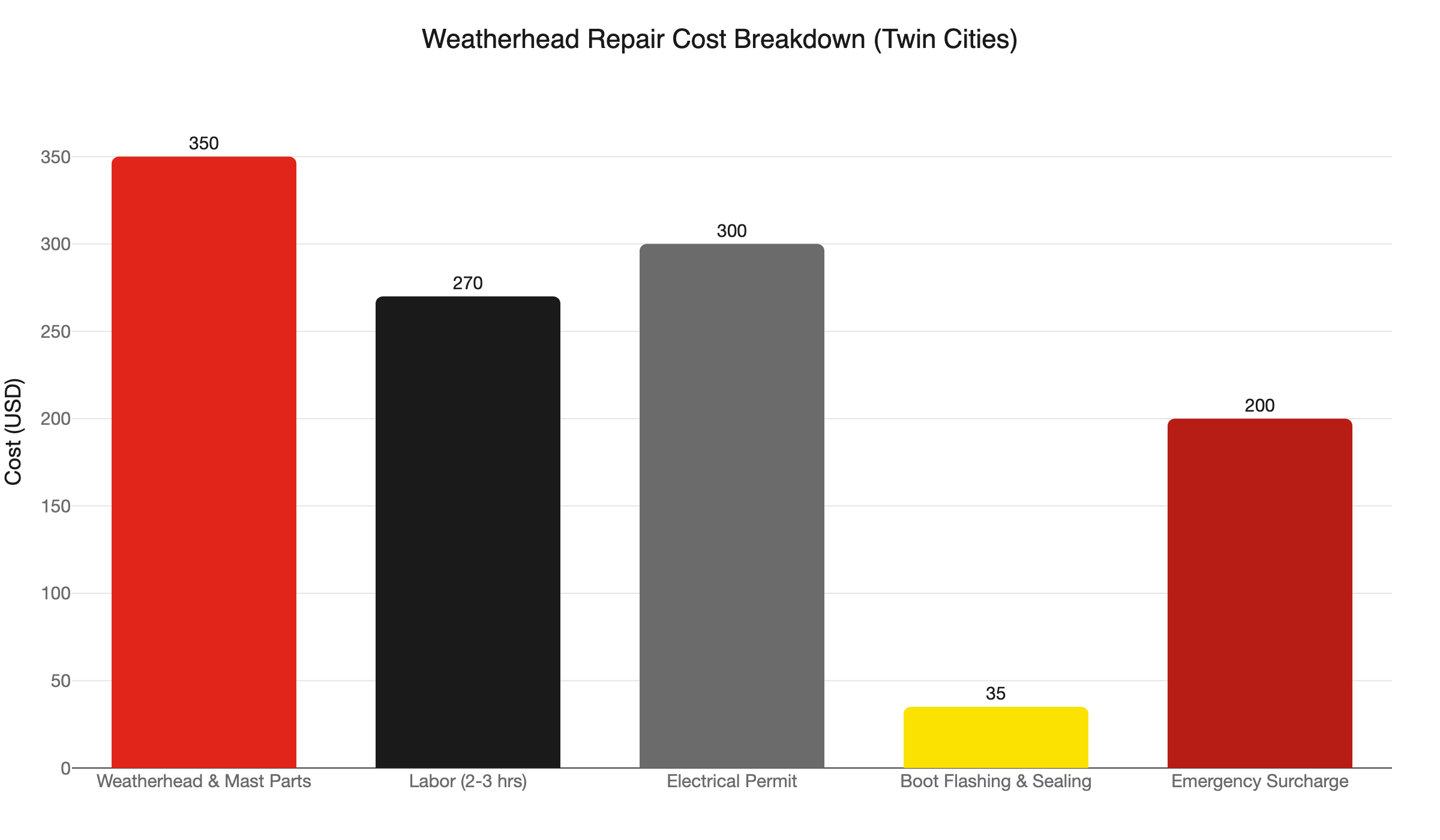
What Does Weatherhead Repair Cost in the Twin Cities?
The short answer: Budget $600 to $1,200 for a standard repair. Emergency service adds $150 to $250. The required permit runs $250 to $350 on top of parts and labor.
Here is how the cost breaks down, based on industry cost benchmarks for service mast work:
Parts
- Weatherhead fitting: $10 to $100, depending on size and type
- Service mast conduit (2-inch rigid or IMC, typically 4 to 6 feet): $20 to $80
- Boot flashing to seal the roof penetration: $10 to $60
- Mast strap and bracing kit: $40 to $50
- Wire connectors and tape: $10 to $20
Labor
- Licensed electrician: $50 to $130 per hour
- Most weatherhead jobs run 2 to 4 hours on site
- A damaged meter base or pulled service entrance conductors add time and cost
Permit
- Electrical permit for service entrance work: $250 to $350
- Required by Minnesota law, not optional
Emergency premium
- After-hours or same-day emergency dispatch: $150 to $250 surcharge above standard rates
- That premium is worth it when the furnace is out in January
Total project range for a standard repair: $600 to $1,200. A more involved job, where the ice pulled conductors loose or cracked the meter base, can reach $1,500 to $2,000.
Three Ways a Weatherhead Gets Damaged
Not all weatherhead damage looks the same. The cause determines the scope of repair.
Ice load
The Twin Cities sees significant ice storm exposure every two to four winters. Freezing rain accumulates on the service drop conductors. One to two inches of ice on a 30-foot span adds real weight. That weight can pull the mast forward at the roof penetration. When the mast tips, the boot flashing cracks. Now you have two problems: a damaged service entrance and a new water intrusion point. The roofing repair is a separate scope from the electrical repair. Both need to happen before the next rain.
Wind pull
High winds rip the drip loop off the weatherhead or pull the service drop conductors free of the connector at the top. This is often a cleaner failure than ice load. The mast itself is usually intact. The electrician re-forms the drip loop and re-terminates the connections. The utility still needs to reconnect the drop after the inspection is complete.
Vehicle strike
This one surprises homeowners. NEC 230.24(B) requires 12 feet of vertical clearance for service drop conductors over a residential driveway. Bungalows and ramblers where the mast exits at eave height over a garage apron can sit right at that minimum. A tall pickup, a box truck, or a loaded cargo van pulling in has zero margin. The damage ranges from a bent weatherhead to a fully sheared mast with conductors pulled loose.
If clearance at your home is marginal, mention it to the electrician. A taller mast extension during the repair is often a $50 fix that prevents the next vehicle strike.
What Does Homeowners Insurance Cover?
The short answer: Storm damage to your weatherhead is likely a covered loss in Minnesota. State law requires all homeowners policies to include wind and hail coverage. File the claim and compare the repair cost to your deductible before paying out of pocket.
Minnesota Statute 65A.01 mandates that every homeowners policy include windstorm and hail coverage. If ice loading or high winds damaged your weatherhead, that is a covered peril under the standard policy. Call your insurer the same day damage occurs.
Document everything before the electrician starts work:
- Photos of the weatherhead, mast, and service drop from multiple angles
- Photos of ice accumulation on the service drop if it is still present
- Visible cracking in the boot flashing or the wall penetration
- The electrician’s written scope of work and parts list
Your insurer may send an adjuster or approve the claim over the phone based on photos and an invoice. Most standard deductibles run $1,000 to $2,500. If the total repair is $800, paying out of pocket may be smarter than filing and affecting your renewal rate. If the repair hits $1,500 or more, filing is almost always worth it.
What If a Car Hit Your Mast?
The short answer: The driver’s auto liability policy covers your property damage when a vehicle strikes your service mast. If the driver is uninsured or unknown, your own homeowners policy’s other-structures coverage applies.
When a vehicle strikes your service mast, the driver’s auto liability insurance covers the cost of repair to your property. Get the driver’s insurance information at the scene. File a property damage claim with their carrier directly.
If the driver leaves or carries no insurance, your homeowners policy typically covers the repair under the other-structures provision, subject to your deductible.
Do not wait to start the repair while the insurance claim is sorted out. In winter, losing power means losing heat. Get the electrician on site, document everything with photos and a written invoice, and submit for reimbursement.
Xcel Energy also offers a service line protection plan through a HomeServe partnership that covers homeowner-side service entrance components including the weatherhead. If you enrolled, check your coverage before filing the homeowners claim.
Will Xcel Energy Reconnect Power After My Repair?
The short answer: Not automatically. The electrician must submit the completed Electric Inspection Certificate to BCLMN@xcelenergy.com first. Xcel will not restore service until they receive and process that form. This is the step that leaves Twin Cities homeowners sitting in the dark hours after the electrician drives away.
This is the single most important thing to understand about weatherhead repair in Xcel Energy territory. It is missing from every national cost-guide article.
Here is the full sequence:
- You call a licensed electrician. They repair the weatherhead and service entrance.
- The electrician or inspector completes the Xcel Electric Inspection Certificate.
- The certificate is submitted to BCLMN@xcelenergy.com.
- Xcel processes the certificate and dispatches a crew to reconnect the service drop.
- Power is restored.
Steps 3 through 5 can take several hours to most of a business day. In an emergency situation, ask the electrician whether they can expedite the submission and call Xcel’s emergency line to flag a life-safety situation. Xcel has protocols for those cases.
If you are sitting in a cold house after the electrician has left and the power is still out, the certificate submission is almost certainly the bottleneck. Call the electrician first. Then call Xcel directly.
Do You Need a Permit to Replace a Weatherhead in Minnesota?
The short answer: Yes. Service entrance work requires an electrical permit in Minnesota. You apply through the Department of Labor and Industry online portal at ims.dli.mn.gov. The permit triggers the inspection that generates the certificate Xcel needs before reconnecting service.
Minnesota requires a permit for any work on the service entrance, including weatherhead replacement, mast replacement, or service entrance conductor replacement. Any licensed electrician doing the work pulls the permit as a matter of course. If a contractor offers to skip the permit to cut costs, that is a red flag. Walk away.
The permit process in Minnesota runs on two tracks. Some jurisdictions are inspected by the state through DLI. Others use a local authority having jurisdiction (AHJ). The DLI jurisdiction directory tells you which track applies to your address before the permit is filed. Your electrician determines this as part of the job setup.
See our post on getting an electrical permit in Minnesota for a full breakdown of the process, fees, and what to expect during inspection.
The Minnesota NEC Code Transition
Minnesota is in a live code transition right now. Permits filed before August 17, 2026 fall under the 2023 NEC. Permits filed on or after August 17, 2026 must comply with the 2026 NEC. The DLI electrical codes and standards page has the official effective date and adoption details.
This matters for service entrance work. The 2026 NEC includes updates to service entrance conductor requirements and grounding specifications. If you are scheduling a weatherhead repair and expect to pull a permit after mid-August, ask your electrician whether anything in the new code affects your scope.
For most standard weatherhead replacements, the impact is minimal. A combined repair that also upgrades the meter base or replaces service entrance conductors may have additional 2026 NEC requirements to meet. Know this before you schedule, not after the permit is filed.
Should You Attempt a DIY Weatherhead Repair?
The short answer: No. Service entrance work is live-voltage work, requires a permit, and must pass inspection before Xcel will reconnect. This is not a YouTube tutorial job.
The conductors from the service drop to the meter are energized by the utility at all times. The utility does not de-energize them because you called. A licensed electrician knows how to work safely around that exposure. A homeowner without that training does not.
Beyond the safety issue: a weatherhead repair without a permit means no inspection, which means no certificate, which means Xcel will not reconnect service. You would be stuck without power and out the cost of the parts. Unpermitted work on your service entrance also creates problems when you sell the home.
Our post on DIY electrical dangers covers the liability and safety reasons in more detail. Service entrance work sits at the top of that list.
When Is a Weatherhead Repair an Emergency?
The short answer: Any time service is lost and the outdoor temperature is at or below freezing, it is an emergency. In Minnesota, that window runs November through March. No power means no furnace controls, and frozen pipes can follow within hours.
Minnesota residential HVAC systems require electricity to operate. The thermostat, the igniter, and the blower all run on power. This is true for gas and propane furnaces as well. No power means no heat, regardless of fuel type.
A January weatherhead repair with temps in the single digits is not a next-business-day job. It is a call-right-now job.
Emergency service exists in the Twin Cities metro. Expect a $150 to $250 after-hours surcharge on top of standard rates. That premium is real, and it is worth it. A frozen pipe repair costs $500 to $5,000 depending on where it bursts and how long it runs before you find it. The after-hours electrical surcharge is the cheaper option.
If a storm caused the damage, your homeowners insurance may cover the emergency service call. Document the time of the outage and the weather conditions before you call the electrician.
A flooded basement moves just as fast. If a spring storm also knocks out your sump pump’s dedicated circuit, that is its own emergency running on the same clock.
How Northern Mister Sparky Handles the Whole Job
We are locally owned and operated in the Twin Cities. We know Xcel Energy’s reconnection process because we do this work in this service territory every week. We pull the permit, complete the Electric Inspection Certificate, submit it to Xcel, and follow up until the crew arrives and your lights are on.
Here is what a typical weatherhead repair looks like with our team:
- We assess the damage on site and photograph everything for your insurance claim.
- We replace the weatherhead, mast, or conductors as needed. We check the meter base and service entrance conductors for secondary damage from the same event.
- We replace the boot flashing and re-seal the roof penetration.
- We complete the permit and inspection paperwork.
- We submit the Electric Inspection Certificate to Xcel Energy and follow up directly.
- We confirm power is restored before we close the job.
Our service mast repair page has more detail on what the on-site assessment covers and how to schedule an emergency visit.
If the damage assessment shows your panel also took a hit, or if the incident exposed an older meter base that needs replacing, we tell you plainly what that costs and why it matters. No malarky. Just the scope and the price, backed by our UWIN(R) 100% satisfaction guarantee.
Call 763-200-5956 or book online to schedule your repair. For emergencies, call the number directly. We answer.
More Questions Answered
How long does a weatherhead repair take?
Most standard repairs take 2 to 4 hours on site. The total time without power depends on how quickly Xcel processes the inspection certificate. Allow half a business day to a full day for complete power restoration.
Can I check my panel while the power is out?
You can look at the panel, but do not touch the top section where the service entrance conductors land. Those conductors stay energized from the utility side even with the main breaker off. Leave that area alone until a licensed electrician is on site.
What if the boot flashing cracked during the storm?
Cracked boot flashing lets water into the wall cavity at the mast penetration. The electrician replaces the flashing as part of the mast repair. If water has already entered the wall, have a moisture assessment done before closing up the penetration. Two contractors, two scopes, one event.
Frequently Asked Questions
How much does weatherhead repair cost in Minnesota? +
Does homeowners insurance cover a damaged weatherhead? +
Why does my power stay off after the electrician finishes? +
Need an electrician now?