
Detached Garage Electrical Subpanel Installation: MN Guide

Key Takeaways
- Minnesota adopted the 2023 NEC on July 1, 2023. All new electrical work must comply with it, including detached garage subpanels.
- A heated garage with a unit heater and an EV charger can draw over 100 amps continuously before you plug in a single tool. A 60A subpanel is dead on arrival for this setup.
- About 40 Minnesota cities have their own electrical inspection authority. Minneapolis and St. Paul are both local-authority cities. File with the wrong office and you will face delays.
- Minnesota homeowners who own a single-family homestead can pull the electrical permit and do the work themselves.
- Any subpanel with more than 6 breakers requires a main breaker. Buy the right panel before you start.
- Under the 2023 NEC, 240V garage receptacles now require GFCI protection, not just 120V outlets.
- NEC 250.32 requires two 8-foot ground rods at the detached structure, in addition to the 4-wire feeder ground.
Why Do Minnesota Garages Need More Panel Capacity?
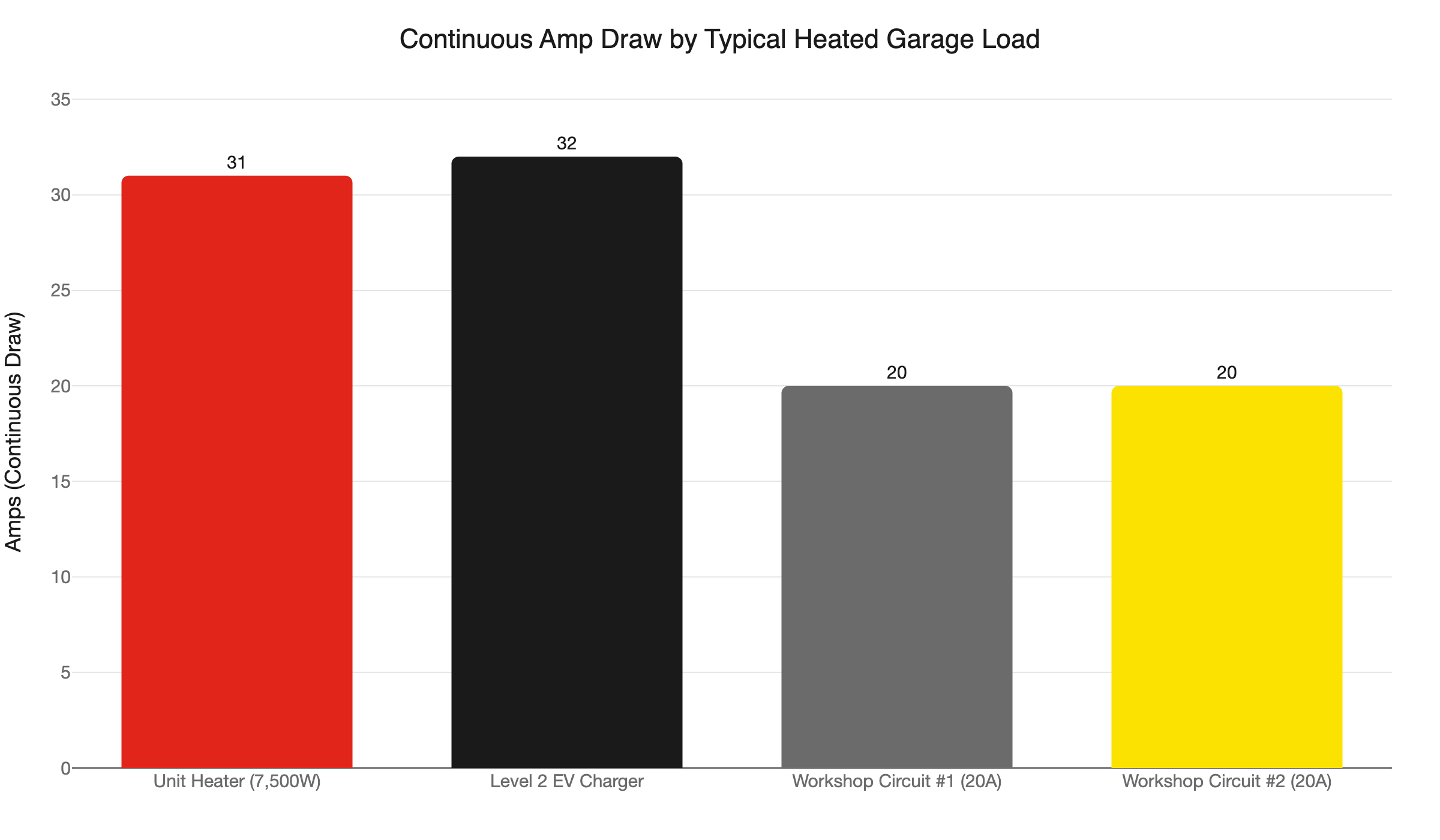
Short answer: A heated Twin Cities garage with an EV charger can draw over 100 amps continuously before you plug in a single tool. Generic national guides miss this entirely and recommend panels that are already maxed out for a real Minnesota setup.
A 7,500W electric unit heater draws about 31 amps on 240V continuously. The 2023 NEC requires 125% sizing for continuous loads, so that heater requires a dedicated 40A circuit. Now add a Level 2 EV charger running at 32A continuously. That is another 40A circuit.
Two 20A workshop circuits, one per wall, add another 40A of capacity to plan for. You are now at 120A of required circuit capacity before a welder, air compressor, or tablesaw enters the picture.
This is why serious Minnesota shops run 150A or 200A subpanels. A 60A panel is insufficient from day one. A 100A panel works for a basic shop with no EV charger and a smaller heater. For anything beyond that, size up now. Running a second feeder after the fact costs far more than buying the right panel today.
How Do I Size a Subpanel for a Detached Garage?
Short answer: Add up the amperage of every load you plan to run simultaneously, apply NEC’s 125% rule to all continuous loads, and leave at least 20% headroom for future circuits. Most heated Minnesota garages with an EV charger need 150A or more.
Start with your heat source. A 7,500W unit heater on 240V draws 31A continuously. At 125% sizing, it needs a 40A breaker. A 10,000W heater requires a 50A circuit. If you plan on radiant floor heat, add that load to your total.
Next, account for the EV charger. A standard Level 2 charger draws 32A continuously and requires a 40A breaker. Our EV charger installation guide covers what that dedicated circuit involves.
For workshop use, plan at least two 20A receptacle circuits, one per wall. Add a separate 20A circuit for lighting. If you own a welder, budget a dedicated 50A or 60A circuit. Air compressors over one horsepower benefit from a dedicated 20A or 30A circuit.
Total those circuit sizes. If you reach or exceed 100A, move to a 150A panel. If you are building a serious shop, step up to 200A. Panels are relatively inexpensive. Feeder cable is not. Pulling an undersized feeder now and replacing it in three years is the most expensive path you can take.
Which Office Issues Your Electrical Permit in Minnesota?
Short answer: It depends on your city. Roughly 40 Minnesota cities have adopted their own electrical inspection authority. In those cities, you file with the city, not the state Department of Labor and Industry (DLI).
Minneapolis and St. Paul are both local-authority cities. A homeowner in Maple Grove or Blaine files with the state DLI. A homeowner in Minneapolis calls the city permit office. Getting this wrong delays your project. In some jurisdictions, filing with the wrong authority triggers an investigation fee or requires a full refile.
Minneapolis manages its own permit and inspection process for garage projects. St. Paul’s Safety and Inspections office handles electrical permits and charges $85 per service plus $15 per circuit, with a minimum $85 and a $1 state surcharge.
When in doubt, look up your municipality in the DLI electrical inspector directory. It lists the authority having jurisdiction (AHJ) for your specific address.
Can I Pull My Own Electrical Permit in Minnesota?
Short answer: Yes, if you own a single-family homestead. Minnesota law allows the owner of a single-family homestead to pull the permit and perform the electrical work themselves. For any other residential occupancy type, a licensed contractor is required.
This is a meaningful Minnesota advantage that no national blog covers. National guides typically say “hire an electrician for all of it.” Minnesota law gives single-family homeowners a real option if they have the skills. That includes pulling the permit, doing the wiring, and scheduling the inspection.
That said, the inspection is not optional. All permitted electrical work in Minnesota requires an inspection before walls are closed or the panel is energized. Do not skip that step. A failed inspection creates more work than doing it correctly the first time.
If you are not confident in your wiring skills, the DIY route carries real risk. Our guide on DIY electrical dangers covers what commonly goes wrong when homeowners tackle electrical work without proper training.
What Does the Feeder Run Include?
Short answer: A 4-wire feeder (two hots, a neutral, and an equipment ground) run through conduit, buried at least 18 inches deep, connected to a new subpanel with its own grounding electrode system at the garage. Aluminum SER cable is a code-compliant, lower-cost option for long lot runs.
The feeder carries power from your main house panel to the new subpanel. Getting it right is the backbone of the project.
Four wires, not three. The 2023 NEC requires a 4-wire feeder to a detached structure. Three-wire feeders were permitted under older code editions but are not allowed for new work in detached buildings.
Wire material. Copper is the standard choice. Aluminum SER cable is a code-compliant alternative. Size it up one gauge and it can save hundreds of dollars on a long run across a Twin Cities lot. Use aluminum-rated terminals and anti-oxidant compound on all aluminum connections.
Burial depth. NEC Table 300.5 requires at least 18 inches of cover for conductors in conduit. Direct-burial cable without conduit requires 24 inches. Minnesota inspectors generally recommend conduit over direct burial. Conduit lets you repull wire in the future without digging up the yard. Frost heave is real here, and a deeper run protects against shifting.
Conduit type. PVC Schedule 40 is the most common choice for underground runs. It is affordable, easy to work with, and corrosion-resistant. Transition to rigid metal conduit (RMC) or electrical metallic tubing (EMT) for above-grade sections entering the house or garage.
Ground rods. NEC 250.32 requires a grounding electrode system at the detached structure. That means two 8-foot ground rods, driven at least 6 feet apart. Bond them together and tie them to the ground bus in the subpanel. The equipment ground in the 4-wire feeder is not a substitute for the ground rods. Both are required.
The Main Breaker Rule: Why Homeowners Buy the Wrong Panel
This is the most common reason a subpanel fails inspection in Minnesota. The rule is straightforward. If a subpanel contains more than 6 overcurrent devices, it requires a main breaker. That main breaker serves as the building disconnect under NEC 225.36 and 230.71.
Homeowners often buy a 12-space main lug only (MLO) panel because it is cheaper. The inspector counts 8 breakers and the job fails. There is no main breaker to serve as the building disconnect.
Buying the right panel the first time is cheaper than buying twice. If you plan 6 circuits or fewer, an MLO panel may work. Those breakers can collectively serve as the disconnect. If you plan 7 or more circuits, buy a panel with a main breaker.
Count the circuits in a typical heated garage: unit heater, EV charger, two workshop circuits, one lighting circuit. That is 5. Add one spare and you are at 6. Plan for growth and buy the main-breaker panel.
If you need help determining the right panel for your setup, our team handles electrical panel upgrades across the Twin Cities.
What Changed with GFCI Requirements Under the 2023 NEC?
Short answer: The 2023 NEC extended GFCI protection to all garage receptacles rated 125V through 250V, not just 120V outlets. Your 240V tool outlet and EV charger receptacle now require GFCI protection under Minnesota’s adopted 2023 NEC.
Under older code editions, only 120V receptacles in garages required GFCI protection. The 2023 NEC changed that. All receptacles in garages and accessory buildings from 125V through 250V now fall under the GFCI requirement.
That change catches homeowners and some electricians off guard. An inspector trained on older code may even miss it on the first walk-through. Wire it correctly from the start and save yourself the rework.
When Should You Start Planning the Project?
Short answer: If you want the garage powered before winter, file your permit in May or June. The Twin Cities ground is frozen from roughly November through March. Missing the trench window means losing the project season entirely.
This is a practical reality that no national guide covers. Minnesota’s freeze-thaw cycle directly affects when you can dig. A permit application in September gives you a narrow trench window before the ground closes.
Spring is also the busiest season for this type of work. Our schedule fills up fast between April and July. If you want our crew on-site before the ground hardens, call in March or April, not August.
In Minnesota, driving ground rods is also easier in late spring when the soil has thawed fully. Schedule that step accordingly and do not try to drive rods into frost.
What Does a Detached Garage Subpanel Installation Cost?
Short answer: Most Twin Cities homeowners pay between $1,500 and $3,500 for a complete detached garage subpanel installation. Longer feeder runs, larger panels, and heated concrete that requires core drilling push toward the higher end.
Here is a breakdown of typical cost components:
- Permit fees: St. Paul charges $85 per service plus $15 per circuit, with a minimum $85 and a $1 state surcharge. Minneapolis follows a similar structure. Budget $150 to $250 for permit costs in most Twin Cities municipalities.
- Panel and materials: A quality 200A main-breaker panel with breakers typically runs $300 to $500. Add feeder cable or conduit, ground rods, wire, boxes, and connectors.
- Labor: Licensed electricians in the Twin Cities typically charge $100 to $150 per hour. A complete subpanel installation with a 50- to 100-foot feeder run generally takes 6 to 10 hours. Plan for a two-person crew.
- Total: $1,500 to $3,500 covers most installations. Jobs with long lot runs or concrete obstacles run higher.
Financing is available for larger electrical projects. Ask us when you call.
Is Your Existing Garage Wiring Already Undersized?
Short answer: If your detached garage runs off a single 15A or 20A circuit from the house panel, it is almost certainly undersized for a heated workshop or EV charger. Warning signs appear well before a circuit fails completely.
Watch for these symptoms:
- Breakers tripping when you run two tools at once
- Lights dimming when the heater kicks on
- Outlets that feel warm to the touch
- A single circuit serving the entire building
These are not minor annoyances. They are signs that the wiring is overloaded and potentially unsafe. Our guide on signs you need an electrical panel upgrade walks through what to watch for and when to act.
A single overloaded circuit in a detached garage is also a fire risk. Heat builds in conductors that carry more current than they are rated for. Do not wait for a breaker to fail to take it seriously.
Get Your Garage Wired Right
A detached garage electrical subpanel installation is manageable if you know Minnesota’s rules. Most national guides skip the load math for heated garages, the 40-city AHJ split, and the main breaker rule. Those are exactly the gaps where projects go sideways.
We are locally owned and operated in the Twin Cities. We know which cities file with the DLI and which have their own inspection authority. We size panels for real Minnesota winters, not the “100A is usually enough” advice that does not account for a unit heater and an EV charger running at the same time.
We back every job with the UWIN(R) 100% satisfaction guarantee.
No malarky.
Call us at 763-200-5956 or book online. We will get your garage wired correctly. We will be there when we say we will. That is what America’s On-Time Electrician(R) does.
Frequently Asked Questions
Do I need a permit for a detached garage subpanel in Minnesota? +
What size subpanel do I need for a heated detached garage in Minnesota? +
Can I pull my own electrical permit in Minnesota? +
How deep does feeder conduit need to be in Minnesota? +
Need an electrician now?