
Kitchen Electrical Circuits Required by Code: MN Guide

Key Takeaways
- The NEC requires a minimum of two 20-amp small-appliance branch circuits for all countertop receptacles in the kitchen, pantry, and dining area.
- Those two circuits cannot supply any lighting. Kitchen lighting is a separate circuit requirement.
- Refrigerators, dishwashers, and permanently mounted microwaves each need a dedicated circuit.
- All kitchen countertop receptacles must have GFCI protection. All 120-volt kitchen circuits must have AFCI protection under the 2023 NEC.
- Minnesota adopted the 2023 NEC on July 1, 2023. A separate electrical permit is required for all kitchen electrical work. The building permit does not cover it.
- Bringing a pre-1975 Twin Cities kitchen up to code typically means five to seven new circuits. That almost always requires a panel upgrade.
- DLI published a 2026 NEC FAQ and Residential Inspection Checklist on July 6, 2026. A code transition may be coming. Ask your electrician which edition the inspector will enforce at the time of your rough-in.
The Mid-Renovation Moment Most Homeowners Don’t See Coming
The drywall is down. Insulation is on the floor. Your contractor is holding a flashlight at the electrical panel, counting breakers.
If you own a Twin Cities home built between 1945 and 1975, what they find is almost always the same. One or two 15-amp circuits feeding the entire kitchen. Maybe a second one labeled “kitchen/dining.” Sometimes just one circuit for everything.
That is the moment most homeowners learn what the kitchen electrical circuits required by code actually look like today. The number is not two. It is closer to seven or eight.
The good news: the wall is already open. This is the cheapest possible moment to fix it. The bad news: most older homes need a panel upgrade before those new circuits can even be added. This post explains every circuit the code requires, what each one does, what Minnesota law demands when you pull a permit, and what to expect if you are in the middle of that conversation right now.
What Kitchen Electrical Circuits Are Required by Code?
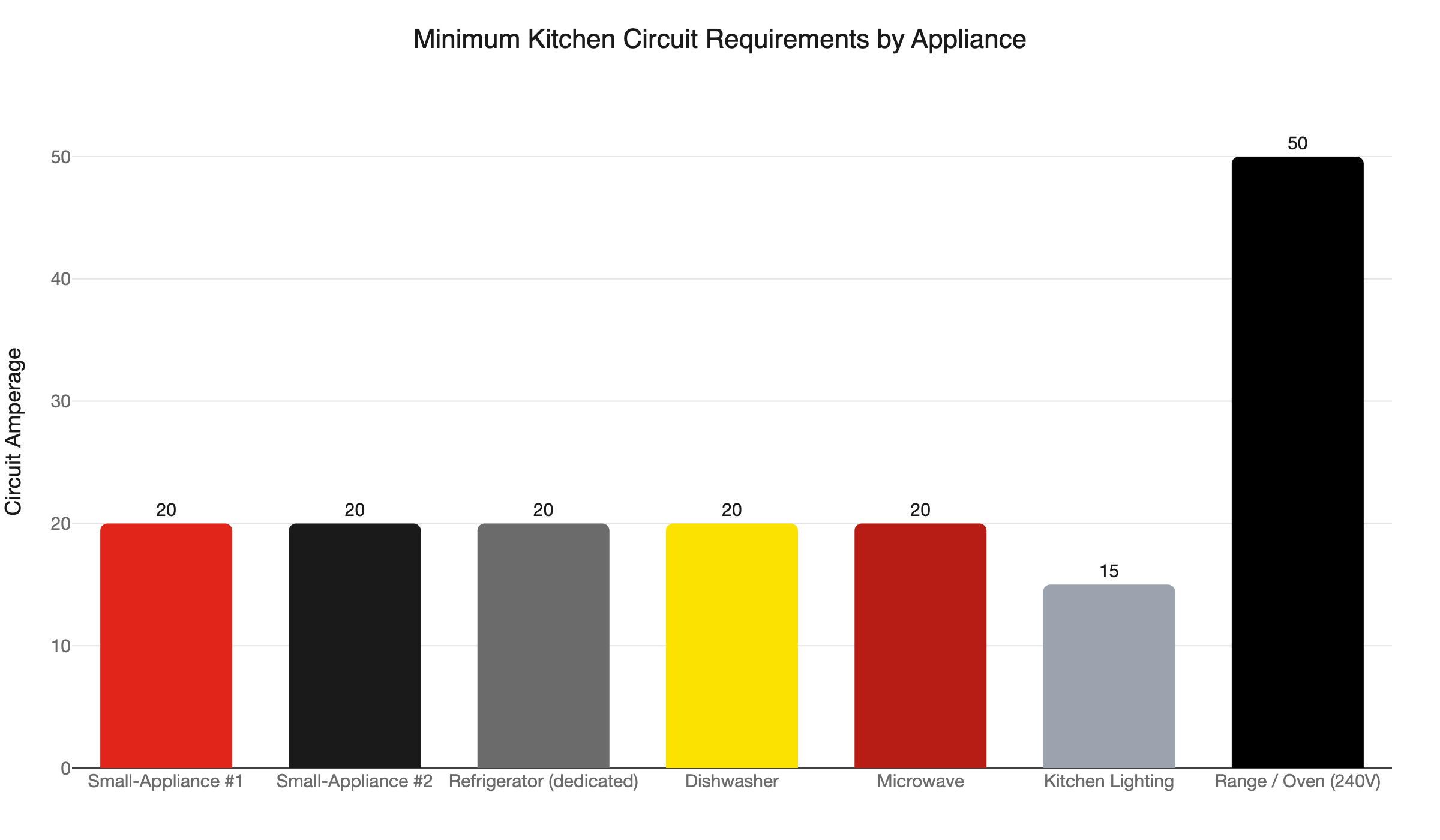
Current code requires a minimum of two 20-amp small-appliance circuits for counter receptacles, plus separate dedicated circuits for the dishwasher, permanently mounted microwave, and range or cooktop. A dedicated refrigerator circuit is expected by most inspectors. A fully outfitted modern kitchen ends up with seven to eight total circuits.
The baseline comes from NEC sections 210.11(C)(1) and 210.52(B). These sections establish two 20-amp small-appliance branch circuits as the floor, not the ceiling. You can always add more. You cannot legally go below two and pass inspection.
Here is what a fully code-compliant kitchen circuit list looks like for a typical all-electric kitchen:
- Two 20-amp small-appliance circuits for all countertop receptacles
- One 20-amp dedicated circuit for the refrigerator
- One 15- or 20-amp dedicated circuit for the dishwasher
- One 20-amp dedicated circuit for a permanently mounted microwave
- One 40- to 50-amp, 240-volt circuit for an electric range or cooktop
- One 15-amp circuit for kitchen lighting (sometimes two, depending on layout and size)
That comes to seven or eight circuits for a typical all-electric kitchen. A gas range eliminates the 240-volt circuit, but the small-appliance, refrigerator, dishwasher, and microwave requirements all remain.
Each circuit has a specific purpose. A circuit that serves multiple appliances on the list above is not a creative shortcut. It is a code violation that will not pass inspection.
The Two 20-Amp Small-Appliance Circuits: What You Can and Can’t Run on Them
The two small-appliance circuits are the backbone of the kitchen’s electrical system. Every countertop receptacle in the kitchen, adjacent dining area, and pantry must be on one of these two circuits. They must be wired with 12-gauge wire to support the 20-amp breakers. Your toaster, coffee maker, blender, air fryer, stand mixer, and instant pot all plug into outlets on these two circuits.
Two things consistently trip people up.
First: these circuits cannot supply any lighting. NEC 210.52(B)(2) makes this a hard prohibition. If under-cabinet lights or a peninsula pendant fixture is wired into one of the small-appliance circuits, the wiring will fail inspection. Kitchen lighting belongs on its own dedicated circuit. This is one of the most common mistakes we see when we pull a permit on an older home that has been partially updated over the years by a previous owner or unlicensed contractor.
Second: the pantry and dining area are included. The small-appliance circuit requirement extends beyond the kitchen counter. Any countertop receptacle in an adjacent pantry, breakfast nook, or dining area must also be fed from one of the two 20-amp small-appliance circuits. If you have a microwave on a pantry shelf or a coffee station in the dining room, the outlet supplying it falls under this rule.
On kitchen island outlets: The 2023 NEC made a notable change here. Island receptacles are no longer automatically required. Under the updated 210.52(C), island outlets are required only when the island meets certain size thresholds. Previous code cycles required island outlets categorically, regardless of island dimensions. Since Minnesota adopted the 2023 NEC on July 1, 2023, this updated conditional standard governs permits pulled in the state now.
If your contractor tells you island outlets are automatically required no matter what, ask which code edition they are referencing. If they are still working from pre-2023 language, that is a conversation worth having before rough-in day.
Do Refrigerators, Dishwashers, and Microwaves Each Need a Dedicated Circuit?
Yes, for dishwashers and permanently mounted microwaves. Both require their own dedicated circuits by code. Refrigerators sit in a gray area: the NEC technically allows a fridge on a shared small-appliance circuit, but most Minnesota inspectors expect a dedicated line. During a remodel, adding one is standard practice.
Here is the breakdown by appliance.
Refrigerator
The NEC permits a refrigerator on a shared 20-amp small-appliance circuit under 210.52(B). This surprises most homeowners, and honestly it surprises some electricians too. The flat statement “your fridge needs its own circuit” is so widely repeated that many people treat it as settled law. Technically, the NEC does not require it. Practically, a dedicated 20-amp circuit for the refrigerator is standard practice, expected by most Twin Cities inspectors, and the right call for any remodel.
Refrigerators cycle on and off throughout the day. When other appliances are drawing load on the same circuit during that compressor cycle, the combination increases the risk of a nuisance trip. If the breaker trips while you are out of the house for a weekend, everything in the freezer goes. A dedicated circuit costs relatively little during an open-wall remodel and removes that risk entirely. We always wire a dedicated refrigerator circuit. Plan for it.
Dishwasher
The dishwasher must have its own dedicated circuit. NEC 210.8 also requires GFCI protection on the dishwasher circuit, a requirement that has been in place since the 2017 NEC cycle. During the heating portion of the wash cycle, a dishwasher draws between 1,200 and 2,400 watts. No other load can share that circuit.
Permanently Mounted Microwave
A built-in or over-the-range microwave that is permanently mounted requires a dedicated 20-amp circuit. A countertop microwave that plugs into a wall outlet is a different case. It can draw from one of the small-appliance circuits. The line between these two scenarios is whether the unit is permanently mounted or portable. If it is hardwired or mounted to cabinetry, it gets its own circuit.
For more on how dedicated circuits protect your appliances and reduce the risk of tripped breakers, see our guide to dedicated circuits for household appliances.
What Is GFCI and AFCI Protection, and Where Does Code Require It in a Kitchen?
GFCI protection is required at all kitchen countertop receptacles and at any outlet within 6 feet of a sink. AFCI protection is required on every 120-volt kitchen circuit under the 2023 NEC. Both protections guard against different and serious hazards.
GFCI and AFCI are often mentioned in the same breath. They do different things, and your kitchen now requires both.
GFCI (ground fault circuit interrupter)
A GFCI protects against ground faults: situations where current escapes the intended path and can pass through a person. It monitors the balance between the hot and neutral conductors. When it detects as little as 5 milliamps of imbalance, it trips in under a tenth of a second. That is fast enough to prevent most fatal shocks in a wet or damp environment.
NEC 210.8 requires GFCI protection at all kitchen countertop receptacles and at any outlet within 6 feet of the rim of a sink bowl. In a kitchen with multiple sinks, the 6-foot rule applies to each one. This covers most counter outlets in a typical kitchen layout.
A GFCI can be built into the outlet itself (the receptacle with the TEST and RESET buttons) or installed at the breaker. Either approach satisfies code. During a kitchen remodel, we often use a combination GFCI/AFCI breaker at the panel to satisfy both requirements with one device per circuit.
AFCI (arc fault circuit interrupter)
An AFCI protects against arc faults: the kind of sparking that occurs inside a wall, behind an appliance, or in a cord with a tiny nick in the insulation. Arc faults are a leading cause of residential electrical fires. Unlike a standard breaker that trips only when current exceeds its rating, an AFCI monitors for the specific electrical signature of arcing and trips before a fire can start.
The 2023 NEC requires AFCI protection on all 15- and 20-amp, 120-volt kitchen circuits. Since Minnesota adopted the 2023 NEC on July 1, 2023, this requirement applies to every kitchen permit pulled in the state. Expect AFCI breakers in the panel for every kitchen circuit during a remodel. Inspectors check for them.
For a full breakdown of GFCI requirements throughout your home, see our post on GFCI outlet requirements explained.
What Does Minnesota Law Require for Kitchen Electrical Work?
Minnesota requires a separate electrical permit before kitchen wiring begins. All work must be performed by a licensed, bonded, insured contractor unless the homeowner files a signed affidavit with DLI. Rough-in wiring must be inspected before walls are closed.
The permit process matters as much as the code specifications themselves.
The separate electrical permit
A separate electrical permit from DLI is required for kitchen electrical work. The building permit your general contractor pulls does not cover the electrical scope. These are separate permits with separate inspection processes. If your GC or kitchen designer has not mentioned this, ask directly before the project timeline is finalized.
The permit must be issued before rough-in work begins, not after. A contractor who wires first and permits later puts you at real risk. An inspector can require the work to be torn out and redone. That cost falls on you, not the contractor.
Licensed contractors only
Minnesota law requires all electrical work to be performed by licensed, bonded, insured contractors. There is a homeowner exemption, but it requires filing a signed affidavit with DLI affirming that you own and occupy the residence as your primary home. If you are hiring a contractor, verify their license is current before work starts. License lookups are available through DLI directly.
The rough-in inspection
This is the step that costs homeowners the most when it gets skipped. The rough-in inspection must occur before any wiring is concealed behind drywall or insulation. If the walls close before the inspector signs off, you bear the full cost of cutting drywall back open. Andover, Bloomington, and Coon Rapids inspection checklists all state this explicitly, and the standard holds across every jurisdiction in the metro.
Your electrician should schedule the rough-in inspection as a line item in the project plan, not as an afterthought. Do not let GC schedule pressure push drywall ahead of the electrical inspection.
For a complete walkthrough of the Minnesota permit process, see our post on electrical permits in Minnesota.
Why Do Older Twin Cities Kitchens Fall So Far Short of Current Code?
Homes built in the Twin Cities between 1945 and 1975 were wired when kitchens ran a handful of modest appliances. Current code requires seven or more circuits. Bridging that gap almost always requires a panel upgrade.
The older housing stock across Minneapolis, St. Paul, Bloomington, Brooklyn Park, Woodbury, Blaine, and Maple Grove was built at a time when the kitchen held a refrigerator, a stovetop percolator, and a toaster. Total kitchen load was modest. The wiring reflected that reality, and nothing in the code of that era pushed back.
Today’s kitchen is a different machine entirely. A refrigerator, dishwasher, built-in microwave, electric range, garbage disposal, and a countertop of plug-in appliances run simultaneously throughout the day. The seven-plus circuits that current code requires represent an enormous jump from the one or two circuits that were standard in homes from that era.
The practical consequence shows up the moment you open the wall. A 100-amp service panel with two open slots cannot accommodate five to seven new 20-amp circuits. You either need a panel upgrade to 200 amps or a subpanel dedicated to the kitchen load. This is not optional. You cannot add circuits that do not fit in the panel. And a 100-amp panel that was already 50 years old when you bought the house is often due for replacement on its own merits regardless of the kitchen remodel.
This is why the mid-renovation discovery carries so much weight. The moment your contractor counts the breakers and sees two 15-amp feeds for the whole kitchen, you are making two decisions at once: which circuits to add, and whether the panel can support them. Both decisions are far easier to make while the wall is open and the project is already in motion. Circling back to the panel after the kitchen is finished means cutting into new drywall. That is always more expensive than doing it right the first time.
Is the 2026 NEC Going to Affect My Kitchen Remodel?
Minnesota’s DLI published a 2026 NEC FAQ and Residential Inspection Checklist on July 6, 2026, signaling that a code transition is being prepared. Minnesota currently enforces the 2023 NEC. If your permit gets inspected under the 2026 edition instead, some requirements could differ. Ask your electrician which edition the authority having jurisdiction is enforcing at your inspection date.
Minnesota adopted the 2023 NEC on July 1, 2023. The 2026 NEC FAQ and 2026 Residential Inspection Checklist from DLI, published on July 6, 2026, indicate the state is actively preparing for the next code transition.
If your kitchen remodel is planned for late 2026 or into 2027, it is worth a direct conversation with your electrician about which edition the inspector will be enforcing at the time of your rough-in. Projects permitted and inspected under the current enforcement window fall under the 2023 NEC. Projects that extend past a new adoption date may not.
No malarky: the exact adoption date has not been confirmed as of this writing. But a locally owned shop that works in Minnesota every day tracks DLI communications as part of doing the job right. If your electrician is not aware of the 2026 NEC FAQ, that is worth noting.
Ready to Get Your Kitchen Circuits Done Right?
A kitchen remodel is the single best window to upgrade your home’s electrical system. The wall is already open. The panel is accessible. Adding circuits during a remodel costs far less than cutting back into finished drywall after the project is closed out.
Our team at Northern Mister Sparky is locally owned and operated in the Twin Cities. As America’s On-Time Electrician(R), we handle every step: permit application, rough-in, inspection coordination, and final connections. Every job is backed by the UWIN(R) 100% satisfaction guarantee.
If you are mid-demo right now, or if you are planning a kitchen remodel for later this year, call us at 763-200-5956 or book online. We will assess your panel capacity, map every circuit your kitchen requires, and make sure the rough-in is inspected before a single sheet of drywall goes back up.
Frequently Asked Questions
How many circuits does a kitchen need by code? +
Does a refrigerator need its own circuit in Minnesota? +
Do I need a permit for kitchen electrical work in Minnesota? +
What is AFCI protection and does my kitchen need it? +
Can a small-appliance circuit supply kitchen lighting? +
Need an electrician now?