
Cost to Install a Light Fixture: Twin Cities Guide

Key Takeaways
- A simple flush-mount swap runs $70 to $250, all-in, nationally. Twin Cities labor lands toward the higher end.
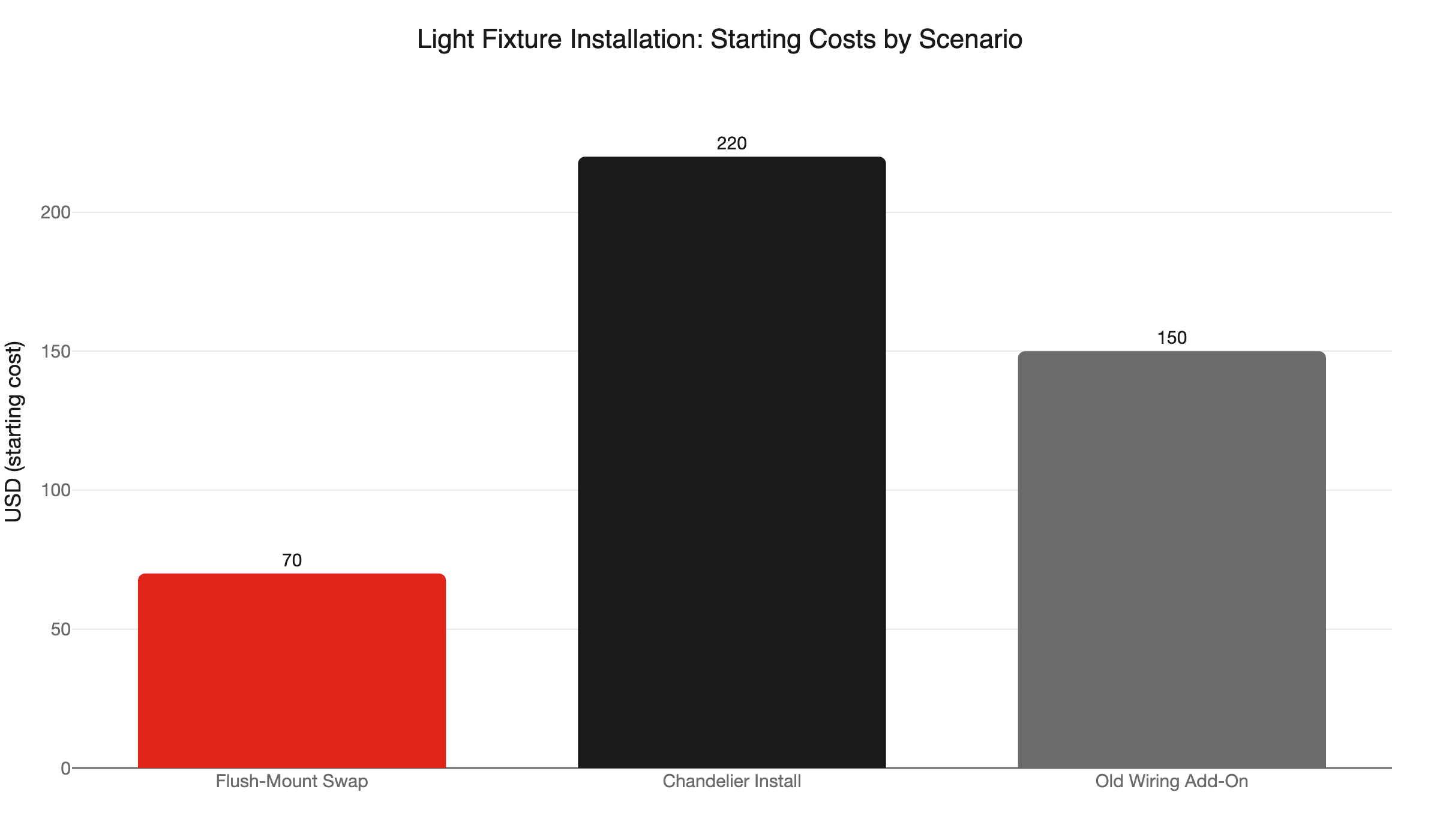
- Chandelier and heavy pendant installations start at $220 and can reach $3,400.
- An unmarked ceiling box defaults to a 6-pound weight limit under the National Electrical Code. Most fixtures weigh more than that.
- Minnesota requires a permit for any fixture replacement, including a direct like-for-like swap.
- Pre-1950 homes in Minneapolis and St. Paul commonly have plaster ceilings, ungrounded wiring, or knob-and-tube circuits. These change the scope and the price.
- The 2026 National Electrical Code takes effect in Minnesota on August 17, 2026.
- Our team assesses the box, the wiring, and the fixture weight before quoting. Call 763-200-5956 or book online.
You bought the fixture. It is sitting in the box. When the electrician arrives, the first thing they look at is not the fixture. It is the ceiling above where it will hang.
That is not a stall. That is the job.
The ceiling box is the metal housing anchored to a joist or a brace above your drywall. It is what the new fixture will hang from. It determines the weight the installation can safely carry and what the wiring looks like behind it. Understanding that sequence helps you read any quote you receive on the cost to install a light fixture.
What Does It Cost to Install a Light Fixture?
A flush-mount swap in a home with modern wiring and a rated ceiling box runs $70 to $250, all-in, nationally. Chandelier installations range from $220 to $3,400 depending on weight and complexity. Discovering old or ungrounded wiring adds $150 to $300 or more.
Those national price ranges give you a useful starting frame. They do not account for two factors that shape most Twin Cities jobs: the condition of the ceiling box and the age of the wiring behind it. Labor in the Minneapolis-St. Paul market runs toward the top of the national range. Homewyse cost data that includes Twin Cities-adjacent figures confirms that labor in this market runs above the national midpoint.
National pricing guides also aggregate across markets with very different housing stock. A $70 flush-mount install assumes a quick swap with no complications. In Minneapolis and St. Paul, the electrician often finds plaster ceilings, an unmarked box, or ungrounded wiring baked into the housing stock. Those conditions are not unusual. They are the norm in older neighborhoods.
Here is how the cost tiers stack up on a typical job:
Flush-mount swap, modern home. The electrician removes the old fixture. They check the box rating, verify the wire gauge, connect the new fixture, and test it. This is a clean, contained job in a home with labeled boxes and romex wiring.
Flush-mount swap, box replacement required. The existing box is unlabeled, cracked, or anchored to drywall alone. The electrician installs a rated expanding brace through the existing ceiling hole. No ceiling patching required in most cases. The scope is wider, and so is the price.
Chandelier or heavy pendant. Weight and ceiling height drive cost here. A chandelier approaching or exceeding 50 pounds requires a higher-rated box or an independent structural support. Access to the space above the ceiling matters.
Old wiring found at the box. If the circuit feeds from knob-and-tube or aluminum wiring, the job scope shifts. Minnesota does not allow adding new loads to knob-and-tube circuits. That means replacing the circuit, not just the fixture.
Why Does the Electrician Check the Box Before Quoting?
The box is a structural component, not just a wire hub. It must be rated to carry the fixture’s weight. An unmarked or unlabeled ceiling box defaults under the National Electrical Code to a 6-pound limit. Most ceiling fixtures weigh more than that.
A typical flush-mount fixture weighs 8 to 15 pounds. That is already over the default limit of an unmarked box. Many chandeliers and heavy pendants weigh considerably more.
A fixture can work loose over time when the box is not rated for the load. Vibration from foot traffic above, thermal cycling through Minnesota winters and summers, and normal structural settling all stress the connection. It is a preventable failure.
The electrician looks for two things. First, a weight rating stamped or labeled on the box itself. Second, how the box is physically anchored. A box screwed into a ceiling joist is a different situation from a box held to drywall alone.
Boxes labeled “For Fixture Support” per UL White Book standards are rated for fixtures up to 50 pounds. Anything heavier requires a listed, higher-rated box or an independent mounting support that carries the load around the box entirely.
One useful distinction: ceiling fan boxes are a separate category from lighting boxes. Fan boxes must handle dynamic load - the vibration and torque a motor produces over time. A lighting box cannot do that job, even a 50-pound rated one. If a ceiling fan was removed from this location previously, the fan box left behind may work fine for a new light fixture. The reverse - using a lighting box for a new ceiling fan - is a code violation. See our ceiling fan installation guide for the full breakdown.
The 50-Pound Rule: What NEC 314.27 Actually Says
NEC 314.27(A)(2) sets the baseline: a ceiling outlet box used to support a luminaire must be capable of supporting at least 50 pounds. If the box carries no weight rating, the code treats it as rated for 6 pounds only.
That default is conservative by design. If the box was never tested or listed for fixture support, the safest assumption is the lowest load it could plausibly carry. Six pounds is lighter than almost any ceiling fixture sold today.
This matters in the field because many ceiling boxes installed before the early 1990s carry no marking at all. They may be structurally fine. But without a label, the electrician cannot certify them as code-compliant for a fixture that weighs more than 6 pounds. Replacement is required by code, not optional.
For fixtures over 50 pounds, the code goes further. A listed box rated for higher loads, or an independent support structure that carries the fixture weight without relying on the box, is required. This applies to large chandeliers, heavy statement pieces, and oversized pendants.
The NEC provides detailed guidance on how boxes must be listed and marked for luminaire support. “Listed” means a recognized testing laboratory has evaluated the box for that specific application. A box that is merely stamped “ceiling box” without a fixture-support listing does not qualify.
The practical step for any homeowner: check the fixture’s listed weight in the product specs before the electrician arrives. Compare it to the rating stamped on your existing ceiling box. That one check tells you whether the job stays simple or whether a box swap is coming.
Does Minnesota Require a Permit to Replace a Light Fixture?
Yes. Minnesota requires a permit for any electrical installation or replacement, including a direct like-for-like fixture swap. The permit fee is $25 plus a $1 surcharge. The minimum inspection fee for a one-family home is $226.
Homeowners can legally perform electrical work on their own occupied single-family home in Minnesota. The permit and inspection are still required regardless of who does the work. The inspector verifies the connection is safe, the box is properly rated, and the work meets current code.
Homeowners who self-perform under the Minnesota homeowner permit provision face the same inspection as any licensed electrician would. The inspector looks at the work, not at who did it. A DIY fixture swap that passes inspection is as code-compliant as one an electrician performed. The risk in the DIY path is work that does not pass - and the cost to correct it after the fact.
Skipping the permit does not save money. It creates a disclosure obligation when you sell the home. It can also complicate an insurance claim if the repair site is later involved in a wiring problem.
The Minnesota Department of Labor and Industry adopted the 2023 NEC statewide on July 1, 2023, without local amendments. The 2026 NEC takes effect in Minnesota on August 17, 2026 - three weeks from today. Projects starting after that date will be inspected under the updated code. Our team tracks these transitions as standard practice.
When you hire a licensed electrician, the permit and inspection process is handled for you. It is part of the quote, not an add-on. Our post on electrical permits in Minnesota covers what inspectors actually check and what to expect on inspection day.
What Do Pre-1950 Twin Cities Homes Add to the Job?
Minneapolis and St. Paul neighborhoods built before 1950 commonly have plaster-over-lath ceilings, ungrounded two-wire circuits, and knob-and-tube wiring. Each condition adds labor. In combination, they can turn a fixture swap into a circuit replacement.
These are not edge cases in the Twin Cities. South Minneapolis, Linden Hills, St. Paul’s Summit Hill, Merriam Park, and similar neighborhoods were built largely between 1910 and 1945. A fixture swap in a 1928 bungalow is a fundamentally different job than the same swap in a 1985 rambler.
Plaster-over-lath ceilings. Plaster is dense and brittle. Electricians work through the existing box opening whenever the canopy size allows. Cuts that go wider require patching, which is a separate trade. Specialized access methods for plaster work add labor that national pricing guides do not reflect.
Ungrounded wiring. Older two-wire circuits lack a ground conductor. Modern fixtures are designed to connect to a ground. The electrician can install a GFCI device to provide protection without a physical ground wire, or run a new ground conductor back to the panel. Both are code-compliant solutions. Your electrician should quote both options so you can choose based on budget and your longer-term plans for the circuit.
Knob-and-tube wiring. Knob-and-tube wiring is common in Twin Cities homes built before 1940. It has no ground conductor and no insulation jacket between wires. Minnesota does not allow adding new loads to knob-and-tube circuits. If the fixture box feeds from a knob-and-tube run, the circuit must be replaced from the panel forward. That is a circuit replacement job, not a fixture swap. The price difference is significant.
The combination of plaster ceilings and knob-and-tube wiring is the most labor-intensive scenario a fixture job can surface. Both conditions independently affect access and scope. Together, they can turn a contained job into a multi-hour circuit replacement. A quote that explicitly acknowledges both possibilities protects you from an unexpected invoice.
Our full post on knob-and-tube wiring replacement covers what the replacement process involves and what to expect from start to finish.
What Triggers the Biggest Cost Increases?
Three conditions reliably push a fixture installation past the initial estimate: an unlabeled or undersized ceiling box, old or ungrounded wiring at the box, and a fixture that weighs more than the box can support.
Unlabeled box. This is the most common cost surprise. The electrician opens the canopy, sees no weight rating, and checks the fixture at 12 pounds. The old box must be replaced with a rated one. An expanding brace bar - installed through the existing opening without ceiling damage - resolves this cleanly in most cases. It is a real addition to the scope, but it is a contained one.
Ungrounded circuit. Adding GFCI protection to an ungrounded circuit is straightforward. Running a new ground conductor to the panel takes more time and material. Either way, the work is documented and inspected. Addressing it at fixture replacement time is the right moment. An undisclosed ungrounded outlet is a common finding during pre-sale electrical inspections, and correcting it then costs more than correcting it now.
Old wiring at the box. If the circuit feeds from knob-and-tube wiring, the job scope expands to circuit replacement. A professional electrician stops, shows you the finding, and gets your approval before continuing. This is the house revealing a condition that existed before the electrician arrived. It is not the electrician making the job bigger.
Heavy fixtures. A piece over 50 pounds requires a higher-rated listed box or an independent mounting strap anchored to the structure above. This is a straightforward addition on a well-accessed ceiling. It is more involved above a 12-foot great room with limited attic access.
One practical note: if a mid-job condition is discovered, the right move from any professional is to pause, explain the finding, and give you a revised number before continuing. That is standard practice. If that conversation does not happen on its own, ask for it.
How to Get a Quote That Covers the Full Job
The most useful thing you can do before booking: find the fixture weight in the product specs and compare it to the weight rating stamped on your existing ceiling box, if one is there at all. That one check tells you a great deal about what the quote is likely to include.
Before the appointment, note the following:
- The fixture weight, from the product specs or the packaging
- The approximate age of your home
- Whether the ceiling is drywall or plaster
- Whether the existing ceiling box has a weight rating stamped on it
- Whether any prior electrical work surfaced old or ungrounded wiring
Bring the fixture to the appointment if you can. The electrician can check the weight against the existing box rating in the first few minutes. That prevents a mid-job revision on scope.
A few questions worth asking when you call: Does the quote include a box assessment? What happens if old wiring is found? Is the permit and inspection included? A team that answers those questions clearly before starting is the difference between a fixed-price experience and an open-ended invoice.
Northern Mister Sparky is locally owned and operated in the Twin Cities. As America’s On-Time Electrician(R), we serve Minneapolis, St. Paul, Bloomington, Brooklyn Park, Woodbury, Blaine, Maple Grove, Plymouth, and the surrounding metro. Every quote we give includes a box assessment. If the box needs to be replaced or upgraded, we tell you before we start - not after. We back every job with the UWIN(R) 100% satisfaction guarantee.
Call 763-200-5956 or book an appointment online. We will check the box, quote the job honestly, and get you scheduled at a time that works.
Frequently Asked Questions
Do I need a permit to replace a light fixture in Minnesota? +
What is the weight limit for a standard ceiling light box? +
Why does my electrician check the ceiling box before giving a price? +
Need an electrician now?