
Electric Meter Box Replacement Cost in the Twin Cities

Key Takeaways
- The homeowner owns the meter box. Xcel Energy owns the service drop (the wires from the pole to your building) and the glass meter itself.
- The meter socket, weatherhead, riser, mast, and service entrance cable are all the homeowner’s responsibility to repair and replace.
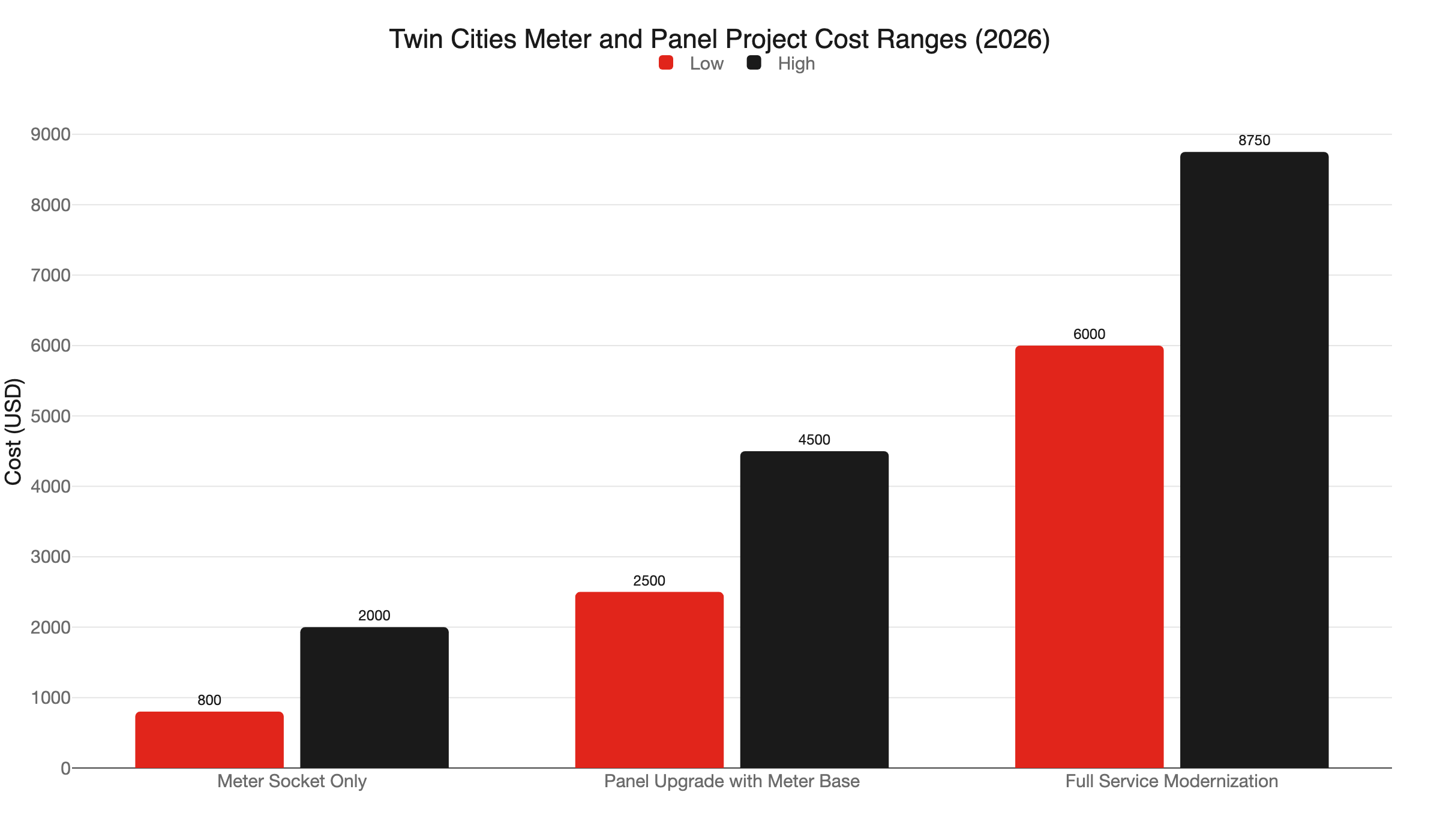
- Meter socket replacement only: $800 to $2,000 in the Twin Cities.
- 100A to 200A panel upgrade with new meter socket, permit, and inspection: $2,500 to $4,500.
- Full service modernization: $6,000 to $8,750 or more.
- Xcel Energy offers a rebate up to $1,500 on qualifying panel upgrades. The federal 25C tax credit expired December 31, 2025 and does not apply to new projects.
- Minnesota electrical permits are issued by the state, not by your city.
- Minnesota adopts the 2026 NEC on August 17, 2026. Permits filed on or after that date must comply with the new code.
The Meter Box Question That Catches Twin Cities Homeowners Off Guard
You get a quote for electrical work and the number surprises you. Your electrician says the meter box has to come out as part of the job. Your first thought is reasonable: isn’t that Xcel Energy’s responsibility?
The short answer is no. The reason behind that answer explains every line of the quote you received.
This post covers who owns the meter box, why it almost always gets bundled with a panel upgrade, and what that work actually costs in the Twin Cities in 2026. It also covers the Xcel rebate most homeowners miss, a permit detail unique to Minnesota, and a code change taking effect in 20 days that affects projects being scheduled right now.
Who Owns the Meter Box? It Is Not Xcel.
Xcel Energy owns the glass meter and the service drop, the overhead wiring from the utility transformer to your weatherhead. Everything past that connection, including the weatherhead, mast, riser, meter base, and service entrance conductors, belongs to the homeowner.
Xcel’s Standard for Electric Installation and Use states it plainly: “Safety and compliance with applicable electrical codes on the customer’s side remain the responsibility of the customer and authorities having jurisdiction.”
Here is the ownership split, clearly laid out:
Xcel Energy owns:
- The service drop (overhead lines from the transformer or pole to your building)
- The glass meter itself
You, the homeowner, own:
- The weatherhead (the curved fitting at the top of the mast)
- The riser and mast (the pipe running up your exterior wall)
- The meter base, also called the meter socket or meter can
- The service entrance cable (wires from the weatherhead down to your main panel)
- The main panel and everything inside your home
This split applies across most of the Twin Cities metro, where Xcel handles electric service. CenterPoint Energy is a separate utility that handles gas service in Minnesota. CenterPoint owns the gas service line from the main to the meter and the gas meter itself; the homeowner’s responsibility starts at the meter outlet on the gas side. The two utilities do not overlap. If your question is about an electric meter box, you are dealing with Xcel.
What Does Electric Meter Box Replacement Cost in the Twin Cities?
Meter socket replacement alone runs $800 to $2,000 in Minnesota. A 100A to 200A panel upgrade with a new meter base, permit, and inspection falls between $2,500 and $4,500 for most jobs. A full service modernization, covering riser, socket, cable, grounding, disconnect, and new panel, runs $6,000 to $8,750 or more.
The national cost guides that dominate search results for this topic cite $500 to $2,100 for meter socket replacement. Those are national averages. Minneapolis electrical costs run roughly 5% above the national average, and Minnesota code requirements add permit and inspection costs that most generic articles do not factor in.
Here is what local Twin Cities contractors actually report for 2026:
Meter socket or mast replacement (like-for-like, no amperage change): $800 to $2,000, per BH Electric. This covers replacing a damaged or deteriorated socket at the same amperage, without upgrading the full service entrance.
100A to 200A panel upgrade with new meter base, Xcel coordination, permit, and inspection: $2,500 to $4,500. This is the most common scope for Twin Cities homeowners adding an EV charger, finishing a basement, or addressing a capacity issue flagged during a home inspection.
Full service modernization: $6,000 to $8,750 or more, per Great Northern Electric. This covers the full run: riser, meter socket, service entrance cable, updated grounding and bonding, external emergency disconnect, surge protection, and a new panel. Most pre-1970 homes in Minneapolis, St. Paul, and the inner-ring suburbs require this scope.
Final costs depend on your current amperage, the condition of existing hardware, the panel’s location in the home, and how much of the service entrance assembly must be replaced. An in-person estimate is the only number that applies to your specific house.
Why Does the Meter Box Get Bundled With a Panel Upgrade?
A meter socket is amperage-rated. A 100-amp socket cannot safely carry 200 amps of current. When you upgrade from 100A to 200A service, the meter socket must be replaced with a 200A-rated unit. This is a code requirement, not upselling.
The meter socket is not a passive pass-through. It is a rated component, just like a breaker or a wire gauge. Running 200 amps through a socket rated for 100 amps creates a fire hazard. The service entrance cable, which runs from the weatherhead down to your panel, is also sized for the original ampacity. It must be replaced at the same time.
This is why electricians quote a “panel upgrade” as a full service entrance project: riser, socket, cable, grounding, disconnect, and panel. These components function as one continuous electrical system. They cannot be left mismatched at different amperage ratings.
If your existing service entrance is already 200A and the socket is in good condition, a simple panel replacement may be possible without pulling the full service entrance. Your electrician will confirm that during the site visit.
For more on what separates a panel swap from a full upgrade, see our post on signs you need an electrical panel upgrade.
What Triggers a Meter Socket Replacement?
The meter socket must be replaced when you change service amperage, when physical damage or corrosion is found, when the socket rating falls below the current service level, when service equipment is relocated, or when any major component of the socket assembly is replaced.
Xcel’s MN/ND/SD Service Guide triggers replacement for “replacing major components or any integral part of a meter socket, current transformer cabinet, riser, mast, line or load-side conductor, or relocating electric service equipment.”
In practical terms, that covers:
- Upgrading from 100A to 200A service, or any amperage change
- A cracked, corroded, or physically damaged socket housing
- An inspector flagging an undersized socket for the service currently in place
- Moving the service entry point on the building
- Storm or ice damage to the mast, weatherhead, or riser
That last trigger deserves extra attention for Minnesota homeowners. Most Twin Cities homes built before 1990 have overhead service entrances. The weatherhead and mast take the full force of Minnesota winters: ice loading, freeze-thaw cycling, and thermal stress. These conditions degrade conduit seals and mast anchors faster than in warmer climates. If your service entrance has never been inspected, put it on the list.
Minnesota Permits and the NEC 2026 Code Change
Two things make Minnesota different from most states on electrical permits and code.
Permits are state-issued, not city-issued. In most states, you pull an electrical permit from your city or county. In Minnesota, the Department of Labor and Industry (DLI) issues electrical permits at the state level. Your contractor pulls the permit with the state. Your city does not issue it or track it separately. This affects who handles the inspection, the paperwork, and the timeline.
Minnesota adopts the 2026 NEC on August 17, 2026. That is 20 days from today. Permits filed before that date must comply with the 2023 NEC. Permits filed on or after August 17 must comply with the 2026 NEC. If you are getting quotes right now for service entrance work, ask your electrician which code window your permit will fall under. Ask that question before the estimate is signed, not after.
One requirement already standard under the 2023 NEC is the external emergency disconnect, mandated by NEC Section 230.70. This section requires the service disconnect to be at a readily accessible location, either outside the building or inside nearest the point of entrance. Older homes that have never had this added will need it as part of any service entrance job. It adds cost. It also adds real safety value: firefighters and first responders can cut power from outside without entering the building.
For a full walk-through of how Minnesota’s electrical permit process works, see our post on electrical permits in Minnesota.
What About Rebates and Tax Credits?
Xcel Energy offers a rebate up to $1,500 on qualifying panel upgrade projects in Minnesota. The federal 25C tax credit for electrical panels expired on December 31, 2025 and does not apply to new 2026 projects. A Minnesota state grant program exists on paper but has not launched as of today.
Xcel rebate (up to $1,500): This rebate applies to qualifying panel upgrade projects in Xcel’s service territory. Some contractors file the paperwork on the homeowner’s behalf, so ask about this specifically when you collect estimates. Confirm current amounts and eligibility directly with Xcel before the project starts, as program terms can change.
Federal 25C tax credit: This credit covered a portion of qualifying panel upgrade costs. It expired on December 31, 2025. If you completed a qualifying upgrade by that date, you can still claim it on your 2025 return via IRS Form 5695, per Rewiring America’s federal incentives guide. Projects starting in 2026 do not qualify.
Minnesota Residential Electrical Panel Upgrade Grant (MN Stat. 216C.45): This income-qualified program targets households at or below 150% of the area median income. It is designed to cover upgrades to 200A or full electrification capacity. As of late June 2026, the program is awaiting DOE approval with no published start date. Monitor the Minnesota Commerce Department energy programs page for updates.
For 2026 work, the Xcel rebate is the only active incentive worth building into your project budget. The others are either expired or unavailable.
The Xcel Coordination Step Most Articles Skip
Meter socket replacement requires Xcel Energy to pull the glass meter before work begins. After the work passes inspection, Xcel returns to re-seat it. This step is not optional, and it is not same-day.
Xcel controls the scheduling. Depending on Xcel’s workload and your availability, meter pulls can take several days to get on the calendar. Your electrician coordinates this, but the overall project window is longer than just the hours of labor. Plan for a realistic timeline. A same-week turnaround for this scope of work is not typical.
You will be without power during the work itself. For a full service entrance replacement, that usually means most of one business day. Plan accordingly if you have medical equipment, a home office, or other power-dependent needs during business hours.
A good contractor covers the Xcel coordination step during the estimate. They explain the full timeline, not just the labor portion. If they do not bring it up, ask.
Is Right Now a Good Time to Schedule?
Yes, with one timing note. Permits filed before August 17, 2026 fall under the 2023 NEC. Permits filed on or after that date must meet the 2026 NEC. If your project is ready to move, scheduling now locks in the current code window. That matters if your job is clean and straightforward under the 2023 rules.
Summer is also the most practical time for overhead service entrance work in Minnesota. The mast and weatherhead are accessible. There is no ice risk during installation. Work typically completes in a single business day without weather delays. If a panel upgrade or service entrance replacement has been on your list, the next few weeks are a good window to act.
If your home is still on 100A service and you are weighing whether to upgrade, see our post on 100-amp vs. 200-amp electrical service. It covers what the upgrade unlocks and what typically tips the decision.
If you have a damaged mast or weatherhead that needs attention on its own, our service mast repair service can handle that work outside of a full service upgrade timeline.
Get a Straight Answer on Your Meter Box
Electric meter box replacement cost in the Twin Cities is not a single number. It depends on your current amperage, the condition of the existing equipment, and the full scope of what needs to come out and go in.
What does not change: the meter box is yours to replace. Permits run through the state, not your city. The Xcel rebate is real money worth asking about. The NEC 2026 code transition affects permits filed in the next 20 days.
Northern Mister Sparky is locally owned and operated in the Twin Cities. As America’s On-Time Electrician(R), we show up when we say we will. We walk you through the full scope before any work starts. We handle the permit paperwork and Xcel coordination so you do not have to manage two separate phone queues.
Call us at 763-200-5956 or book online. We serve Minneapolis, St. Paul, Bloomington, Brooklyn Park, Woodbury, Blaine, Maple Grove, Plymouth, and the surrounding metro. Every job is backed by the UWIN(R) 100% satisfaction guarantee.
Frequently Asked Questions
Who owns the electric meter box in Minnesota? +
How much does electric meter box replacement cost in the Twin Cities? +
Does Xcel Energy pay for meter box replacement? +
Is there a rebate for a panel upgrade or meter socket replacement in Minnesota? +
Need an electrician now?