
Cost to Rewire a House in the Twin Cities Explained

Key Takeaways
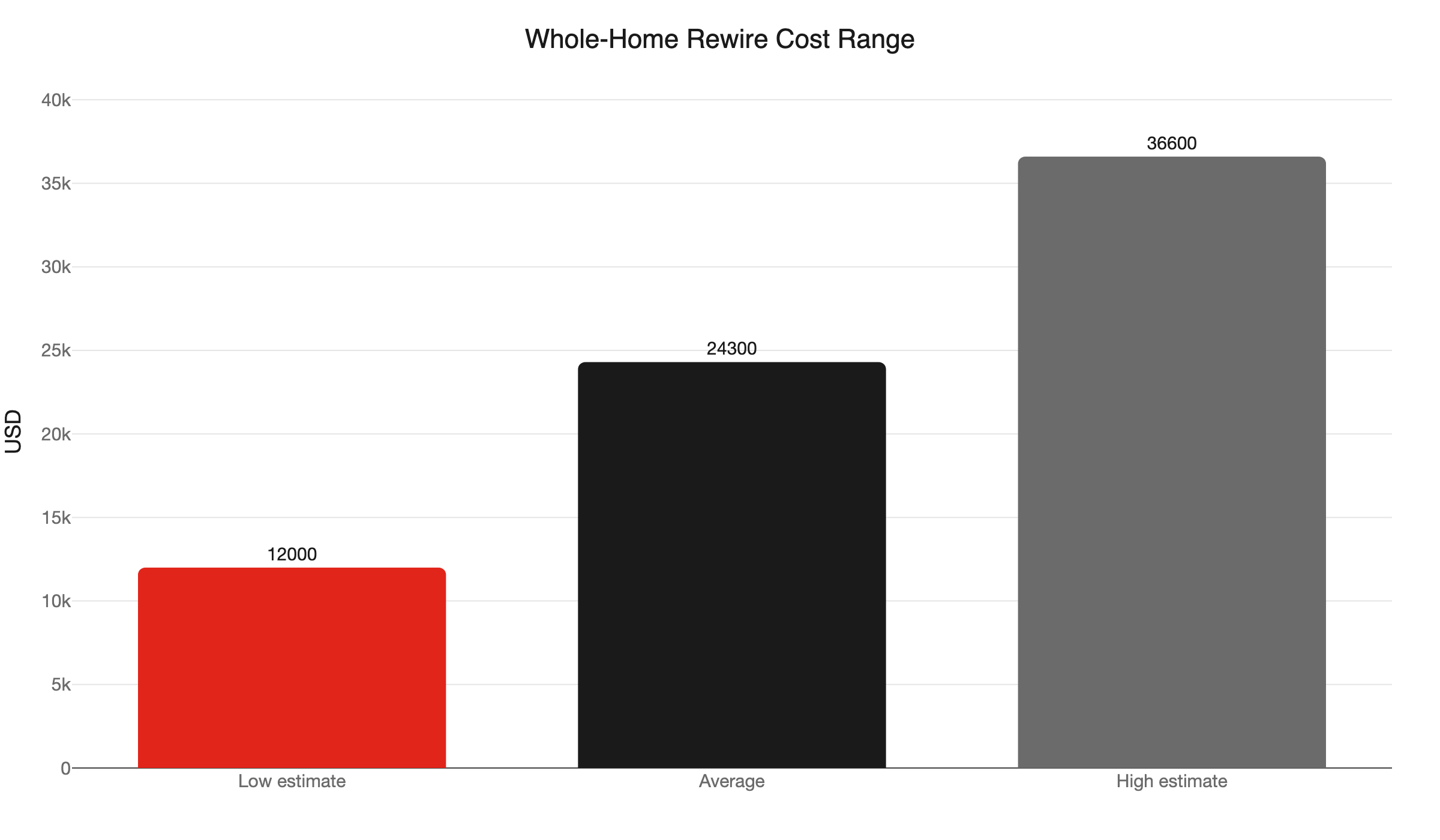
- A whole-home rewire runs $12,000 to $36,600, averaging about $24,300, or roughly $10 to $20 per square foot (Angi).
- Opening finished walls adds 25% to 30% to the job, and Twin Cities plaster repair costs far more than drywall (Angi).
- Knob-and-tube and pre-mid-1970s aluminum branch wiring are the classic local triggers for a rewire (CPSC).
- Any Minnesota permit filed on or after July 1, 2023 must meet the 2023 National Electrical Code (MN DLI).
- Xcel Energy pays a rebate up to $1,500 when you increase panel amperage (Xcel Energy).
- A phased, room-by-room plan turns a $20,000-plus job into fundable steps.
What does it cost to rewire a house in the Twin Cities?
The cost to rewire a house here usually falls between $12,000 and $36,600, averaging around $24,300 (Angi). That works out to roughly $10 to $20 per square foot. Smaller or partial jobs run $2,000 to $20,000 (Angi). Your final number depends on wall access, panel size, and how old your home is. We are a locally owned and operated Twin Cities electrician, so our quotes reflect real Minnesota conditions, not a national calculator.
What actually drives the cost to rewire a house?
Four things move your quote more than anything else. First, wall access. Second, panel amperage. Third, home size and layout. Fourth, whether old wiring like knob-and-tube or aluminum is hiding in the walls. Twin Cities homes are old, so access and panel work tend to dominate the bill.
Here is how each factor plays out on a real quote:
- Wall access. Running new wire means reaching inside finished walls. Opening them completely adds 25% to 30% to the total (Angi).
- Panel amperage. Moving to the modern 200-amp standard adds $1,300 to $3,000 (Angi).
- Home size. More square footage means more circuits, more outlets, and more labor hours. Because the job is priced at roughly $10 to $20 per square foot, square footage is the single biggest swing between a small bungalow and a large four-bedroom (Angi).
- Old wiring. Knob-and-tube and aluminum branch circuits force a full rewire and add safety work, since every connection has to be brought up to current code.
Many older Minneapolis and St. Paul homes still run a 100-amp panel or a fuse box. A rewire is the right time to size that up, and it is often the moment the Xcel rebate comes into play. If your panel struggles today, read the signs you need an electrical panel upgrade before you plan the job.
Why does opening walls add so much to the bill?
Opening walls to run new wire adds 25% to 30% to the project (Angi). In older Twin Cities homes, those walls are plaster and lath, not modern drywall. Repairing plaster runs $80 to $200 per square foot, two to four times the cost of standard drywall (Angi).
That repair cost is the hidden driver most homeowners miss. The wire itself is not the expensive part. The labor to open plaster, fish new cable, then patch and refinish the wall is what grows the quote. Plaster does not cut clean like drywall either, so the patch work and refinishing take more skilled hours per opening. Large parts of Minneapolis and St. Paul are pre-1940 housing stock. That means plaster-and-lath is the rule, not the exception, and it is the number one reason a Twin Cities quote looks higher than an online estimate.
This is also why a phased plan often makes sense here. You limit plaster repair to one area at a time instead of gutting the whole house at once, which keeps each invoice smaller and your walls livable while the work moves through the home.
What forces a full rewire? Knob-and-tube and aluminum wiring
Two wiring types force the issue. Knob-and-tube is the oldest and has no ground. Pre-mid-1970s aluminum branch wiring is the other. Homes built before 1972 with aluminum connections are 55 times more likely to reach fire-hazard conditions at an outlet than copper-wired homes (CPSC). Those conditions include cover-plate screws hitting 300F or the connection sparking, which is exactly the failure you cannot see behind a wall.
Aluminum branch wiring is essentially a pre-mid-1970s problem. Homes built before 1965 rarely have it. It shows up in homes and additions wired from 1965 to the mid-1970s (CPSC). Knob-and-tube is older still and lacks the grounding that modern circuits require. Both are common in older Twin Cities neighborhoods, and both are strong reasons to rewire.
There is a financial angle beyond safety. Insurers and lenders in Minnesota often refuse or surcharge policies on knob-and-tube or aluminum branch wiring. That turns a someday project into a closing or renewal deadline. If you are buying, selling, or renewing coverage, the wiring can become the deal, and the timeline is set by the underwriter rather than by you. Our team handles this every week through our home wiring repair and replacement service.
How do Minnesota permits and inspections work?
Every electrical permit in Minnesota requires an inspection (MN DLI). Any permit filed on or after July 1, 2023 must meet the 2023 National Electrical Code (MN DLI). Homeowners can pull their own permit online, but a rewire for resale or insurance is typically done by a licensed contractor.
Minnesota adopts the National Electrical Code through Chapter 1315 of the State Building Code (MN DLI). The Authority Having Jurisdiction, either the state or your local city, sets the exact process. After a permit issues, homeowners receive inspection-request details by email (MN DLI).
Permit and inspection fees are real line items, so factor them into your budget. They also protect you. A passed inspection is proof the work meets code, which matters for insurance and for your buyer at closing. That paper trail is often what an insurer or lender wants to see before they will write or renew a policy on an older home. This is one reason a licensed rewire beats a weekend attempt. Compare that with the risks in our guide to common DIY electrical dangers.
Can the Xcel rebate lower the cost to rewire a house?
Yes, if the rewire includes a panel amperage upgrade. Xcel Energy Minnesota pays a residential electrical panel upgrade rebate covering full project cost up to $1,500 (Xcel Energy). You must increase amperage, for example from 100A to 200A. Replacing a broken same-size panel does not qualify.
The details matter, so read them before you count on the money. The work must be done by a Minnesota DLI-licensed electrician, and the rebate processes in about six to eight weeks (Xcel Energy). Because the panel is often the single most expensive line item on a rewire, this rebate takes a real bite out of the total.
No local competitor ties this rebate to a whole-home rewire, but the math is simple. If your rewire already needs a 200-amp panel, you may recover up to $1,500 of that cost. Since so many older Twin Cities homes still sit on a 100-amp panel or a fuse box, a lot of local rewires qualify without any extra work. We handle the paperwork as part of our panel upgrade service, so nothing gets left on the table.
Can you rewire a house in phases?
Yes. You do not have to gut every wall at once. A phased plan rewires the home circuit-by-circuit or room-by-room. That spreads a $20,000-plus project across a schedule you can fund, and it lets us tackle the highest-risk circuits first.
Phasing fits old Twin Cities homes especially well. With plaster walls, working one area at a time keeps repair costs contained instead of exposing the whole house. A smart sequence starts with kitchens, bathrooms, and any active knob-and-tube runs. Those carry the heaviest loads and the highest risk. Bedrooms and secondary spaces can follow on your timeline, and you can line the later phases up with your budget or a resale date.
This is the question most homeowners actually have, and few local sites answer it. The honest answer is that a rewire does not have to be one giant invoice. If your breakers trip under normal use, that is a good place to start. Our guide on why your circuit breaker keeps tripping explains what those trips are telling you.
Why does the quote look higher than the online calculators?
National calculators skip local reality. Minnesota charges 6.875% state sales tax on materials, which adds up fast on a whole-home wire run. Plaster repair, permit fees, and mandatory inspection also raise the local number above a generic estimate. A true Twin Cities quote reflects all of it, which is why it beats a one-size-fits-all figure.
Think of it this way. The online range gives you the wire and the labor in a modern, easy-access home. Your home may have plaster walls, an undersized panel, and old wiring that code now requires you to correct. Each of those is a real cost, and each is a reason to trust a local walk-through over a web form. We would rather show you the honest number than surprise you later. That is the no malarky way we work.
Who should do a whole-home rewire?
A rewire touches every circuit in your home, so it belongs with a licensed, insured electrician. Minnesota requires licensed work for resale and insurance rewires, and the Xcel rebate requires a DLI-licensed installer (Xcel Energy). A licensed crew also pulls the permit, meets the 2023 NEC, and passes inspection for you.
As a locally owned and operated Twin Cities team, we know the housing stock, the plaster, and the local inspectors. We back our work with the UWIN(R) 100% satisfaction guarantee, and as America’s On-Time Electrician(R), we show up when we say we will. You get national franchise standards with a neighbor who lives here.
Ready to price your rewire?
Get a real Twin Cities number instead of a national guess. Call 763-200-5956 or book online, and we will walk your home, flag any knob-and-tube or aluminum, and lay out a plan you can fund in phases. Ask about financing on larger jobs and the Xcel panel rebate when you call. We are here to make your home safer, on time, with no malarky.
Frequently Asked Questions
How much does it cost to rewire a house? +
Does knob-and-tube or aluminum wiring require a rewire? +
Can I get money back from Xcel for a rewire? +
Can a house be rewired in phases? +
Need an electrician now?