
Types of Electrical Outlets Every Twin Cities Home Needs

Key Takeaways
- Minnesota adopted the 2023 NEC on July 1, 2023, and it changed which outlets your home needs. (source)
- Every 15A and 20A receptacle that is installed or replaced must be tamper-resistant. (MN DLI checklist)
- GFCI protection now covers kitchens, garages, basements, laundry, outdoors, and any outlet within 6 ft of a sink or tub.
- AFCI protection is required in bedrooms, living rooms, family rooms, dining rooms, hallways, and most living spaces.
- Outlets are room-specific. A bedroom outlet will fail a kitchen inspection, and a kitchen outlet is overkill in a hall.
- You can pull your own permit only on a single-family home you own and occupy.
The Types of Electrical Outlets in Your Twin Cities Home, Explained
The types of electrical outlets in your home are not created equal, and Minnesota code now treats them very differently by room. As a locally owned and operated Twin Cities electrician, our team installs and replaces outlets to the 2023 NEC every week. This guide breaks down every outlet type, which room needs which, and what your house must have to pass a Minnesota inspection.
Minnesota adopted the 2023 NEC on July 1, 2023, and it rewrote the rules for GFCI, AFCI, tamper-resistant receptacles, and outdoor outlets. (MN DLI) If your home was wired before that date, your outlets may still work. They may not pass an inspection or a sale.
That matters when you sell, refinance, finish a basement, or add an EV charger. It also matters for safety. Modern outlets stop shocks, prevent fires, and handle loads the old ones were never built for.
What Are the Main Types of Electrical Outlets?
The main types are the standard 15A duplex, the 20A T-slot, GFCI, tamper-resistant (TR), weather-resistant (WR), USB-combo, smart, and 240V receptacles like the NEMA 14-30 dryer and NEMA 14-50 EV or range outlet. Each one solves a different code or convenience problem.
A standard duplex outlet is the familiar two-plug, 15A, 120V receptacle in most bedrooms and living rooms. It runs lamps, TVs, chargers, and small electronics. It is still legal in many rooms, but it must now be tamper-resistant.
A 20A T-slot receptacle looks similar, but one slot is shaped like a sideways T. That lets it accept a heavier 20A plug as well as a standard 15A plug. Kitchens, bathrooms, laundry rooms, and garages all run on 20A circuits, and the outlets on them should match.
A GFCI outlet has the small Test and Reset buttons between the plugs. It watches for current leaking outside the circuit and shuts off in a fraction of a second.
A tamper-resistant outlet has a built-in shutter inside the slots. The shutter only opens when two plugs push in at once, which blocks keys, hairpins, and tools.
A weather-resistant outlet is built with corrosion-resistant metal and UV-stable plastic. It carries a WR stamp on the face, and it belongs outside.
A USB-combo outlet adds USB ports next to the plugs. A smart outlet connects to Wi-Fi for app or voice control. Both are legal, but both must carry a recognized listing mark.
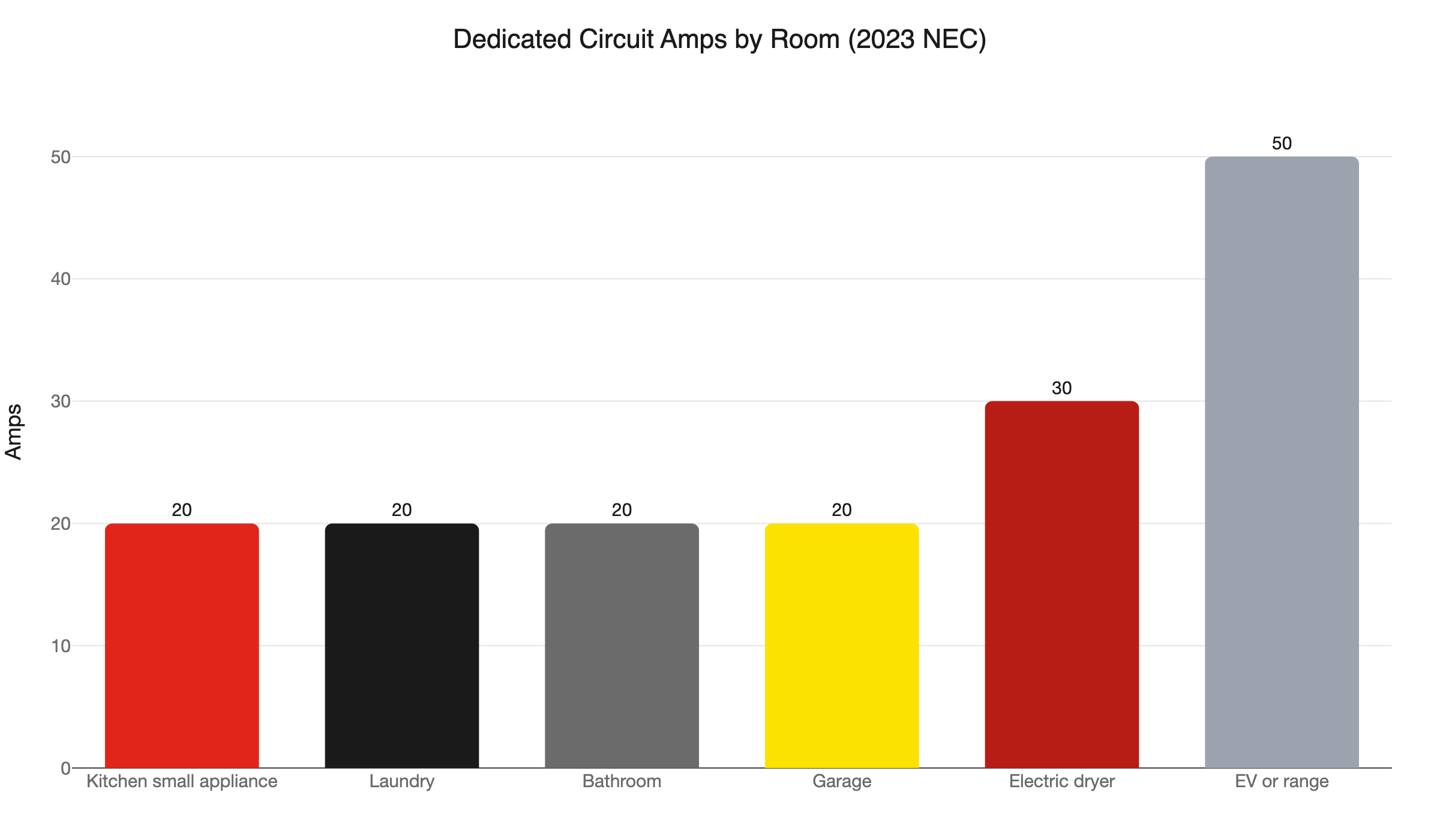
The 240V outlets are the big ones. The NEMA 14-30 runs an electric dryer on a 30A circuit. The NEMA 14-50 runs an EV charger or electric range on a 50A circuit.
Which Types of Electrical Outlets Does Each Room Need?
Kitchens need 20A GFCI and AFCI-protected outlets at the counters. Bathrooms need a dedicated 20A GFCI. Bedrooms and living areas need AFCI and tamper-resistant receptacles. Garages, laundry, basements, and outdoors all need GFCI, and outdoor outlets must also be weather-resistant with an in-use cover.
Here is the room-by-room map, built straight from the Minnesota residential checklist. (MN DLI checklist)
Kitchen. Two dedicated 20A small-appliance circuits, with 20A T-slot receptacles at the counters. No point on the counter can sit more than 24 inches from an outlet. Every kitchen receptacle needs GFCI, and the circuit needs AFCI.
Bathroom. One dedicated 20A GFCI receptacle. No receptacle within 3 ft horizontally, or 8 ft vertically, of the tub or shower rim.
Bedroom, living room, family room, dining room. AFCI-protected, with standard 15A or 20A tamper-resistant receptacles. No point along a wall can sit more than 6 ft from an outlet.
Laundry. One dedicated 20A circuit, GFCI-protected.
Garage. One dedicated 20A circuit, GFCI-protected, with tamper-resistant receptacles. Every vehicle bay needs at least one receptacle within 5.5 ft of the floor.
Outdoors. Weather-resistant receptacles inside extra-duty in-use covers, GFCI-protected. The home needs at least one at the front and one at the back.
Basement and crawl space. GFCI everywhere. If the basement is finished living space, the circuits need AFCI too.
EV, dryer, and range. A NEMA 14-30 on a 30A circuit for the dryer, and a NEMA 14-50 on a 50A circuit for the EV charger or range. Both must be 4-wire, with an equipment ground. The old 3-prong NEMA 10-series outlets are no longer code for new installs. (MN DLI checklist)
What Is a GFCI Outlet and Where Is It Required?
A GFCI outlet cuts power in a fraction of a second when it senses current leaking outside the normal path, such as through water or a person. The 2023 NEC requires GFCI on outlets in kitchens, bathrooms, garages, basements, laundry, outdoors, and within 6 ft of sinks and tubs.
GFCI stands for ground-fault circuit interrupter. It compares the current flowing out on the hot wire with the current coming back on the neutral. If even a small amount goes missing, the GFCI trips. That missing current is often traveling through water, a metal appliance, or a person.
The 2023 NEC expanded GFCI to all kitchen receptacles and to outlets up to 250V. (MN DLI, 2023 NEC FAQ) Minnesota adopted it on July 1, 2023. The rule now covers dishwashers and sump pumps too, whether they are hardwired or cord-and-plug.
GFCI protection can live in the outlet itself, in a circuit breaker, or in a feed-through setup where one GFCI outlet protects the standard outlets downstream. For more on the rule and how we install it, see our guide to GFCI outlet requirements.
What Is an AFCI Outlet and Which Rooms Need It?
An AFCI detects the erratic electrical arcs that start fires, the kind a frayed lamp cord or a nail through a wire can create. The 2023 NEC requires AFCI protection on bedroom, living room, family room, dining room, hallway, laundry, and closet circuits.
AFCI stands for arc-fault circuit interrupter. Where a GFCI protects people from shocks, an AFCI protects the house from fires. It reads the signature of a dangerous arc and trips before heat can build.
AFCI protection usually lives in the circuit breaker, not the outlet. In a remodel or an older panel, we can also install an AFCI receptacle at the start of a circuit to bring it up to code without a full panel swap. (MN DLI checklist)
The list of rooms that need AFCI is long. It covers kitchens, family rooms, dining rooms, living rooms, parlors, libraries, dens, bedrooms, sunrooms, rec rooms, laundry areas, closets, and hallways. If your home was built before about 2002, most of those circuits probably have no AFCI.
Are Tamper-Resistant Outlets Required in Minnesota?
Yes. Since Minnesota adopted the 2023 NEC, every 15A and 20A receptacle that is installed or replaced in a home must be tamper-resistant. A built-in shutter blocks the foreign objects a child might push into the slots. The few exceptions include receptacles over 5.5 ft high and dedicated appliance outlets.
This rule catches a lot of homeowners off guard. If you call us to swap one cracked bedroom outlet, the new one must be tamper-resistant, even if the old one was not. The rule applies to replacements, not just new installs. (MN DLI checklist)
The shutter system is simple and it works. Two internal doors only open when equal pressure hits both at once, the way a real plug does. A single hairpin or key cannot trip it.
What Is a 20A T-Slot Outlet and Why Does My Kitchen Need It?
A 20A T-slot receptacle has one slot shaped like a sideways T. That lets it accept a 20A plug as well as a standard 15A plug. Kitchens, bathrooms, laundry rooms, and garages all need 20A circuits, and the outlets on them should match the rating.
The T-slot exists so a heavy 20A appliance, such as a commercial blender or a large window AC, can draw its full rated current. A standard 15A outlet on a 20A circuit works for most loads, but it leaves headroom on the table.
The 2023 NEC also tightened the kitchen rules. A kitchen now needs at least two dedicated 20A small-appliance circuits for the counters. No point on the counter can sit more than 24 inches from a receptacle. (MN DLI checklist)
What Outlet Do I Need for an EV Charger or a New Dryer?
A modern electric dryer needs a 4-wire NEMA 14-30 outlet on a 30A, 240V circuit. An EV charger or electric range needs a NEMA 14-50 on a 50A, 240V circuit. The old 3-prong NEMA 10-series outlets are no longer code for any new install.
The difference between a 120V outlet and a 240V outlet is the amount of power it can deliver. A standard outlet peaks near 1,800 watts. A NEMA 14-50 can deliver more than four times that, which is what a car needs to charge overnight.
If you are adding a charger, Xcel Energy offers up to $500 toward a Level 2 EV charger and its dedicated 240V circuit. Income-qualified homes can get up to $1,200. (Xcel Energy) Confirm the current amount before you file.
We install EV chargers across the Twin Cities. For the full process, see our EV charger installation guide. Ask us about financing on the larger 240V jobs.
Do USB and Smart Outlets Pass a Minnesota Inspection?
Only if they carry a recognized NRTL listing mark, such as UL or ETL. Cheap imported USB and smart outlets routinely fail Minnesota inspection because they are not listed and labeled, per MN Rules 3801.3620. We install only listed, labeled equipment. (MN DLI checklist)
An NRTL is a Nationally Recognized Testing Laboratory. It tests products to a safety standard and stamps them with a mark. Without that mark, an inspector can red-tag the install, even if the outlet works fine.
This is the most common place a do-it-yourself project goes sideways. A homeowner finds a cheap USB outlet online, wires it in, and fails the inspection. The fix is to start with listed gear.
Do I Need a Permit to Replace an Outlet in Minnesota?
Most simple like-for-like outlet swaps do not need a permit, but any added, moved, or rewired outlet does. The state permit must be submitted and approved before any covered work begins, through the IMS portal. (MN DLI permits)
Homeowners may pull their own electrical permit only on a property they own and occupy as a single-family residence. Unlicensed DIY electrical is illegal in two-family homes, apartments, condos, townhouses, manufactured homes in parks, and any rental property.
If you are unsure whether your project needs a permit, that is a good question to ask before the work starts, not after.
When Should I Upgrade My Outlets?
Upgrade when outlets are loose, discolored, cracked, two-prong, ungrounded, or not tamper-resistant. Upgrade too when you add a large load, such as an EV charger, a hot tub, or a new kitchen circuit. Any outlet that buzzes, smells warm, or trips a breaker needs attention now.
Two-prong outlets are a clear flag. They mean the wiring has no equipment ground. That is both a code issue and a real shock hazard for anything with a metal case.
Loose outlets are another sign. When the plug falls out on its own, the contacts inside are worn, and they start to arc.
Discoloration, heat, or a burning smell is an emergency, not a maintenance item. Turn off the breaker and call us the same day. For the broader signs your whole system is behind, read our piece on signs you need an electrical panel upgrade.
Whole-Home Surge Protection and Your Outlets
Every new service installed in Minnesota must include a Type 1 or Type 2 surge protective device, plus an outdoor emergency disconnect. (MN DLI checklist) That device sits at the panel and guards every outlet in the house from the voltage spikes that fry electronics.
Power strips do not count. A strip protector sacrifices itself once and protects only what is plugged into it. A whole-home unit shunts the surge to ground before it ever reaches the outlets.
If your home was built before 2023, you probably have no panel-level surge protection at all. For the full case, see our whole-home surge protection guide.
Do I Need Weather-Resistant Outlets Outdoors?
Yes. Outdoor receptacles must be weather-resistant, and they must sit inside an extra-duty in-use cover. The 2023 NEC also requires at least one outdoor outlet at the front of the home and one at the back, both GFCI-protected.
Minnesota freeze-thaw adds a wrinkle the southern states do not deal with. Any underground cable or raceway here must be installed with room to expand. That way, ground movement does not crack the conduit or pull the wire loose. (MN DLI checklist)
An in-use cover is the deep bubble that closes over a plugged-in cord. It lets you run holiday lights or a block heater without exposing the outlet to rain or snow.
We Install Every Type of Outlet the Right Way
The types of electrical outlets your home needs are not a guess. They are written into the 2023 NEC, and our team installs them to the letter. We are locally owned and operated in the Twin Cities. We show up on time as America’s On-Time Electrician(R). Every job is backed by the UWIN(R) 100% satisfaction guarantee. No malarky, no surprises on the invoice.
Whether you need one tamper-resistant bedroom outlet swapped or a NEMA 14-50 wired for a new EV charger, we handle it. We pull the permit, run the work through the state portal, and pass the inspection the first time.
Call 763-200-5956 or book online to get on the schedule. For installs and replacements, see our outlet installation service.
Frequently Asked Questions
How many types of electrical outlets are there? +
Are tamper-resistant outlets required by code in Minnesota? +
What outlet do I need for a Level 2 EV charger? +
Can I replace an outlet myself in Minnesota? +
Does my kitchen need GFCI and AFCI? +
Need an electrician now?