
What Size Generator Do I Need? A Twin Cities Guide

Key Takeaways
- A gas furnace blower only draws 300-1,200 watts of electricity. A 5-7 kW portable covers your furnace, refrigerator, sump pump, and lights through a Minnesota winter outage.
- The jump from a portable to a whole-home standby is about comfort, not survival - if you heat with natural gas.
- Any permanently installed standby generator requires a transfer switch. Installing without a permit is a code violation in Minnesota.
- Size for starting watts, not running watts. Motor-driven appliances like sump pumps draw 3-6x their running load on startup.
- Minnesota adopted the 2023 NEC on July 1, 2023. Plymouth, Maple Grove, and St. Paul each operate their own inspection departments.
- Call 763-200-5956 or book online to get a load calculation and installation quote.
Why Minnesota Changes the Generator Sizing Equation
Most generator sizing guides are written for a general audience. They walk you through a watt calculator and send you to the store. That works fine in Atlanta. In Minnesota, it misses something critical.
A winter power outage here is not an inconvenience. It is a safety emergency. The Twin Cities design low hits around -20°F. The heating season runs October through April - seven months. Without heat at -10°F, pipes can freeze in six to eight hours. A poorly insulated home can present hypothermia risk within twelve hours.
Start with the right question. Not “what do I want to keep running?” but “what do I need to stay safe for three days?” That reframe changes the recommendation entirely for most households in this market.
Twin Cities homeowners also know firsthand how often outages happen. 150,000 homes lost power in August 2024 storms. Separate winter storms have knocked out 70,000-plus Xcel customers, with some households dark for 36 hours or more. A generator is not a luxury item here.
National guides will not tell you any of this. They are not written for a market where the furnace load is a survival issue, not a comfort preference.
What Size Generator Do I Need to Survive a Winter Outage?
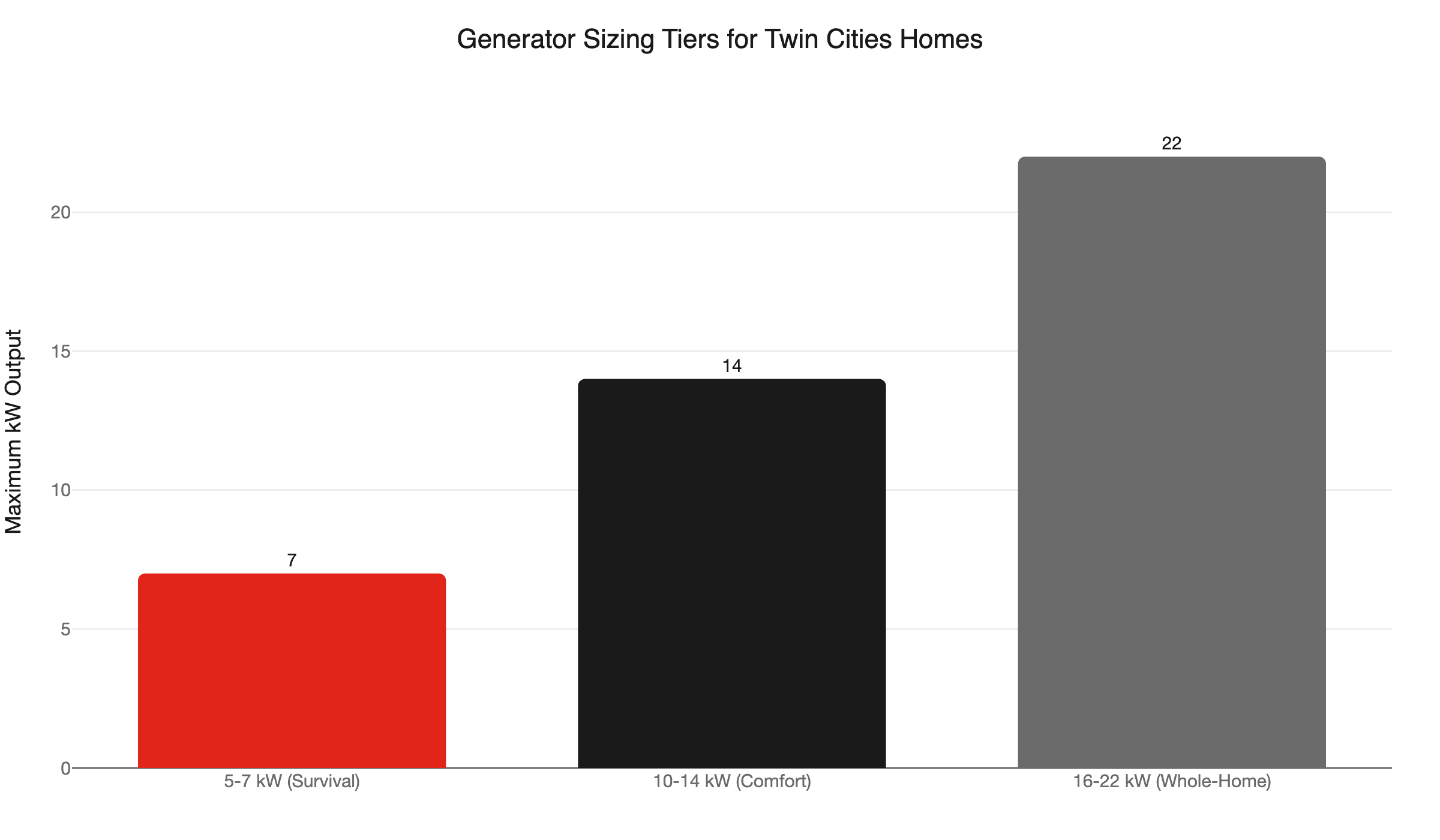
If you heat with natural gas, a 5-7 kW portable is your survival floor. It runs the furnace blower, refrigerator, sump pump, and basic lighting at the same time. You do not need a whole-home standby unit just to stay safe through a Minnesota winter.
Here is what most homeowners miss: your gas furnace barely uses electricity. The burner runs on natural gas. The parts that need power are the blower motor, the igniter, and the control board. Together they draw 300-1,200 watts running, with a surge up to 1,500 watts on startup.
A 5,000-watt portable handles that load with room left over for a refrigerator and a few lights.
The sump pump is the variable to watch. A typical sump pump runs around 750 watts but can surge to 2,200 watts on startup. Size your generator to cover that surge, not just the steady running draw.
Rough survival math: 1,500W furnace surge + 400W refrigerator + 2,200W sump surge + 100W lights = 4,200W worst case. A 5-7 kW unit gives you that plus meaningful headroom. That is your floor.
What Are Starting Watts, and Why Do They Matter?
Starting watts are the short burst of power a motor needs to get going - usually 3-6x the running load. If your generator cannot supply that burst, the motor will not start or will bog the unit down and trip the breaker. Always size for starting watts, not running watts alone.
Every electric motor takes more energy to start than to sustain. That sump pump at 750 running watts can demand 2,200 watts for the first second. A central air conditioner at 3,500 running watts can surge past 7,000 on startup.
The sizing method: add up running watts for everything you want to run at once. Then swap in the starting wattage for the single largest motor in the group. That total is your minimum generator output. Add 20% headroom on top.
Appliances without motors are straightforward. LED lights, phone chargers, and most microwaves draw the same watts every time. Only motors create the surge challenge.
What Does a Survival Load Look Like in a Twin Cities Home?
For most homeowners on natural gas heat, a survival load is the furnace blower, refrigerator, one sump pump, and basic lighting. That adds up to roughly 4,000-6,000 watts of capacity needed, depending on your specific equipment.
A working example for a typical 1,800-square-foot Twin Cities home:
- Gas furnace blower: 700W running / 1,500W starting
- Refrigerator: approx. 200W running
- Sump pump: 750W running / 2,200W starting
- LED lights (10 bulbs): approx. 100W running
- Phone chargers, modem, router: approx. 50W running
Running total: roughly 1,800 watts. Required capacity accounting for the sump pump surge: roughly 4,600 watts. A 5,000 to 7,000-watt portable covers that with room to spare.
Check your appliance nameplates for exact numbers. The furnace nameplate is usually on the inside of the cabinet door. The figures above are typical benchmarks.
One note for homes outside the core metro: if you have a well pump rather than city water, factor it in. Well pumps are common in Dakota, Scott, and Carver County suburbs. They add 750-1,500 watts running with a significant starting surge. That may push your survival load into the 7-10 kW range.
Standby vs. Portable: Which Is Right for Your Home?
A portable generator is lower cost and handles the survival tier well. A standby generator comes on automatically, covers your whole house, and requires professional installation with a transfer switch. Most Twin Cities homeowners choose portable for basic backup and standby for whole-home, automatic peace of mind.
Portable generators:
- Cost: $500-$3,000 for most units
- Output: typically 3,500-12,000 watts
- Fuel: gasoline or dual-fuel (gas plus propane)
- Requires manual startup, outdoor placement at least 20 feet from any opening, and a connection via extension cord or a manual transfer switch
- Best for homeowners who want survival coverage at a manageable cost and are comfortable managing the unit during an outage
Standby generators:
- Cost: $5,000-$15,000 installed (unit, transfer switch, and electrical work)
- Output: 7,500-22,000-plus watts
- Fuel: natural gas or propane piped to the home
- Starts automatically within seconds of a power failure
- Requires permanent installation with an automatic transfer switch per NEC Article 702, an electrical permit, and a passing inspection
- Best for homeowners who want whole-home power restored without any manual steps
The standby unit fires itself. No one has to go outside in -20°F to pull a recoil starter. For many Twin Cities households - especially those with older family members, young children, or a home-based business - that automatic start is the deciding factor.
If upfront cost is a concern, standby installations qualify as a home improvement for most financing programs. Ask our team for current options when you schedule your quote.
What Size Generator Do I Need for a Whole House?
A 16-22 kW standby generator handles a typical Twin Cities home with central air conditioning, a 200A service panel, a gas range, and a sump pump. If you have an electric range or an EV charger you want to run during an outage, size toward the upper end or get a full load calculation.
A few benchmarks to orient you:
- 16 kW covers a 1,500-2,500 sq ft home with central AC, gas range, and gas heat on standard 200A service
- 20-22 kW covers larger homes, homes with electric ranges, or homeowners who want to keep an EV charger active during an outage
Do not skip a professional load calculation. These benchmarks are starting points. A licensed electrician measures your actual service capacity, identifies your largest simultaneous loads, and specifies the right unit. Oversizing wastes money. Undersizing means the generator bogs under load - worse than no generator at all.
Our team does a full load assessment as part of every installation quote. If your panel is already showing signs of strain - breakers tripping under normal load, for example - we catch that during the evaluation. An overloaded panel sometimes needs attention before a transfer switch can be properly installed.
Does Minnesota Require a Permit for a Generator Transfer Switch?
Yes. Installing a transfer switch is electrical work that requires a permit in Minnesota. You file with the Minnesota Department of Labor and Industry or your local jurisdiction, depending on where you live.
Minnesota adopted the 2023 NEC on July 1, 2023. NEC Article 702 requires a transfer switch on any permanently installed optional standby generator. Plymouth, Maple Grove, and St. Paul each operate their own electrical inspection departments. If you live in one of those cities, file locally rather than with state DLI.
Homeowners can pull their own electrical permits on a homesteaded single-family residence. You cannot pull a permit on a condo, apartment, or any rented portion of a property. The permit must be in place before work begins.
The transfer switch is not optional, and it is not just paperwork. It prevents backfeed. Without it, a running generator energizes your home’s wiring. It stays connected to the utility grid at the same time. That pushes household current back up to distribution voltage on the power lines outside. Utility workers on those lines can be killed. A proper automatic transfer switch with break-before-make switching eliminates that risk entirely.
A common point of confusion: Xcel Energy does require an Interconnection Agreement for solar systems that export power to the grid. A standby generator in true standby mode does not export power. Xcel’s own rate schedule confirms that a standby generator meeting NEC 702 requirements does not need a separate IA. If a customer service rep sends you toward the IA process, you are on the wrong track. Ask specifically about the optional standby generator exception.
What About Carbon Monoxide Safety?
Portable generators produce lethal carbon monoxide. Minnesota law requires a CO alarm within 10 feet of every sleeping room. NEC requires portable generators to be placed at least 20 feet from any home opening. Both rules apply every time you run the generator.
Carbon monoxide has no smell, no color, and no taste. A gasoline generator running in a garage with the door open has killed people through the shared wall with the living space. This is not a fringe scenario. It happens every storm season across the country.
Minnesota Statute 299F.51 requires a CO alarm within 10 feet of every sleeping room in any single-family home. If your alarms are missing or outdated, our team handles carbon monoxide detector installation as a standalone service.
For portable generator placement: 20 feet minimum from any window, door, garage door, or vent. Point the exhaust away from the house. Never run a portable under an overhang or in any enclosed or semi-enclosed space.
Standby generators on natural gas produce far less CO than gasoline units. They are installed permanently outdoors in a fixed location with a proper exhaust path. The CO risk profile is substantially lower, and the placement is controlled at install. Our whole-house generator installation guide covers what that permanent installation looks like from start to finish.
Our Team Can Size and Install Your Generator
You should not have to figure all of this out on your own. Generator sizing, transfer switch selection, permit filing, and installation are each their own specialty. Getting any piece wrong is expensive at best and dangerous at worst.
Our team is locally owned and operated in the Twin Cities. We handle the complete installation: load calculation, generator sizing, transfer switch installation, permit filing, and inspection coordination. We serve Minneapolis, St. Paul, Bloomington, Brooklyn Park, Woodbury, Blaine, Maple Grove, Plymouth, and the surrounding metro.
As America’s On-Time Electrician(R), we show up when we say we will. Our UWIN(R) 100% satisfaction guarantee means if you are not completely satisfied, we make it right.
A generator assessment fits naturally into a fall or winter electrical safety visit. If your panel is already at capacity, we will find that during the site evaluation. We will tell you straight what your home needs, and what it does not. No malarky.
Call us at 763-200-5956 or book online. We will size the right generator for your home, pull the permit, and install it correctly. When the next storm rolls through, your family will be covered.
Frequently Asked Questions
What size generator do I need for a gas furnace in Minnesota? +
Do I need a permit to install a generator transfer switch in Minnesota? +
Does Xcel Energy require an interconnection agreement for a standby generator? +
How far does a portable generator need to be from my house? +
Need an electrician now?