
Transfer Switch for Portable Generator: Manual, Interlock, ATS

Key Takeaways
- Connecting a portable generator to your home’s wiring requires a transfer switch, interlock kit, or meter-socket adapter. “Suicide cords” backfeed electricity into the utility lines and can electrocute workers. They are illegal.
- Three code-compliant options exist: an interlock kit, a manual transfer switch subpanel, and an automatic transfer switch (ATS). A fourth option, the meter-socket transfer collar, is worth asking about.
- Minnesota requires an electrical permit and a licensed electrician for all three. Homeowners cannot self-permit this work under MN Stat. 326B.
- Interlock kits are panel-brand-specific. Many 1960s-1990s Twin Cities homes have panels with no listed kit available.
- Unpermitted generator wiring voids your homeowner’s insurance and creates personal liability. That is not a risk worth accepting.
- In a Minnesota winter, how much manual work you are willing to do at -10 degrees Fahrenheit matters as much as the sticker price of the hardware.
- Call 763-200-5956 or book online to get a licensed electrician on-site before the next outage.
Why Every Portable Generator Needs a Transfer Switch
Millions of Twin Cities homeowners own a portable generator. Most of them have no safe, legal way to connect it to their home’s wiring.
The root problem is backfeed. When a generator powers your home’s circuits without a physical disconnect from the utility, it pushes electricity back into the grid. Utility lineworkers contact what they believe is a dead line. People are killed. This is not a hypothetical risk - it happens every year across the country during outage events.
NEC Article 702 requires transfer equipment on any optional standby system. A portable generator hookup is an optional standby system. Transfer equipment that prevents the utility and generator from being energized at the same time is a code requirement, not a suggestion.
Northern Mister Sparky is locally owned and operated in the Twin Cities. We pull permits, we work under the 2023 Minnesota NEC, and we install transfer equipment the right way. The options below are your code-compliant paths.
What Happens If You Skip the Transfer Switch?
Short answer: Backfeeding through a dryer outlet (a “suicide cord”) or any unpermitted generator hookup is illegal in Minnesota. It can kill a utility worker, void your homeowner’s insurance claim, and expose you to personal liability. The consequences are financial as well as physical.
Minnesota homeowners who run unpermitted generator wiring face a specific problem after any claim. Consumer Reports confirms that insurers routinely inspect after electrical damage or fire events. If unpermitted generator wiring contributed to the loss, the insurer has clear grounds to deny the claim.
Running extension cords through a window to power individual appliances is a different matter entirely. That is legal and reasonable. What is illegal is connecting a generator to your home’s wiring by any means other than approved transfer equipment, installed with a permit, by a licensed electrician.
The stakes of getting this wrong are high enough that it is worth understanding your options clearly before you buy anything.
The Three Options for Connecting a Portable Generator
Here is how each option works, what it costs, and where it fits.
Option 1: Interlock Kit
An interlock kit is a mechanical slide or plate installed directly on your existing main panel. It prevents the main breaker and the generator back-fed breaker from being on simultaneously. During an outage, you flip the main breaker off, slide the interlock plate, and flip the generator breaker on. Every circuit in the panel is then powered by the generator - but your generator must supply all of them at once.
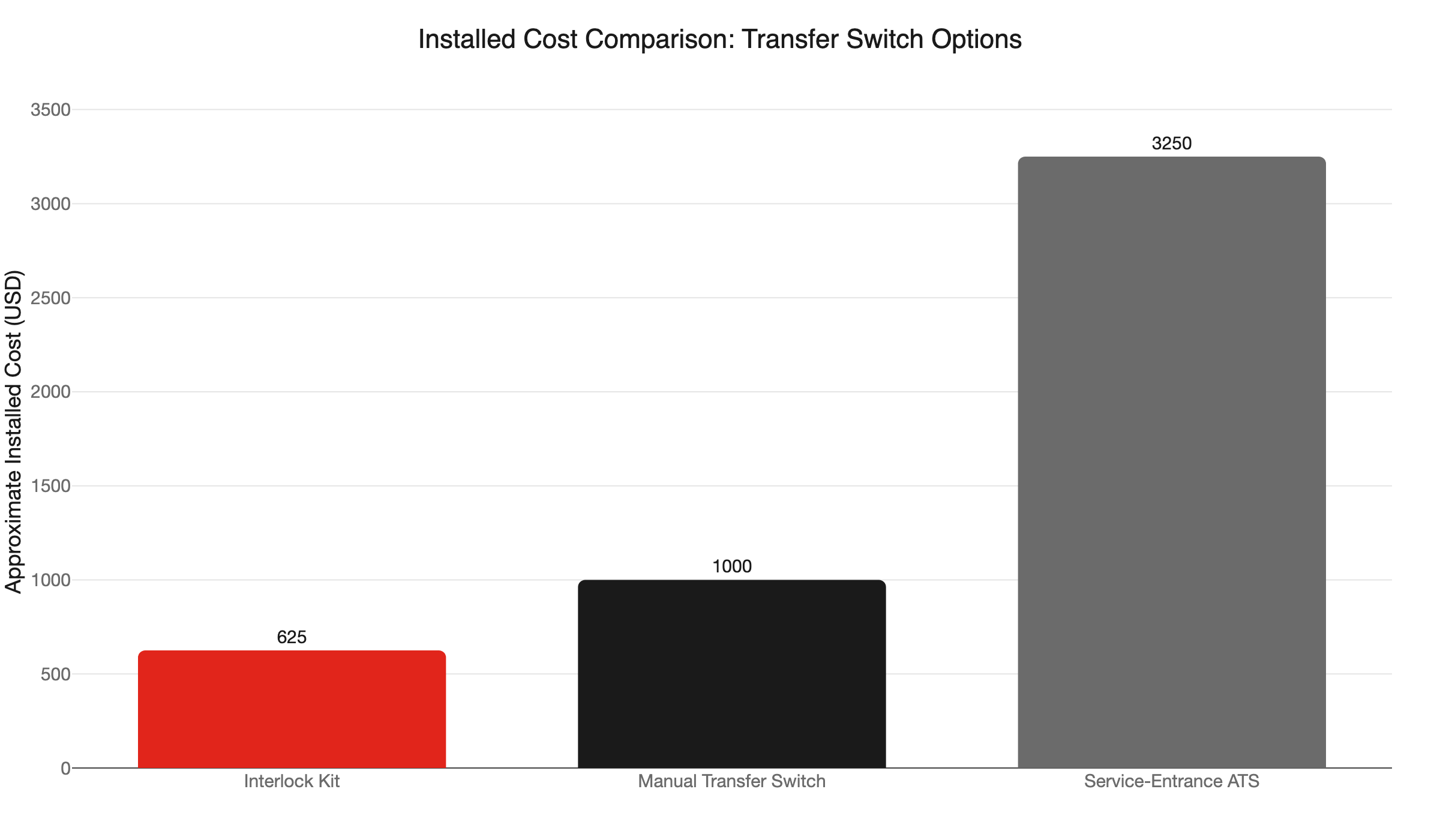
Hardware runs $69-$120 for common brands such as Square D Homeline and Eaton BR. Installed - including the inlet box, wiring, permit, and inspection - expect $400-$850 or more depending on how far the inlet box runs from the panel.
The technical detail that catches people off guard: interlock kits are evaluated to UL 67 as a panelboard accessory. They must match the exact panel brand and model. The back-fed breaker also requires a hold-down retainer per NEC 408.36(D). If your panel brand has no listed kit, the interlock option is off the table. Your electrician verifies compatibility before any hardware is ordered.
Best fit: A homeowner with a modern panel that has a listed interlock kit, who is comfortable manually managing generator loads during an outage.
Option 2: Manual Transfer Switch Subpanel
A manual transfer switch subpanel is a small dedicated panel wired to 8-10 critical circuits you choose at installation: typically the furnace, refrigerator, sump pump, and a few lights. During an outage, a single lever switches those pre-selected circuits from the utility to the generator.
Hardware runs $380-$520 for common units. Installed cost ranges from $400-$1,600 depending on how far the critical circuit wiring runs. You are limited to those pre-wired circuits only. There is no access to the rest of the panel.
The trade-off is simplicity. You give up whole-panel flexibility in exchange for a clearly labeled, easier-to-manage setup. You plug in the generator, flip one lever, and the critical loads are running. There is no need to mentally track which breakers are on when the furnace, sump pump, and refrigerator are all drawing at the same time.
Best fit: A homeowner who wants defined critical-circuit coverage with minimal load-management complexity. Also the right path when no listed interlock kit exists for an older or discontinued panel.
Option 3: Automatic Transfer Switch (ATS)
A service-entrance ATS is wired between the utility meter and your main panel. When it detects a utility outage, it disconnects utility power and connects the generator automatically. With a portable generator, you still need to start it and plug in the inlet cord - but once power is flowing, the switch manages the transfer.
Installed cost for a 200-amp service-entrance ATS typically runs $1,500-$5,000 or more. It is the most expensive option for a portable generator hookup. It makes the most economic sense for homeowners who plan to upgrade to a whole-home standby generator later, since the ATS transfers to both a portable generator now and a permanent unit later.
Best fit: A homeowner who wants hands-off power transfer, has the budget for it, or is planning a future standby generator upgrade.
Which Option Is Right for Your Home?
Short answer: If your panel has a listed interlock kit and you are comfortable managing loads manually, the interlock is the most affordable code-compliant path. If you want simpler operation with pre-defined critical circuits, the manual transfer subpanel wins. An ATS makes sense when you want automatic transfer or are planning a future standby generator.
Two factors determine the answer more than price alone: your panel brand and how Minnesota winters factor into your plan.
If you have a mid-2000s or newer Square D Homeline or Eaton BR panel, a listed interlock kit likely exists. If you have an older or discontinued panel, your electrician must confirm compatibility before any hardware is purchased. If your panel is already aging, undersized, or showing stress under current loads, it may be worth reviewing our guide to signs you need an electrical panel upgrade before adding transfer equipment on top of it.
The winter angle is covered in detail below. But the short version is: the option that looks cheapest on paper may cost more in effort on the worst nights.
What Does a Transfer Switch Cost in Minnesota?
Short answer: Installed costs run roughly $400-$850 for an interlock kit, $400-$1,600 for a manual transfer switch subpanel, and $1,500-$5,000 or more for a service-entrance ATS. Permit and inspection fees are always additional and vary by city and county.
Consumer Reports pegs the installed range at $500-$1,500 for a transfer switch, which aligns with the interlock and manual subpanel tiers. In the Twin Cities metro, labor rates and permit fees tend to push toward the higher end of national published ranges.
A few cost factors specific to Minnesota and the metro area:
- Panel location. If your main panel is in an unfinished basement near an exterior wall, inlet box wiring is short and affordable. If the panel is in a finished utility room far from where the generator will sit, conduit runs add meaningful labor cost.
- Permit fees. Electrical permit fees vary by city and county in Minnesota. Your electrician pulls the permit; the fee is typically rolled into the overall quote.
- Panel compatibility. If no listed interlock kit exists for your panel, you shift to the manual subpanel option, which changes the hardware cost calculation.
- Inlet placement. The generator inlet box must be weatherproof and accessible. Placement decisions affect both labor and material cost.
For larger generator projects, ask our team about financing options when you call.
Do You Need a Permit to Install a Transfer Switch in Minnesota?
Short answer: Yes, always. Transfer switch installation requires an electrical permit in Minnesota. Homeowners cannot self-permit this work under MN Stat. 326B.35. A licensed electrician pulls the permit, and the completed work is subject to inspection by the local authority having jurisdiction.
Minnesota is currently on the 2023 NEC, adopted July 1, 2023. The 2026 NEC transition is actively underway - DLI published an updated FAQ on July 6, 2026. Permits filed today are inspected under the 2023 NEC. A licensed Minnesota electrician knows exactly which version governs your project and what the inspector will verify.
If any generator hookup work was done without a permit in the past, disclose that when you call. We can often assess and remediate unpermitted work as part of a permitted installation. Our guide to electrical permits in Minnesota explains the homeowner’s permit process and what to expect at inspection.
Unpermitted transfer switch work is not just a paperwork problem. If a fire or electrical damage event is traced back to unpermitted wiring, your homeowner’s insurance company has documented grounds to deny the claim. Minnesota insurers inspect after claims. That is a financial exposure that sits on top of the safety risk.
What About Older Panels Common in Twin Cities Homes?
Short answer: Many 1960s-1990s Twin Cities homes have panels with no listed interlock kit available. A manual transfer switch subpanel is usually the right path for those homes. It is also a good moment to evaluate whether the panel itself needs an upgrade before adding generator equipment.
Twin Cities homes built between roughly 1960 and 1990 commonly have older main panels. Some are discontinued brands. Others lack a back-fed breaker slot positioned correctly for an interlock plate. A few are panels with documented reliability concerns, such as Federal Pacific Stab-Lok or older Zinsco panels, that a licensed electrician should evaluate regardless of whether generator work is involved.
The interlock kit requirement is strict: the kit must be evaluated to UL 67 for your specific panel brand and model. Your electrician confirms this on-site before any hardware is ordered. If the kit does not exist, the manual transfer switch subpanel is the cleaner and safer path.
Generator transfer equipment is also a natural entry point for the panel capacity conversation. If your 100-amp panel is already near its limit and you are adding a generator inlet plus a dedicated back-fed breaker, that is worth a broader assessment. Our panel upgrade service team can evaluate both the transfer equipment and the panel in a single visit.
Why Does Winter Matter for Portable Generator Transfer in Minnesota?
Short answer: At sub-zero temperatures, manual load management at the panel is a real physical task, not a theoretical one. The interlock option gives whole-panel access but requires you to actively shed loads to stay within your generator’s output. A pre-wired manual transfer subpanel removes that guesswork when conditions outside are brutal.
A national buyer’s guide written for a homeowner in Atlanta reads very differently than one written for someone in Woodbury in January. Minnesota winters change the transfer switch decision in three specific ways.
Cold-weather generator starts. A portable generator at -10 degrees Fahrenheit is harder to start and more likely to stall under sudden load. Cold starts require the right oil viscosity and often a careful choke sequence. If your transfer setup requires you to walk outside, start the generator, manage the choke, and come back inside to manually flip breakers, that is the actual workflow you are signing up for. Plan for it before you buy.
Load management with an interlock. NEC 702.4 requires that loads connected to a manually managed generator stay within the generator’s capacity. A 7,500-watt portable running a gas furnace, refrigerator, sump pump, and a few lights is near the edge of its rated output. Add one space heater or one extra appliance and you overload it. In Minnesota in January, a generator shutdown means a cold house and a potential freeze event. The stakes of mismanaging those loads are real.
Sump pump protection. Twin Cities basements flood during winter thaws and spring snowmelt. The sump pump is typically the first critical circuit in the conversation. Our home generator sizing guide can help you think through load priorities before you commit to a transfer option.
A pre-labeled manual transfer subpanel is easier to operate in the dark, in the cold, with gloves on, than an interlock that puts every breaker in front of you at once.
What Is GenerLink, and Is It Available in the Twin Cities?
Short answer: GenerLink is a transfer collar that mounts at the utility meter socket, providing whole-panel transfer without any modification to your main panel. It requires explicit utility approval before installation. In Xcel Energy territory, which covers most of the Twin Cities metro, you must confirm availability and approval directly with the utility before ordering any equipment.
GenerLink and similar UL 1008M-listed meter-socket adapters are a fourth transfer option that most national guides overlook. They install between the utility meter and the meter base, requiring no changes to your main panel. They connect to a portable generator via a standard generator inlet cord.
The catch is utility approval. GenerLink is not universally available. Some cooperatives in Minnesota actively promote it as a safe portable generator connection method. Butler Rural Electric Cooperative is one Minnesota example. For homes served by Xcel Energy - the dominant utility across the Twin Cities metro - you must confirm availability and approval directly with Xcel before purchasing equipment or scheduling installation.
If GenerLink turns out to be available at your address, it is worth discussing during your quote. It avoids panel modifications entirely, which is relevant when no listed interlock kit exists for your panel and you want whole-panel access rather than the limited circuits of a transfer subpanel.
Your electrician can help navigate the utility approval process. It is one more reason to call before you buy hardware.
How to Schedule Your Transfer Switch Installation
The right time to get this done is before a storm is in the forecast. Consumer Reports notes that electricians book solid when a significant weather event is on the way. A transfer switch installation is a planned project, not an emergency call.
Here is what the process looks like with Northern Mister Sparky:
- On-site assessment. We confirm your panel brand and model, identify the right transfer option, measure the inlet box location, and flag any panel issues that need to be addressed first.
- Permit pulled. We pull the electrical permit with your local authority having jurisdiction.
- Installation. We install the transfer equipment, inlet box, and wiring per the 2023 NEC. The work is inspectable and documented.
- Inspection. The local inspector signs off. You keep the paperwork for your insurance records.
- Walkthrough. We walk you through how to operate the transfer equipment safely and how to manage your generator loads during an outage.
As America’s On-Time Electrician(R), we show up when we say we will. The UWIN(R) 100% satisfaction guarantee means the work is done right or we make it right. No malarky.
Call 763-200-5956 or book online to schedule your assessment. If a panel upgrade makes sense alongside the transfer switch, our panel upgrade service team can evaluate both in a single visit. We are locally owned and operated in the Twin Cities, and we would rather set you up before the next outage than take an emergency call during one.
Frequently Asked Questions
Do I need a permit to install a transfer switch in Minnesota? +
What is the cheapest legal way to connect a portable generator to my home? +
Can I install my own transfer switch in Minnesota? +
What size transfer switch do I need for a portable generator? +
Need an electrician now?